
Don’t Panic, UK! Despite Impending Shortages, Jacob Rees Moggs Still Insists We Have Plenty of Happy Fish
Fears of fuel shortages and increasing food prices are just some of the results unravelling from Brexit
The UK is descending into panic-buying madness again.
We have been witnessing half-empty supermarket shelves for months, and expecting more food shortages and raised prices. But this time it’s petrol and diesel.
Today, I toyed with the idea of boycotting the petrol queues, but the station in question actually had fuel…and I succumbed.
I never realised how satisfying having a full tank of diesel can be!
The discussion in our family’s WhatsApp chat has become quite political. I chime in, as ever, trying to keep the humour high, and the conversation light.
“There are still plenty of cabbages on the shelves. We’ll be fine.”
Cabbage grows very well through the winter in the UK. One of a very limited number of vegetables that does.
Ever the entrepreneur, I add in:
“I might start preparing my Cabbage Recipes From Around The World cookbook, ready for an explosion in sales.”
My Dad is worried (I think he took me seriously).
“I cannot live from cabbages alone. Actually, I hate them.”
I suggest stocking up on wine to take the edge off. Then I placate him.
“It’s alright, Dad. I don’t think it’s going to get that bad. You’ve got plenty of fish in Brixham anyway.
Happy fish.
Happy British fish.”
This last part is referring to the devastating effect that Brexit has had on the fishing industry. My dad lives in Brixham in Devon, one of the largest fishing ports in the UK. It thrives on its fishing industry, as well as its local restaurants that are renowned for serving the best choice of catch from waters both near and surrounding the continent. The most famous original Brixham fish restaurant carries the slogan ‘Tomorrow’s fish are still in the sea’. Not the most pleasant image if you are a vegan, but you get the idea of what they pride themselves on.
Brixham has long been famous for its wholesale fish market and has historically exported healthy quantities of top-quality, fresh seafood.
Not anymore.
One of the biggest topics of the Brexit conflict has been the fishing industry.
The Pro-Leave brigade milked this one big time by riling the British fisherman and persuading them that the EU laws allowed EU fisherman to legally but unfairly steal their fish. They introduced the notion that it was time to claim their fish back and take back control of their own waters!
The Leave Campaign promised that British fishermen would not only resume total control of a wider coastal territory surrounding the British Isles but that the EU market, upon which sales of British fish depend so heavily, would not be impacted.
However, when the time came for the UK to leave the European Union, what actually happened was very different. It turned out that, amidst the tug-of-war of a deal-to-leave that was underway, Boris Johnson’s promises started to disintegrate. The fishing industry, making up less than 1% of the UK’s economy, suddenly became far less significant in the grand scheme of things, and the fisherfolk did not get what they had voted Leave for.
The trade was not given the width of coastal territory for sole British fishing they were promised, though an increase is gradually being given over the course of 5 and a half years, and the trade with the EU has been problematic, to say the least.
Nevertheless, those Brexshit-pushing politicians in Parliament continued to celebrate their success in securing fish that would now be entirely British — caught by the British and eaten by the British. Um…that wasn’t actually the plan, Rees Moggs!
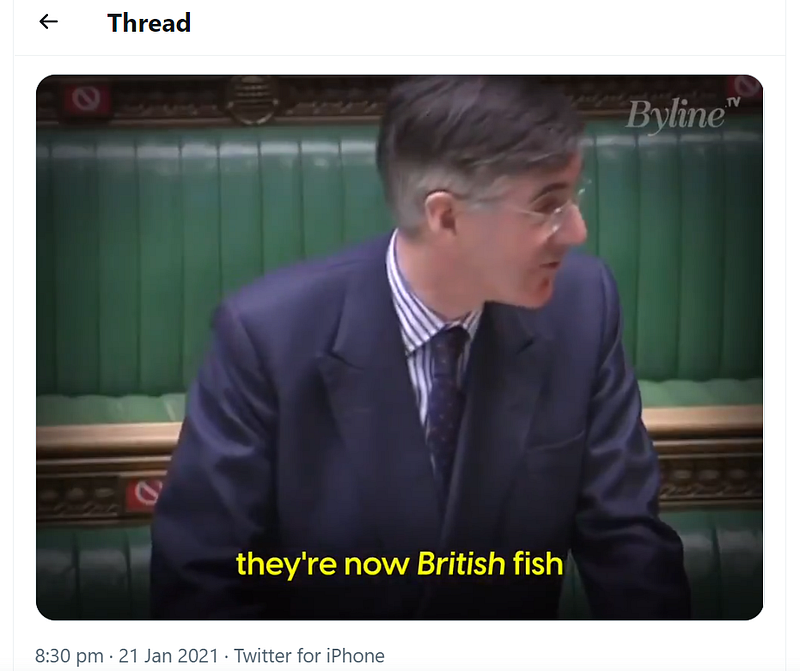
“The key is we’ve got our fish back. They’re now British fish, and they’re better and happier fish for it.” — Jacob Rees Moggs
Great! We now have happy fish because they no longer have an identity crisis. They know they are British…apparently! But we have a scuppered fishing industry, depleted morale, and an uncertain future.
Bullshit Brexshit!
What now?
Here we are, nearly nine months following the rollout of the deal coming into play, and we have seen half-empty supermarket shelves since day one. We have also started to see the beginnings of hefty increases on food prices. Nothing life-threatening so far, but now things are starting to unfold into a potential crisis point.
This week we are seeing the panic-buying of diesel and petrol due to a shortage of lorry drivers to transport the fuel. The problem is the enforcement of working visas for foreign nationals following Brexit, meaning that we currently have a shortfall of 100,000 HGV drivers.
We have a broken food supply system. What was once a “just in time” delivery system has been destroyed by a combination of Covid and Brexit, and Ian Wright, head of the Food and Drink Federation, said:
“I don’t think it will work again, I think we will see we are now in for permanent shortages.” — From The Independent.
We haven’t even seen the full impact yet, since post-Brexit Custom Laws gave us a softer transition into the post-Brexit reality, and the real extent will become more apparent from January 2022. Further enforcements for Safety and Security on imports and exports will come into play in July 2022.
The likely result? Higher and higher prices on food.
Increasing poverty rates
The UK’s rate of poverty already stands extremely high for a rich nation, at 22%. (Source — jrf.org.uk)
Prior to Brexit and Covid, there were 4.2 million children living below the poverty line. All of the government’s post-lockdown welfare cuts and increasing of taxes and National Insurance is hitting those on the lowest incomes the hardest. If the children in this sector of society are already living below the poverty line, how are these rising food prices going to affect the levels of poverty now?
Personally, I see a huge and very worrying crisis looming.
Brexshit Bullshit
The British public was lied to on a colossal scale. That much is clear.
Those in the fishing trade are just some of the many who have now realised this. Many others, however, are still clinging to the belief that the utopia of an independent Britain, as depicted by the Leave Campaign’s pre-referendum promotions, will still happen.
What we are seeing is very different.
The government told us we would have £350 million extra per week, which would go to fund the NHS. We don’t. And the NHS is being sold off, one little bit at a time.
The economy is in dire straights. Salaries are in jeopardy, meaning those in the most demanding and most needed services — health care and education — are being overworked and underpaid. Businesses have been exiting the City of London for brighter, more European pastures.
The hospitality industry, much of which is seasonal and therefore relied on short-term workers from the EU, is struggling to find the necessary workforce to keep the businesses running. Many are closing their doors.
The government is financially propping up yet more sectors and services that would otherwise collapse as we go through this transition period, and stinging us with the bill in the form of higher taxes.
The EU is changing laws in order to exclude the UK from trade deals. Meanwhile, our government is trying to secure trade deals with nations across the other side of the planet, meaning extortionate transportation costs, instead of trading with our nearest neighbours, as is normal.
This is where the colossal lies got us.
This is what Brexit is looking like.
The WhatsApp conversation was picked back up again this morning. My dad decided that banter was the only way forward, and quoted some imaginary news articles.
“British public so traumatised by mad government that shortage of cabbages leads to widespread psychosis and brain trauma (headline in the BRIXHAM Guardian).”
I reply.
“Sorry, my fault! I thought I would try fermented cabbage juice as a possible replacement for diesel. You never know, it might work!”
We are doing our best to keep the humour in it all. It’s not always easy.
But at least the fish are happy!


