
“Don’t Let Your Disability Keep You From Having a Normal Life” is Terrible Advice
From well-meaning comments to ableism porn, this will always be garbage.
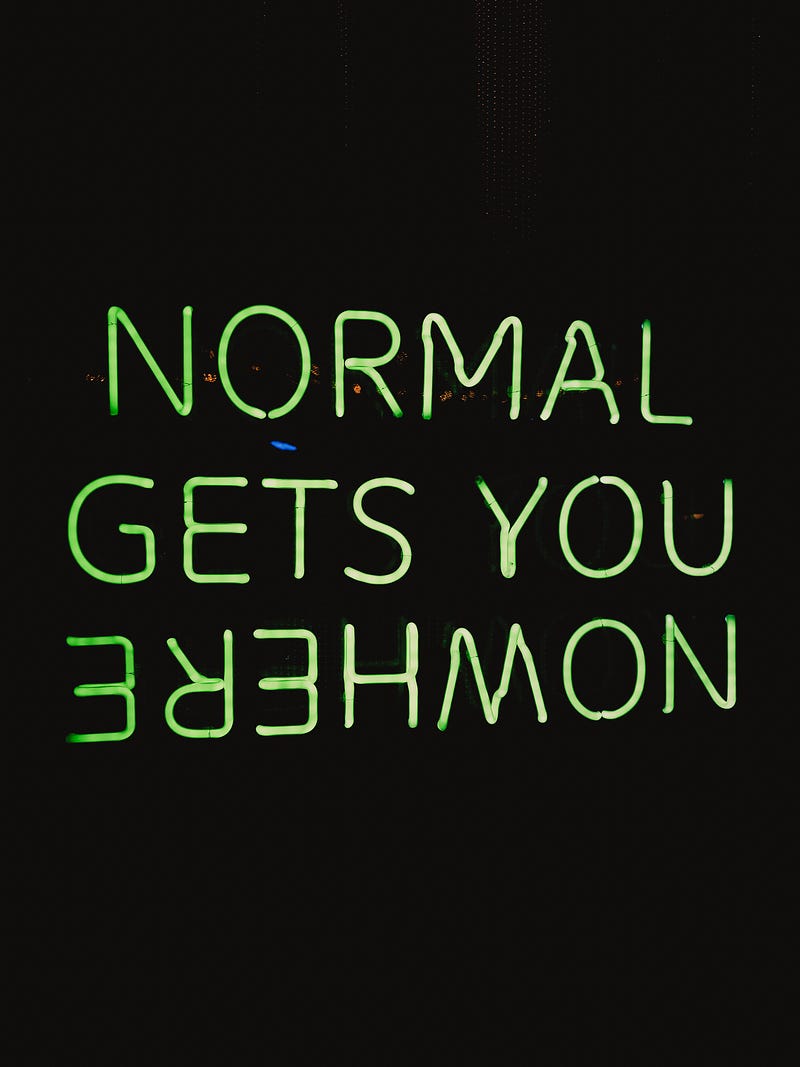
My father ingrained in me that, despite my bipolar diagnosis and potential reliance on daily medication for my whole life, I should strive to live a normal life. Yes, I could do things like ask for accommodations at work to help me manage my illness, but in reality that’s nobody’s business but my own and I should keep it to myself.
I have come to realize that living a normal life is not something I will ever be able to do. I can manage my bipolar disorder with daily medication and lifestyle choices, but the idea of living a normal life is not something I will ever achieve.
I say that despite, by all accounts, living a fairly normal life. I am married and own a house and car, I have a degree and work a 9–5 office job in my field, and I manage to take care of myself in an acceptable way. I present a bit weird to most people — I have come to understand that having waist-length hair and several personality quirks that affect how I interact with people tends to come off as a bit quirky. However, by “functional adult” standards, I tend to pass muster.
Holy crap am I not very functional sometimes. Yes, I can reliably drag myself out of bed in the morning, but some days that’s all I can do. Sometimes, doing chores is a struggle because I am too depressed to function properly. Other times, doing anything is a struggle.
I do my best to make accommodations for myself — I use life hacks to make certain things easier, I take rest days when I need them, and I talk to my partner or friends when I need a boost. However, dealing with these particular struggles is not considered “normal,” and many people would call me lazy or entitled for not doing chores or taking care of my house.
You know what? While I can make accommodations for myself to make my chores easier, I hate that I have to do so. Years of hearing ableist stuff about living a normal life has become part of my thought process, so the idea that I sometimes get so depressed that I can’t function makes me feel like a bad person.
We see a lot of that kind of ableism porn in the media. There are countless “motivational” stories and videos of people who overcame their disability to start a business or do something extraordinary. I remember one YouTube video in particular about a guy who was born without arms or legs but still managed to take care of himself with minimal effort. The last bit of the docu-video has him taking part in a mile swim event.
The takeaway is evident — he has no arms or legs, yet he still dresses himself, drives himself around, and does normal, everyday things by himself. He swam a mile and he has no arms or legs! If he can do all of that, why can’t I function at all some days?
The thing is, that little docu-video showed a bunch of stuff that he was able to do and a variety of tools he was able to use to accommodate his disability. He has a special setup in his car that allows him to drive. His home was full of things that make his life easier and allow him to function with some level of normalcy. He did the mile swim using a custom-designed swimming fin that allowed him to propel himself through the water.
And yet, the docu-video somehow manages to portray these things as marvelous while simultaneously downplaying their part in making his life easier. “He can live a normal life, why can’t you?” Well, yes, he is living a normal life, but that life is facilitated by a lot of things that help make that life easier.
None of this is to downplay this guy’s life — he worked hard to get to a point where he can function more-or-less by himself, and he deserves a lot of credit for that. What I have an issue with is the message that anyone can overcome adversity in their lives with gumption and grit. The thing is, some people just…can’t.
Things like alcoholism and drug abuse (which, by the way, are mental health issues and are not moral failings) kill many people each year, and while many people overcome their addiction, many can’t. That is not a judgment of their character, that is merely a fact of their condition. Suicide takes tens of thousands of lives every year for the same reasons — for many, their mental health issues are simply insurmountable.
And, for the tens of thousands who die, many hundreds of thousands, if not millions more, will live substandard or low-quality lives because of their disabilities. Between America’s substandard healthcare system and almost non-existent support for people with disabilities, so many of those who deal with chronic illness or a disabling injury struggle to merely survive.
So much of this is because of the ableist idea that someone with a disability can simply overcome that disability with mental fortitude. The truth is that some people can, and for those people, we have news articles and documentaries that hold them up as paragons of disabled virtue. “These people overcame their disabilities! Look at how amazing they are!”
In reality, these stories only serve to give those who don’t experience life with a disability or chronic illness warm fuzzy feelings and terrible ideas of what our lives are like. For those of us who live with a disability or chronic illness — mental, physical, or anything in between — all these stories do is make us feel bad that we can’t do that too.
So, when I have trouble doing the dishes, I beat myself up over the incredibly full sink. Sure, I can accommodate my illness by taking it in stages and using life hacks to make things easier, but that feels like a cop-out. The guy with no arms or legs can do his dishes without trouble, why can’t I?
As a result, many of us are stuck in this weird all-or-nothing mindset where if we can’t do a task or chore, we beat ourselves up over it. The upshot is that it takes twice as long to get done because if we can’t do it all the way, we break down and just don’t do it.
I don’t claim to speak for everyone. Obviously, plenty of people have it figured out and can manage their conditions without beating themselves up over basically nothing. However, so many of the people I know feel this way about themselves — somehow, having a sink full of dirty dishes is a moral failing and not an effect of an illness or disability.
And, if you are one of those people who can’t get through the day without feeling inadequate because you can’t manage some small task without help, I hope you can learn to be kind to yourself. Allow yourself to take an accommodation for a chore. If standing in the shower is too hard, sit. If all you can manage is putting all the dirty dishes in one place, do it. If your room feels cluttered but you don’t have the energy to clean it, put all the clutter in one big pile and tackle that pile later.
If you have some sort of chronic illness or disability, you are almost inevitably going to live a life that isn’t normal, and that’s okay. Be kind to yourself and allow yourself to do things in your own way. Accept help from someone. Take that shortcut. Do something half-assed just to get it done. Anything worth doing is worth doing poorly, after all.
Most importantly, don’t beat yourself up if you can’t get it figured out right away. We have all been overwhelmed with ableist sayings and stories for years, often decades, so undoing years or decades of that kind of thing doesn’t happen overnight.
Always remember: you can only do what you can only do. We all have different abilities and skills, and living a “normal” life is simply impossible for some people — myself included. I will always struggle with simple tasks that other people find easy, and that’s okay.
I am no better or worse a person because I can’t live a normal life, whatever that even is anymore. Nobody’s value is derived from their ability to be or act normal — humans all have intrinsic value, and your ability or inability to do the dishes does not change that.
You are a good, worthwhile person whether you can live a normal life or not. Don’t let anyone — not your parents, not your friends, not some documentary — tell you otherwise.
If you appreciate my work, why not join Medium as a paying member, which allows you access to unlimited stories (not just three free stories per month). Click this link or the image below. I will receive a little portion of your membership fee, but it won’t cost you any extra.
If you liked this, please subscribe to my publication, Thing a Day. I publish something every day on a variety of topics, so you never know what you’re going to see!
Here are some other things I’ve written: