
Don’t Let The ‘Hertz Effect’ Lure You Into A Badly Timed Investment
Buying near the peak of the 2020 bull trap will be a mistake you will not forget
One of the biggest rookie mistakes an investor can make is buying an overpriced stock because the stock is rocketing higher. I honestly understand how easy it is to be lured into a stupid investment. I’ve made the same mistake myself more than once.
It’s such an easy mistake to make. If you don’t really know how to value a stock or you don’t really have the time to research a stock, it’s so easy to conclude;
‘Why not buy Tesla or Amazon? I know these company names and the stock price is rising quickly. Everyone’s making a ton of money and I’m not. It can’t be overvalued – how can tens of thousands of investors be wrong? Maybe valuations don’t matter anymore …’
Again, chasing an overpriced stock is a very typical mistake for new investors to fall into, but these days the problem is being seriously compounded by what I call …
The ‘Hertz Effect’
‘When an inexperienced investor pours money into a soon-to-be-bankrupt stock, or a soon-to-be zombie company, thinking the stock will rebound soon but instead starts losing money, so the stock is promptly sold and proceeds used to purchase a grossly overpriced stock that has strong positive momentum, … only to get whipsawed ...’
Ed’s rule 2: Don’t buy bankrupt companies and don’t buy the shares of a zombie, or soon to be zombie company. It will only bring you sadness and embarrassment.
What happed to Hertz?
After being in business for the better part of a century, Hertz filed for bankruptcy on May 22, 2020, citing a sharp decline in revenue and future bookings caused by the pandemic.
Like a lot of stocks beaten up by the sudden realization North America had been infiltrated by the new mysterious virus, many retail investors started piling into this stock. These early investors predicted there would be a quick re-opening of the economy and subsequent V-shaped recovery.
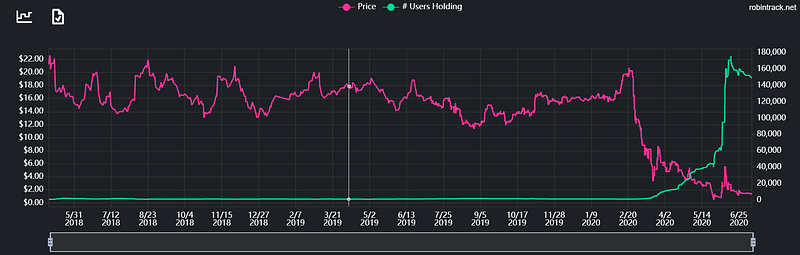
After an initial bounce in price, the stock continued to drift lower while Robinhood accounts holding HTZ continued to steadily increase in inverse proportion.
May 25, 2020 — HTZ drops suddenly to $0.65 per share, down from over $20 per share only 3 months earlier. Robinhood accounts holding this stock go through the roof, rising from approximately 40,000 accounts to over 170,000 accounts by the 15th of June — keep in mind, the company filed for bankruptcy May 22nd (see graphic above).
A combination of retail investors, almost certainly followed by algorithmic trading systems and momentum investors, temporarily drove the stock up to $5.56 on June 9th. Reality set in and HTZ plummeted back down in days. Robinhood accounts accumulating this stock continued to increase. The stock now sits at $1.48 as of this writing and after only a few months, accounts at Robinhood have started sharply decreasing.
How the Hertz Effect is influencing investors
Inexperienced investors, correctly not wanting to overpay for expensive technology stocks, instead look for beaten-up stocks that haven’t started recovering from the pandemic. Although betting on a rapid economic recovery is risky, it’s probably a much smarter investment strategy over the long-term than chasing overpriced technology stocks. However, investors quickly realize their economic-recovery-investment-strategy isn’t gaining value while technology names keep rapidly rising.
It suddenly occurs to the inexperienced investor that they should have bought Amazon or Tesla weeks ago because weeks later these stocks have risen exponentially while the beaten-up economic recovery stocks have gone nowhere or worse yet have fallen in price.
After doing some back-of-the-napkin calculations to determine how much potential trading profit has been lost already, the inexperienced investor dumps Ford, GE, American Airlines, Caribbean Cruise Lines, … and uses the proceeds to buy a technology name, regardless of valuation.
Ladies and gentlemen, the Hertz Effect is going to leave millions of retail investors in tears and tens of thousands in bankruptcy or worse.

Ed’s rule 4: Don’t chase ticker symbols. Any investment with extremely strong positive momentum can reverse suddenly, without warning. If you purchase a stock at a very high valuation, you might be out of the money for many years.
I’ve explained through Medium for months, why we are in the middle of a giant bull trap and why particularly inexperienced investors need to be wary of what’s going on in the real economy and not fall under the mantra of ‘The stock market isn’t the economy’ or ‘This time it’s different’. However, I think most inexperienced investors are not really aware of how damaging a badly-timed purchase can be. For example, …
Amazon
From the peak of the 1999 tech bubble to the trough approximately 2 years later, Amazon dropped from over $80 to well below $10 per share. If an investor made the unfortunate mistake of purchasing Amazon anywhere near its peak during the Dotcom bubble, that investor would’ve had to wait nearly a decade, until 2007 – 2008 to get back to even money before rising significantly higher. Can you wait, out-of-the-money for 5 years or more? I can’t.
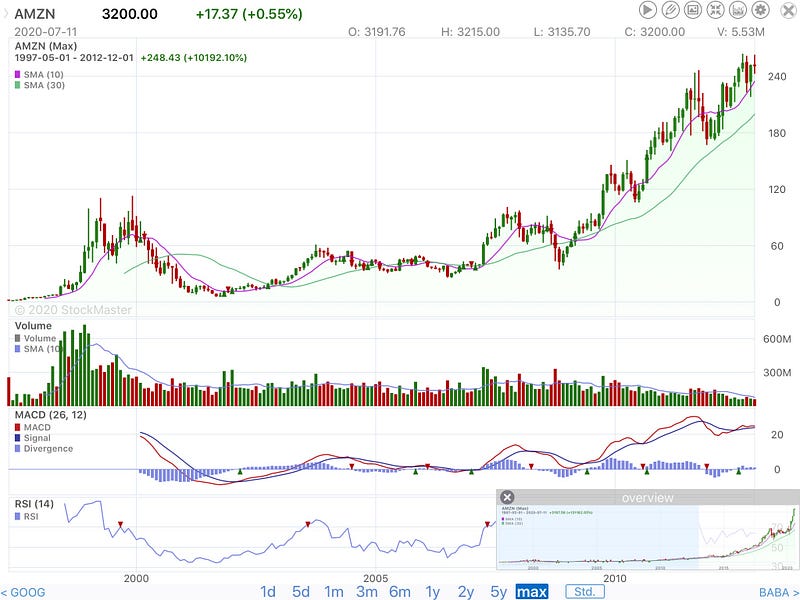
On the other hand, if an investor resisted the urge to buy Amazon during the strong bull market and instead waited until the summer of 2001, prices dropped well below $10 per share. Holding Amazon shares only 3 years produced a 3x + return. Holding Amazon from 2001-2008 rewarded investors approximately a 10x return on investment.
Although it’s true short-term timing of the market generally results in poor results, it’s also clear buying near the peak of the market is absolutely devastating for investors. I seriously worry that if inexperienced investors fall out of the saddle should this bubble suddenly burst, how many young investors will turn their backs on the stock market for years as they did after the dotcom bubble of 1999?

Inexperienced investors also tend to trade too often
What’s also working against the inexperienced investor and causing people to fall for the Hertz Effect is a lack of patience. If you were one of those investors who purchased an airline stock or an oil stock or a cruise ship stock thinking the economy would open quickly, I think you probably made a mistake in the near-term.
However over a longer time horizon (maybe one or two years), when the pandemic has passed and the economy can fully open up again, these stocks will almost certainly rise rapidly in price again. If you haven’t invested too much of your portfolio and you have a long time horizon, you might want to stick with your pandemic rebound investments. If it turns out you double your money in only a year or two, I would consider that a knock-the-ball-out-of-the-park investment decision. Much, much smarter than buying a tech stock at an all-time high.
Ed’s rule 5: If you believe in a stock story and have a good reason for buying it, you’ve got to be prepared to stick with your investment decision for at least a couple of years.
Conclusions
- Don’t buy bankrupt companies and don’t buy the shares of a zombie, or soon to be zombie company. It will only bring you sadness and embarrassment.
- Don’t chase ticker symbols. Any investment with extremely strong positive momentum can reverse suddenly, without warning. If you purchase a stock at a very high valuation, you might be out of the money for many years.
- If you believe in a stock story and have a good reason for buying it, you’ve got to be prepared to stick with your investment decision for at least a couple of years.
The Hertz Effect might be new, but it’s real and it’s going to get worse, and it’s going to make a fool of many investors. I suggest you calculate your investment requirements, make a sound case for buying the stocks you want to buy, and then stick to your investment decisions.
Making money in the stock market takes time and takes unshakable commitment. If you don’t have a minimum of a two-year time horizon, you have no business buying stocks. Let me be even more frank – if you are investing with less than a 2-year investment horizon, you aren’t investing – you’re gambling.
Step back, relax, and make clear-eyed investment decisions. Don’t let the ‘Hertz Effect’ lure you into a badly timed investment.


