
Don’t Let Fear of Taxes Destroy Your Stock Portfolio
Taking money off the table is key to long-term performance
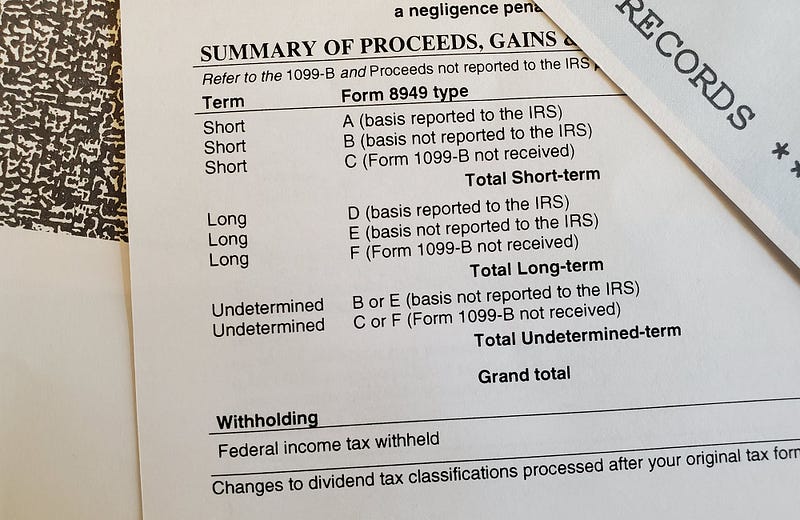
I hate taxes… I mean, I really hate taxes. There was a point in my life where my disdain was so great, I envied people who were able to use the 1040EZ form.
In America, if you have dreams of becoming wealthy, you seek a career that gives you stock bonuses. You create an LLC for a side business even before your first sale — that’s what that influencers on Instagram tell us. You start trading stocks and crypto. And if you’re really lucky, maybe you have a rental property or two. All of these things greatly increase the complexity of filing your federal (and sometimes state) tax return each year.
Paying the amount is painful enough, but I get why taxes are needed. To live in a civilized society, someone or some thing must be paid to provide running water, electricity, and everything else we tend to ignore that makes life easier. But it’s really the process of getting to how much you owe which makes it so painful.
You spend months waiting for your tax forms to come in each year and more hours throughout the year thinking about the tax ramifications of every financial decision you make.
When I first started buying stocks over twenty years ago, I quickly favored the buy-and-hold approach. I learned it was best, since I was young and had time, and no taxable event would occur as long as I bought shares and never sold them. Fast forward ten years and I quickly learned that the big time players in stocks are BIG because they trade, not just simply invest. But every stock trade creates a taxable capital gain or loss. And so began the endless log of every trade recorded and filed as part of my tax returns each year.
But I had lifetime stocks, and I didn’t want to pay the tax man…
A Lifetime is a Long Time
What no one likes to discuss in the investment community is that there are very few stocks that are worth holding a lifetime.
Think about the thousands of public companies traded on the stock market. Some over a hundred years old, yet very few, probably less than 20 make sense to hold for your entire life.
A classic example are companies like Ford Motor Company (F), founded in 1903. It has a one letter stock symbol because it’s that old. Yet the company trades today for around $14 USD. It’s had up cycles and down cycles, but the stock price certainly has not gone in a line up and to the right since it went public. This is for a company with a real product, real sales, that people can’t imagine not having due to its amazing convenience.
The automobile was transformational, but Ford stock is not. But for my son, with Ford’s push into EVs, it may end up being a lifetime stock for him. That’s just how the world works.
General Electric (GE), a company that has produced everything from aircraft engines to advanced medical imaging equipment is nowhere near its all-time high stock price today. If you were lucky enough to join GE in the early 70’s and somehow managed to stay until the late 90’s you would have made out like a bandit with stock appreciation and a pension, but that’s still not holding their stock for a lifetime. After various splits over the years GE trades today at around $85 USD.
For our generation, people often cite the new lifetime stocks as companies like Microsoft (MSFT) and Apple (AAPL), but I still have about 15–20 years left in the workforce, then hopefully a long retirement. A lot can happen between now and then. Will these two companies hold their value until I retire and then some, as I spend my money down in my golden years?
So, this leaves us with the reality that lifetime stocks, really are stocks that you want to reevaluate after 10 years. And if you’re at an all-time high, as much as you might hate selling, it probably makes sense to take some chips off the table and invest in an index fund or other instrument with a more guaranteed rate of return. At some point all stocks have to turn downward and you just won’t know if that’s during the time you’re making an exit from the workforce.
The global pandemic gave us an accelerated experiment in how stocks can rise and fall back to their original price leaving you flat or with minimal gains. Stock appreciation that should have taken 5 years, happened in 2 years.
Many knew this.
I KNEW THIS.
But I had lifetime stocks, and I didn’t want to pay the tax man, so I stupidly held. And now I’m flat or even negative in some cases.
Ally Financial (ALLY)
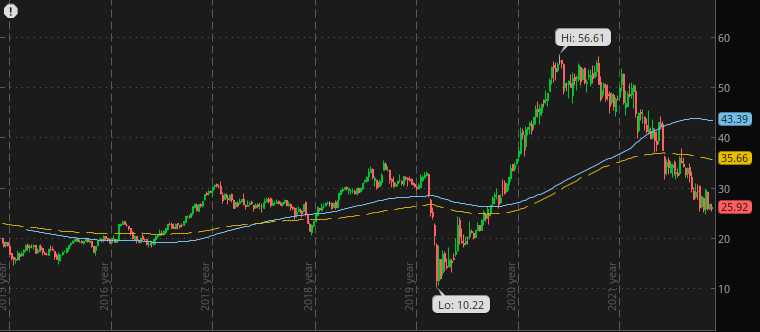
I purchased my first shares of Ally back in October 2018 at around $26.04. It wasn’t necessarily a lifetime pick, but certainly a 10-year stock. It peaked in the mid-50’s around June 2021 and stayed there for several weeks, more than enough time to see that it plateaued.
I essentially had a 100% return and should have taken some chips off the table even when it was a long-term pick. Instead, I held to avoid the big tax bill and today Ally is back down to $25.94. A full roundtrip from 2018.
Adobe Software (ADBE)
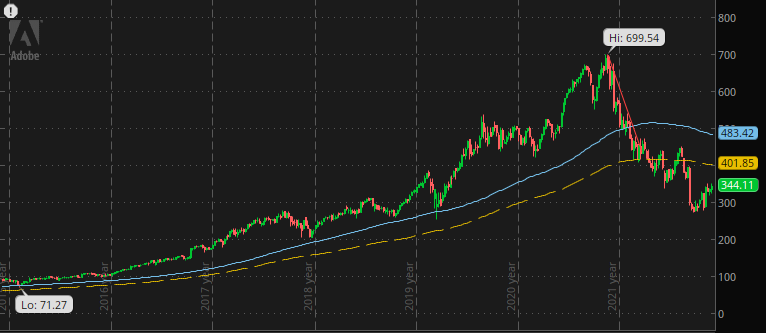
I purchased Adobe back in April 2017 at $129.80 USD. I did consider it a forever stock. Social media is booming, movies, ads, websites are never going away and Adobe is THE PLATFORM for tools in the graphic design and video production space.
It peaked around $667 in September 2021, pulled back and made another rise staying in the mid-600’s for at least two months. Again, enough time to see the plateau and take money off the table. Alas, I didn’t want to pay an even bigger tax bill and just held the shares. With additional purchases after 2017, my average cost rose to $180 and now I am only 88% up on this stock as it flirts with the low $300’s.
Amazon (AMZN)
And finally, Amazon — the powerhouse of ecommerce which should be here for the next hundred years. The pandemic showed us the many benefits of shopping from home. And while it may not have significant stock price appreciation every year, I certainly consider this another lifetime stock, especially when you factor in AWS.
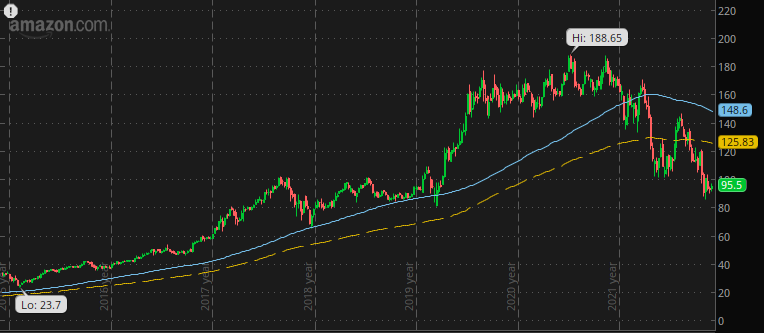
I purchased my first shares of AMZN back in July 2018 at around $86.82. It peaked at $185 in July 2021 and never went below $160 through December of that same year, months to realize it had plateaued and take some gains off the table. As of December 2023, AMZN is now back around $94 per share.
This story can be told over and over for dozens of stocks we would think are high quality; but across all sectors, big companies, small companies, this has happened. It’s hard enough to pick a good stock, much less pick one that will be good for a lifetime.
These three companies I mentioned weren’t meme stocks like GameStop or AMC. When you enter a position into those names, you know you’re going for a wild ride. You know you can see a 100% gain get erased in a few days. But these companies are not that.
The reality is that today’s market is different and will continue to be so going forward.
More people than ever before are in the market, and they all have access to more information to make knee jerk reactions.
Algo-trading still receives inputs from human beings who can’t foresee every worst-case scenario.
People are fickler than ever. A great company with a great product can be destroyed overnight because the CEO said something crazy, they donated to the wrong super-PAC, or they found out the company has a secret factory in Vietnam making bi-sexual teddy bears.
The world has gone crazy, and nothing lasts. So, it’s better to stick with the 10-year plan knowing you may have to swap out a number of stocks.
There’s an oft used saying in the trading community, “You can’t go broke taking a profit,” and we often forget that in our quest to become the next millionaire investor.
Even with my tax hit, I would have been thousands of dollars up if I had sold around the peaks of these stocks — not even the top!
But I’ve let my hatred of extra paperwork during tax season and hard-earned stock picks going to the government get in the way of sensible decisions.
Paying taxes is just like the game Monopoly.
DO NOT PASS GO. DO NOT COLLECT $200.
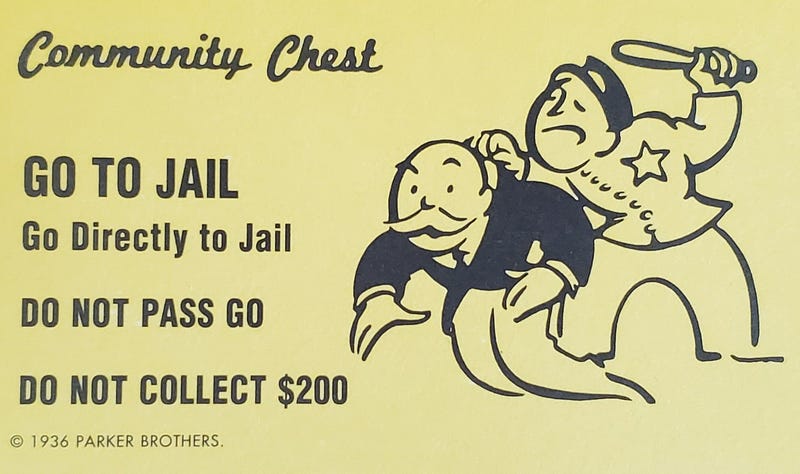
Pay your fair share and just accept a 100% gain on a trade is really not that… once you factor in taxes.
It’s one reason why I hate seeing these trade diagrams where they show you how to grow $1,000 USD into a $100,000 account, but they don’t take any taxes out of the gains when they reinvest for the next trade. In reality, you may need to make 20–40% more trades to hit that same goal amount after tax.
The upside of changing your thinking is this — after ten years, if the stock is still on the uptrend, then simply continue to hold it — you don’t have to sell, but never be afraid to cut bait and switch or take just a little off the table.
Disclaimer
This article is not financial advice. The stocks mentioned in this article are for illustrative purposes only and should not be construed as an investment endorsement/advice for or against the company and/or its securities. Investing involves risks and everyone should perform their own independent due diligence before making any investment decision.
Read more viewpoints from me and other great writers on Medium — Become a Member Today!
Subscribe to DDIntel Here.
Visit our website here: https://www.datadriveninvestor.com
Join our network here: https://datadriveninvestor.com/collaborate