
Don’t Just Do Zone 2!
Understanding Exercise Training Zones: A Guide for People with No Podium Ambitions

In recent years, a new fitness narrative has captured the spotlight, with leading figures like Peter Attia and Andrew Huberman advocating for the concept of Zone 2 training. This concept, however, isn’t a recent discovery. It has been a cornerstone of sports performance, particularly in endurance sports such as marathons, triathlons, and cycling. Any fitness enthusiast who has embarked on a journey through the labyrinth of exercise science has likely stumbled upon the concept of zone 2 and various training zones.
Yet, in the vast landscape of popular media and opinion, the benefits of other training zones have remained a hidden treasures, overlooked and under-appreciated. The path to enhanced fitness isn’t solely paved with Zone 2 exercises; it isn’t a miraculous one-size-fits-all solution. While Zone 2 is indeed a vital piece of the fitness puzzle, offering adaptations that can combat risk factors for cardiometabolic diseases, it might not be the crowning piece.
Choosing the best training zone to inhabit can be akin to navigating a complex maze, as each zone has unique treasures to offer. Some of us may find solace in the serene valleys of long, introspective runs, while others may find their hearts racing in the exhilarating peaks of high-intensity training. The key to this exploration lies in the realisation that the landscape of training isn’t confined to a single zone. A typical week’s expedition through the fitness terrain often comprises a mix of intensities, with some quests venturing into higher intensity zones and others charting a more tranquil path.
So, how should you select the intensity zone for your exercise expedition? This article will act as your compass, guiding you through the diverse training zones and their bounties. It will illuminate how even those of us without aspirations of standing on podiums or holding championship trophies can harness these zones to enhance our fitness efficiently.
Understanding the Zone Systems
The concept of training zones has evolved over time, with various methods being developed to help athletes better understand and manage their training efforts. The simplest of these is the 3 Zone model. This method divides training intensity into three physiological zones, each demarcated by appreciable changes in the body’s response to exercise, such as lactate levels, breathing rate or CO2 exhaled.
The first zone is typically a low-intensity zone, where the body can exercise for extended periods with minimal fatigue. The second zone is a moderate-intensity zone, featuring increased breathing rate and a transition from fat to carbohydrates as the primary source of fuel. The third zone is a high-intensity zone, where carbohydrate metabolism dominates and the body can only maintain this level of effort for a limited time.
To provide more granularity within these 3 physiological zones, the 5, 6, or 7 Zone system methods were developed. These systems further subdivide the three original zones into smaller fractions and label them based on the expected outcome and physiological adaptations theoretically elicited by exercising at a particular intensity. I found a chart on TrainerRoad’s forum by a member who illustrated how the 3-zone model has been adapted to the 5 to 7-zone model:
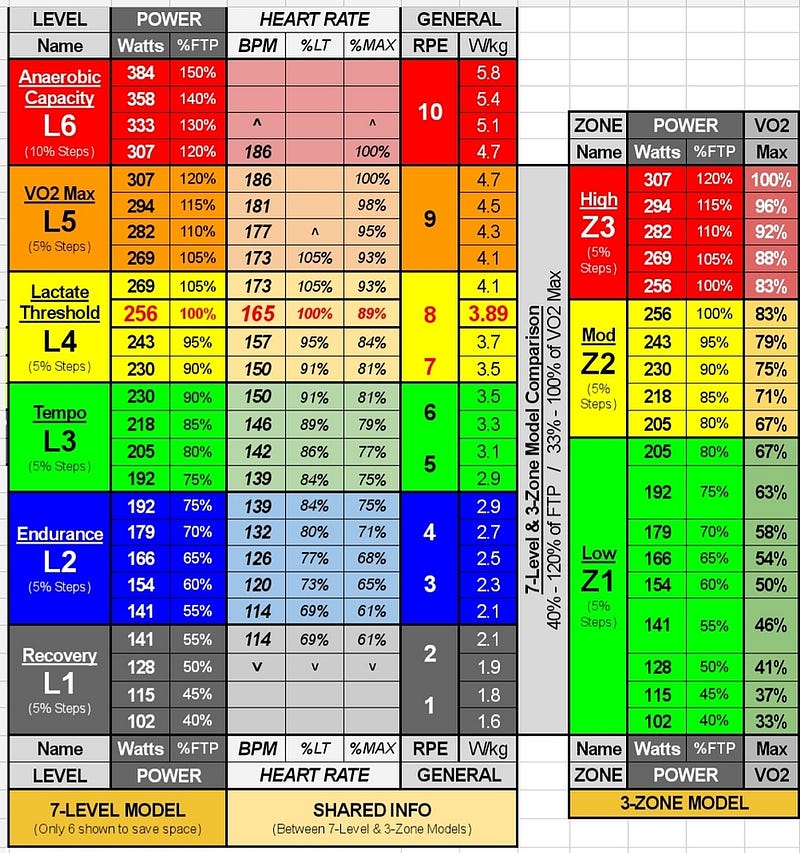
The 6-zone system splits each of the three physiological zones into two — just the right amount of complication we need in our lives.😉 Unlike the distinct changes between zones in the 3-Zone model, the 6-Zone model treats the zones as a spectrum that transitions within each of the three physiological zones.
However, an important point to remember is that these additional zones are arbitrary and may not align with significant physiological changes. The width of each zones also differs between individuals depending on factors such as gender, genetics or level of training. They are intended to provide more precise guidance to athletes about how hard they should be pushing themselves during different types of training sessions.
Understanding these systems and their differences can help you choose the one that best suits their training goals. It’s also crucial to consider the trade-off between training volume and intensity. Generally, lower intensity sessions can be sustained for a longer duration (high volume), while high intensity sessions are shorter (low volume). Depending on the zone, these sessions can bias different exercise adaptations, emphasising either endurance or power.
Diving Deeper into Each Zone
Zone 1: Active Recovery
Zone 1, also known as the Active Recovery Zone, is characterised by very low intensity. Training in this zone is easy and comfortable, introducing only a minimal level of stress to your body.
While Zone 1 is called the Active Recovery Zone, don’t let the name fool you. Training in this zone is about introducing a very low level of stress to improve endurance performance, especially under a state of fatigue, rather than just about recovery. The load, albeit minimal, is still a contributor of stress to your training. Load is load. This zone is especially beneficial for trainees after a high-intensity day or as the second session of the day. However, if the goal is to rest, then complete rest might be more beneficial, particularly for non-elite exercisers. You may find it challenging to exercise at an intensity low enough to remain in this zone. For instance, if your typical easy run already takes you to 7:30–8:00min/km, running at an even easier pace would likely mean walking. Therefore, for beginners or non-elite athletes, taking a complete day off from training or opting for a brisk walk might be a more suitable form of “active recovery”. This approach ensures adequate rest and minimises the risk of overtraining.
The Rate of Perceived Exertion (RPE) for Zone 1 is typically very low, around 1 to 2 out of 10, indicating minimal effort. The Talk Test for Zone 1 indicates that you should be able to maintain a full conversation with ease while exercising in this zone.
Zone 2: Aerobic Threshold Zone
Zone 2, also known as the Aerobic Threshold Zone, is where fat oxidation peaks, improving metabolic efficiency. This doesn’t mean only fat is oxidised; glucose is metabolised too. However, this is the zone where the most fat is used as an energy source. Training in this zone helps your body become metabolically fit, enabling it to utilise more fat, even at very low levels.
Sedentary and unfit individuals often experience metabolic inflexibility, using less fat and more glucose, even at rest. As their activity intensity increases, their proportion of glucose oxidation also rises. Zone 2 training is beneficial for these individuals as it promotes mitochondrial biogenesis and density.
Mitochondria are the “powerhouses of the cell,” responsible for generating the energy our bodies need to function. This energy is produced as adenosine triphosphate (ATP). Increasing the number and density of mitochondria — a process known as mitochondrial biogenesis — boosts the body’s energy-producing capacity. More mitochondria mean more “engines” to burn fat and produce ATP, which is especially beneficial during endurance-type activities with high energy demand.
Additionally, regular Zone 2 training not only increases the number of mitochondria but also improves their function, including the process where mitochondria consume oxygen to produce ATP.
Improved mitochondrial function leads to more effective fat oxidation, better endurance, and overall metabolic health. It also enhances metabolic flexibility — the body’s ability to switch between using fats or carbohydrates as a fuel source depending on the activity’s intensity. This key aspect of fitness and health is often compromised in sedentary and unfit individuals.
There’s plenty of content available about Zone 2 training, including insightful videos and podcasts that explain its intricate details. Notably, videos/podcasts by Peter Attia and Simon Hill are handy resources for those who aren’t hardcore athletes but want to live better and healthier. You can find them here:
You can also find Andrew Huberman chiming in on Zone 2 training with a very short and summarised video here:
For Zone 2, the Rate of Perceived Exertion (RPE) is generally low to moderate, around 3 to 4 out of 10. The Talk Test indicates that you should be able to maintain a conversation with some effort, but full sentences should still be possible while exercising in this zone. Here is Peter Attia shows us how its done for Zone 2 training:
Zone 3: Tempo
Next, we have Zone 3, also known as the Tempo Zone. Here, lactate clearance is enhanced and lactate is reused as fuel. This zone provides a bridge between aerobic and anaerobic exercise. Training in this zone can improve your body’s capacity to buffer and reuse lactate as fuel, which can enhance your endurance performance.
This translates into everyday benefits such as increased stamina, making daily activities easier to perform. Many demanding daily activities fall within this intensity level, such as climbing stairs, running to catch a bus, or playing an impromptu game of football with friends. As you age and your cardiovascular fitness and strength decline, these abilities are typically the first to weaken.
For Zone 3, the Rate of Perceived Exertion (RPE) is generally moderate, around 5 to 6 out of 10. You should be able to maintain a conversation, but full sentences would be more difficult and you might need to breathe in between phrases while exercising in this zone.
Zone 4: Lactate Threshold
In Zone 4, known as the Sub-Threshold Zone, the focus shifts to improving fatigue resistance and tolerance to the accumulation of metabolites within cells, and enhancing the efficiency of glycolytic enzymes. Training in this zone allows your body to adapt to the high levels of metabolites that accumulate during intense exercise, thereby enhancing your ability to sustain such effort for longer periods.
Activities that typically require the capabilities developed through Zone 4 training are those that require a sustained burst of effort or intensity. This could include activities such as:
- Climbing several flights of stairs quickly
- Cycling up a steep hill
- Playing intense games or sports like soccer, basketball, or tennis
- Hiking a technical and steep trail
These activities require a higher level of cardiovascular fitness and muscular endurance, which are enhanced by training in Zone 4. The Rate of Perceived Exertion (RPE) is generally high, around 7 to 8 out of 10, and you should only be able to say a few words before needing to catch your breath while exercising in this zone.
Zone 5: VO2max
Training in Zone 5, also known as the Anaerobic Threshold Zone, isn’t just about pushing one’s limits. It also triggers cellular-level adaptations, including enhanced mitochondrial respiration. This process, where the mitochondria in our cells consume oxygen and generate energy, plays a vital role in overall health, not just athletic performance.
A key aspect of training in this zone is the improvement of VO2max, which signifies the maximum amount and rate at which an individual can utilise oxygen during intense exercise. While this might seem relevant only to athletes, VO2max is actually a strong indicator of overall health and fitness for anyone. Numerous studies have shown a correlation between a higher VO2max and lowered risk of various diseases, including cardiometabolic diseases, and reduced mortality rates. Therefore, incorporating Zone 5 training into your fitness routine can contribute significantly to maintaining good health and fitness, even if you’re not an athlete.
Peter Attia is the only prominent figure I could find who’s advocating for Zone 5 training along side your Zone 2 sessions. I think he’s done a tremendous job illustrating the benefits that having a higher VO2max would have for our health:
However, it is important to note that the physiological adaptations that occur in this zone are both quick to manifest and quick to fade away. This means that the improvements in aerobic capacity and mitochondrial respiration occur rapidly with consistent training in Zone 5. Conversely, if regular high-intensity training is not maintained, these adaptations can detrain just as quickly, returning to their baseline levels. Training at other zone will inevitably improve your VO2max too, but not to the same extent as if you were to have a Zone 5 specific training.
The Rate of Perceived Exertion (RPE) for Zone 5 is very high, typically around 9 or 10 out of 10. The Talk Test for Zone 5 indicates that you should be unable to speak more than a word or two without needing to catch your breath while exercising in this zone.
Zone 6-7: Anaerobic Capacity-Neuromuscular Power Zone
Zone 6–7, also known as the Anaerobic Capacity-Neuromuscular Power Zone, is characterised by extremely high-intensity, anaerobic activities that are typically sustained for only a few seconds, such as sprinting or plyometric exercises. Training in this zone offers several advantages. It significantly amplifies force output and velocity by stimulating fast-twitch muscle fibres, which are responsible for rapid, forceful movements. Additionally, it enhances the neuromuscular system’s effectiveness, improving coordination and the body’s ability to produce force quickly.
Training in this zone can benefit everyday activities requiring sudden bursts of power or speed. Situations such as lifting a heavy object, or swiftly changing direction to avoid an accident while walking or cycling, can be handled more efficiently and safely by enhancing neuromuscular power. This type of training can further bolster your body’s resistance to mechanical stress, boosting your tolerance to heavier loads and minimising the risk of musculoskeletal injuries in everyday life.
For Zone 6-7, the Rate of Perceived Exertion (RPE) should be extremely high, typically about a 10 out of 10. The Talk Test for Zone 6-7 indicates that it should be impossible to speak at all while exercising in this zone due to the high intensity and exertion.
Staying in Zone 1 or 2 can be challenging especially for beginners. But it’s essential for building endurance and metabolic efficiency. It’s important to start slow and steady, even if it means running at a slower pace than you’re used to or even walking intermittently to keep the effort low.
As your fitness level improves, you can start incorporating higher intensity zones into your routine. These zones can help improve your lactate clearance, fatigue resistance, and aerobic capacity. However, remember that these zones are also more intense and require more recovery time.
Its important to note that as workout intensity increases, so does the mechanical stress placed on the musculoskeletal system. More intense and vigorous exercises produce a larger force and require more energy to generate movement per unit of time. This can lead to a higher risk of injury if not managed properly. Therefore, it’s crucial to gradually increase the intensity of your workouts and allow adequate recovery time.
Understanding the role of recovery and rest days is also crucial in zone training. While some may advocate for ‘active recovery’ days, where you perform low-intensity exercises, it’s often better for non-elite exercisers to take complete rest days. This allows your body to fully recover and minimises the risk of overtraining.
Understanding and utilising training zones is akin to embarking on an enlightening journey through the landscapes of your own body. Each zone is a different terrain, each with its unique characteristics and rewards. Imagine Zone 1 as a leisurely walk in the park, where the stress on your body is minimal but the benefits to your endurance are substantial. Zone 2 is like a steady hike up a hill, challenging but manageable, where you’re optimising your body’s fat burning efficiency.
Moving further, Zone 3 feels like a spirited jog, enhancing your body’s capacity to clear and reuse lactate as fuel. Zone 4 is akin to a strenuous mountain climb, where the air is thin, and the challenge is high, but the view at the top is worth it — a body resilient to fatigue and efficient in metabolite management. Then comes Zone 5, the sprint to the finish line, pushing your limits to the max, triggering cellular-level adaptations and improving your VO2max.
Finally, Zone 6–7 is that victorious leap at the finish line, a burst of maximal, anaerobic power that lasts just a few seconds but leaves a profound impact on your power output and neuromuscular efficiency. Each zone, each terrain, holds a unique challenge and a distinct reward. And like any journey, there’s no one-size-fits-all map. What works best for one traveller may not work for another.
So, put on your metaphorical hiking boots, experiment with the different zones, and observe how your body responds. It might be challenging at times, but every step forward, no matter how small, is progress. And soon, you’ll find your perfect balance, your ideal journey that will lead you to your fitness goals.


