
MAY WRITING EXPERIENCE — WEEK 4
Don’t Forget Storytelling: The Missing Substance is You
Show up, open up, and watch your audience grow
You’ve got this great idea for an article. You may even have it all outlined and planned. But something is missing from it, and it reads just over two minutes. You know it, and I know it. It is hard to find the filler. Why would anyone want to read something that leaves them feeling empty? Maybe you need to practice storytelling.
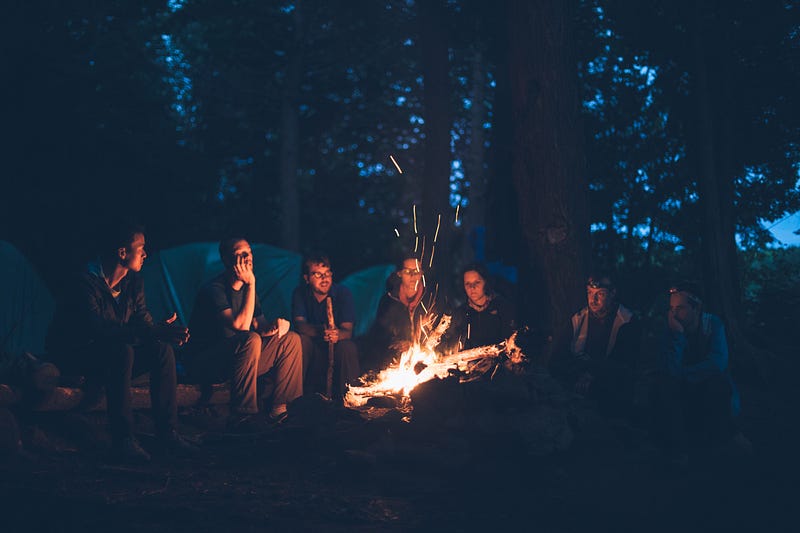
Readers, it’s sort of like showing up to the bonfire after it’s burned to embers — only one guy is left, snoring in a beach chair, empty beer bottles on the ground. When you are late to the party, you are left cold.
As a writer, you want to keep your audience engaged. You need to write with substance, but what is the missing ingredient?
The substance you are missing is you. The solution: show up and open up.
Why writers fall short
It is no secret that anyone can research information faster than a heartbeat, and anyone can write informative articles. Many people can whip out an advice listicle just as fast, but the writers who shine, are the ones who really bring themselves to the party.
Anyone can be an expert on anything, and if everyone is an expert, then no one really is. I can Google anything about what happened in history today. Did you know that on May 24, 1883 the Brooklyn Bridge was opened for business? I am not an expert on this, but I’ve spent a lot of time in Brooklyn. So what?
From my previous days working in sales, I still remember this truism: “Facts tell, but stories sell.” It’s the human connection that will build your audience. But how do you do this?
Show up and open up
Your readers want to know what makes you tick. They came to read your work because there is something compelling about the way you tell a story. That something is your authentic self. Everyone has a story to tell beyond where they are from and what they do to make ends meet. Here are just some of the experiences you can draw from.
An Oral Tradition
There is nothing like staying up late into the night listening to stories passed down from generations. Storytelling is what makes people know history. Not everything gets written down, but word of mouth is powerful. A culture’s oral tradition is important. You can draw from your well of stories passed down to you.
There is nothing written, that I know of, about my ancestors’ escape from the pogrom in Russia. The story goes that my grandfather’s parents and his two older brothers hid under bales of hay on a wagon that drove them to safety. They ended up settling in Wisconsin, and that’s how I’m alive. There also is nothing written about my great-grandma and her sister who escaped to America from similar circumstances, while the rest of the family perished. They settled in Illinois, and that’s how I’m alive.
Family stories
You can tell stories of your family members, and certainly, we can all relate to unique characters and personalities.
When I was a kid, my famously antagonistic father was arrested for speeding. I am not sure if it is because he tried to race the cops or if he was going so much over the speed limit that he needed a time out in jail for recklessness. Either way, the story goes that he asked the cops for a spoon so he could dig a tunnel to escape. I wonder if he was kept longer for his sassy mouth or if they let him go because they didn’t want to hear his sassy mouth.
Work stories
We have all had jobs. If you have had more than one job, then you have stories about how you got the job you have now, or how you lost the one you had.
Maybe you have a story about when you worked in a haunted restaurant, and the strangest things happened. At the bar one night a “flaming Dr. Pepper shot” caused a real fire on someone’s chest hair. Another day, an industrial-sized fan fell from the ceiling, hit me in the head, knocked me out cold while on my way to serve a tray of drinks for a large party on the patio. True story.
Stories of success/failure/overcoming obstacles
There really isn’t anything more relatable than overcoming obstacles. That’s what life is all about. If you are writing to give advice to your audience, then you need credibility. You need a personal story to go with it. I have had a lot more success with my nonfiction articles when I write personal stories within them.
And many of my stories fall flat on their faces. If stories have faces. I guess my stories do. I have found that the more I can connect with my audience by showing up and opening up my authentic self, the more engagement I receive. And the more engagement I receive, the more I have to give.
“After nourishment, shelter and companionship, stories are the thing we need most in the world.” — Philip Pullman
The bottom line
Go read some fabulous articles and see which ones you really love. Are they just a list of facts? You may like that if you are looking for a simple recipe. But if that recipe comes with a little story about a family holiday tradition, it will probably stay with you longer.
If you need a place to start, I recommend reading Aimée Gramblin and the other authors at Age of Empathy. This publication shines with juicy personal narratives and nonfiction.
When we study how other writers engage with their audience, look for the ways they weave their own life into their articles. Try writing some personal micro-stories to add to your work. You and your readers will be happy you did.
Samantha Lazar 2021
Thank you for reading! This is the 2nd post in Week 4 of the May Writing Experience. If you missed the first post on storytelling, here it is:
Thank you to Christina M. Ward, MDSHall, Lennie Varvarides, Kathryn A. LeRoy, Laurie Perez, Lisa Bolin, Nikki Tate, Trisha Dunbar, K. Barrett, Mimi Bordeaux, Janaka Stagnaro, Julia Marsiglio & Allison Cecile for joining us on the journey! Everyone is welcome at any time to try out the May Writing Experience. It is a month-long challenge to improve your writing and grow as a writer. If you are lost, start here.


