
Don’t Drown in the Shallow End
Marcus Aurelius said, “The universe is change, life is understanding.” Today’s news catastrophizes all aspects of AI, with warring factions considering AI an opportunity or a threat.
The internet or email did not exist for my two and a half jobs. The businesses were large, profitable multinationals, and the main difference between then and now was a propensity to hop on a flight for a day for a meeting in Canada. Business Class was the same price as today, which makes it 2.6 times cheaper now.
Businesses adopt change to reduce friction, which accelerates performance and profitability.
In the 1980s, I managed a development group for Westinghouse in Ireland and had two secretaries and twenty filing cabinets — the communications rate was five to ten letters per day. In the 1990s, I managed global development groups for Gateway Computers. I had a part-time assistant in Ireland and America and a filing cabinet drawer in each location — the communications rate was hopefully less than 100 emails per day and no letters.
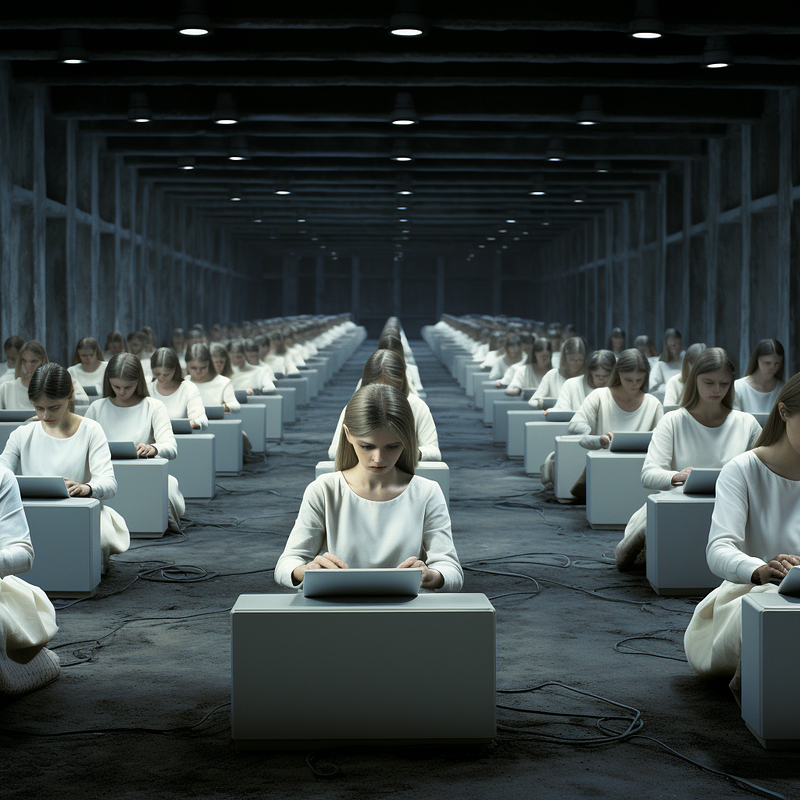
For over half a century, adopting the typewriter for office automation necessitated the efficiencies of the typing pool in large companies — escape was only possible by becoming a private secretary for one of the managers. I angered my colleagues at Westinghouse by “promoting” my secretary to being an office manager as I was traveling, and their secretaries revolted and sought equal status.
What happened to the millions of dictaphone and shorthand typists who were mainly female?
Did they all become extinct, or were they absorbed as administrators in a rapidly changing world of office automation enabled by email and the Internet?
If you watch Mad Men, what is striking is the gender inequality that was expected and accepted. We have progressed somewhat today. Is this why the transformation of the typing pool role into that of the office manager to support the reduced friction and accelerated pace was invisible?
With AI, men will lose their jobs, and the media is inciting hysteria and angst associated with this challenge because, for a century or more, the dominant position of men in industry and services went unthreatened.
The Internet Revolution disproportionately impacted the careers and roles of women, who embraced change and new ways of working effortlessly.
In 1949, Simone de Beauvoir published The Second Sex, where she challenged the long-held notion that gender differences are based on biological differences and that women, therefore, are inherently inferior beings to men. She argues that women’s inferior position to men has been historically constructed.
The AI Revolution will impact everyone, but men appear less able to cope as they flounder at school and the workplace.
Simone de Beauvoir was correct.
Businesses adopt change to reduce friction, which accelerates performance and profitability.
AI will eliminate previously male-dominated tech, media, finance and legal positions. The universe is changing.
Like eliminating the typing pool, new jobs associated with business acceleration and reduced friction will emerge. For employees of all genders, equal opportunities will be available.
However, only those who have shown themselves to be most adaptable will thrive in the AI-integrated world.
AI is a tool, not a threat — except for those who cannot swim.