
Don’t Despair If You’re Not a Morning Person
Is it socially acceptable to be a night owl?
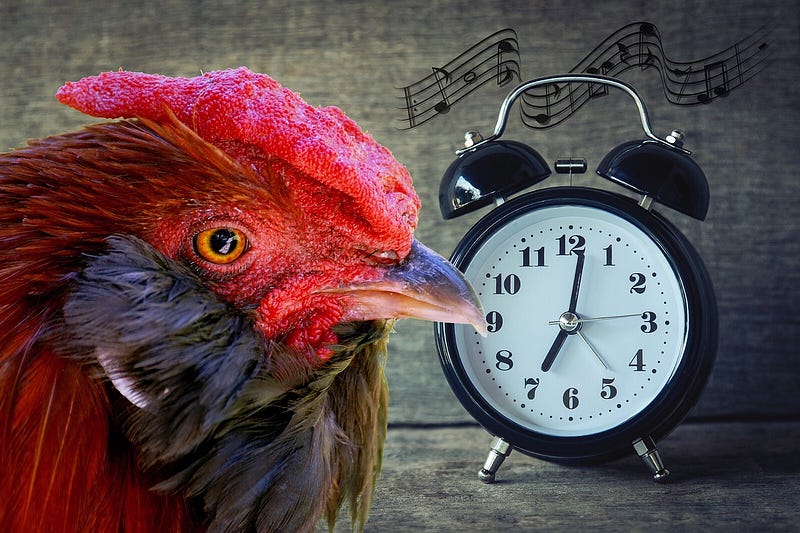
If late dinners and parties are your thing, you work the evening shift, or birth your best ideas in early evenings or deep into the silent night, take comfort you’re not alone.
Does your energy soar as the sun goes down?
Do you battle to rise as the sun comes up?
You pitch up panting and bleary-eyed for a 7 am office meeting. In the dog box — your tail doesn’t wag until high noon.
“Too many late nights,” your colleagues mutter.
Our society dictates early to rise and early to bed.
I could never get my head around that — believe me, I tried.
I remember one time I’d arranged for a colleague to collect me at 5 am to share a ride to a corporate conference at Sun City. I went to bed at 8 pm but only fell asleep 11 pm. I set my alarm for 4 am — plenty of time to shower and dress with a packed suitcase waiting in the hallway.
I never heard the clock. The frantic ringing of the doorbell at 0500 woke me. Panic! I shook my partner awake and told him to delay my colleague at the front door. I didn’t time myself but I was on speed dial. Must have been a world record for dressing and applying make-up in ten minutes.
My fellow manager wanted to talk shop on the 3-hour journey. I craved sleep so I could dream of that cup of coffee I’d missed in the frenzied rush; if only he’d shut up! I muttered and mumbled my way across the miles.
On arrival my first question was “Where’s the coffee?”
Throughout the years of formal employment, I battled to arrive on time.
During the times I ran my business, I could be flexible and arranged my workday around a 10 am start. I was more productive and my energy peaked between 6 and 10 pm.
As a writer, working from home, I no longer have to follow the rules! Yay!
What if your body clocks sync a different way?
Note I used the plural.
No doubt you’ve heard the term circadian rhythm, which describes our sleep/wake cycles; when you are most alert and when you’re sleepy over a 24-hour period. This signals our brains when to release hormones such as melatonin and cortisol.
But we have other clocks set to this master clock which regulate digestion, liver function, detox, metabolism and much more.
Most of us are diurnal creatures — awake in daylight and asleep in the dark. We create our personal sleep schedule around our lifestyle, including our work and environment.
But I and others struggle to conform to societal expectations.
I’m no early bird!
This lark sings the blues when she cannot choose what time to start her day.
Why the difference?
Turns out my guilt is misguided because our DNA codes our optimum sleep time.
A group of genes called Period Genes which include CLOCK and PERS code for circadian propensity, or your preference for morning or evening; they code for proteins that help keep us awake during the day and asleep during the night.
(Early birds have longer PERS genes, while night owls have shorter ones. Besides your wake-up and bedtimes, the length of your PERs gene dictates how much sleep you need. Early birds need more, while night owls need less.)
Sleep Chronotypes
“A person’s chronotype is the propensity for the individual to sleep at a particular time during a 24-hour period.” — Wikipedia
The morning chronotype
The world works in your favor.
Up at 6 am, at school by 7:45 am or in your office job by 8 or 9 am. To bed at 10 pm for your 8 hours of sleep.
You’ll be most productive in the early part of the day.
That ain’t me babe, as Bob Dylan sings.
The evening chronotype
Conforming to the norm is a challenge.
Here our master clock which syncs with our body clocks shifts forward according to our genes.
Up at 8 am and to bed by midnight.
If we can’t adjust our schedule to those times, our hormones, digestion, immune system and cognitive ability and a host of other functions such as body temperature and blood pressure don’t run at optimum efficiency.
I thought I was an evening chronotype until I answered this Morning-Eveningness Questionnaire. (Click here for the pdf.)
The five categories are:
- Definite Evening
- Moderate Evening
- Intermediate
- Moderate Morning
- Definite Morning
My score put me squarely in the middle as an Intermediate though I believe I’m a Moderate Evening. I determined to track down the reason for this discrepancy.
I discovered the time we are born affects our sleep/wake cycle too. I entered this life in the evening! More on this later.
Other sleep chronotypes
The following two sit at opposite ends of the spectrum:
Advanced Sleep Phase Syndrome (ASPS)
A small percentage of people have an extreme morning preference.
Up at 4 am and best going to bed at 8 pm.
No late dinners as your digestive system is switching off for the night!
The defunct English tradition of high tea between 5–7 pm favored an ASPS individual of the working classes as that was their last meal of the day.
But the upper classes partook of high tea to tide them over until dinner at 8 pm. If you were part of that privileged circle, you’d gain an unsavory reputation for either for your non-attendance or excessive belching.
Dinner in Croatia, Portugal, Spain, Italy or Greece is out of the question. They eat between 9 and 10 pm — way past your bedtime!
Despite the dining debacle, an ASPS person can adjust and slot into the normal workday.
Delayed Sleep Phase Syndrome (DSPS)
Dwelling at the other end are those with an extreme evening preference.
Up at 10 am and to bed 2 am the following day.
They do their best work late at night. A corporate job presents a myriad of chronic health conditions and they struggle to be productive at their job. Being out of sync, the solution is to choose a career that caters to their own body’s clocks.
The time of your birth
It’s not an old wives’ tale!
To discover this influences whether you are a lark or an owl stunned me. I’d wondered for years if my being born at 6 pm explained my struggle to wake early but had never found out.
In 2010, psychologists from Cleveland State University in Ohio gave large groups of students mental-performance tests in the morning and late afternoon. The researchers then examined the students’ health records to see whether they were born in the morning or later.
- The larks scored better in the morning tests.
- The owls did better in the late-afternoon exams.
The scientists reported in the Journal of Social Psychology,
‘Time of birth was significantly related to being a day person or a night person. The results suggest a critical period for setting the biological clock for alertness may be the moment of birth.’
Researchers found morning people are more persistent in pursuing tasks and are “more resistant to fatigue and frustration”, says Dr Ana Adan, the Barcelona University psychologist who led the study.
But night owls need not be jealous.
A survey of 420 people by Sydney University declared:
‘Contrary to conventional folk wisdom, evening types are more likely to have higher intelligence scores and to be more creative and novelty-seeking.’
Beware fellow owls, as we are more prone to burnout and mood problems and likely to suffer from depression. I’m evidence of that but am over it!
A study in 2016 by the U.S. Centers for Disease Control and Prevention found that in modern times births now peak in the hour after 8 am.
The balance between morning larks and night owls is shifting in the lark’s favor. Will this create a more ordered society bereft of nights owls?
Does it matter?
Of importance is that we live and thrive as human beings, connecting with love, compassion, kindness and laughter, no matter the time of day or night.
“Time flies like an arrow; fruit flies like a banana.” — Anthony G Oettinger
With that, I bid you good night — or good morning.
Thanks for reading.