
WRITING
Don’t Be Afraid of Writing Memoir
Experience Storytelling In Its Rawest Form

Throughout the years I’ve heard from a lot of writers who seem to be intimidated, yet intrigued, by the idea of writing memoirs. The reasons are understandable but if you’ve been flirting with writing memoirs, the rewards can be much greater than your fears.
Why Writers Are Drawn to the Memoir Genre
As writers, we naturally draw from our own feelings and experiences in our storytelling. Even fictional characters are born from a creation deep inside your psyche — perhaps an amalgamation of different people you’ve met, visualized in media, and developed in your mind — but still related to you in some way.
Storytellers are always looking for inspiration in something. Finding a new idea is like a surprise gift landing at your feet. Cue the fireworks! And what better place to find inspiration than from the stories of our lives? For a writer who knows how to use their brush and canvas, creating a brilliant portrait out of a seemingly private memory can have amazing results.
What Makes Writers Anxious About Writing Memoirs
There are a number of reasons why writers shy away from writing memoirs or are trepidatious about their memoir pieces. The most legitimate reason is the fear of writing about family and friends, what they might think (and whether it will destroy their relationship), and how to even go about it. This is a perfectly valid fear and the answer can only be found in the writer.
There are certain things you can do — you can assign pseudonyms, only use first names, change up certain details (there is no crime in adding color to your memoirs), not announce to your family and friends that you’re writing memoirs yet, etc. But I can’t give you the answer here. What is right for you depends on what’s inside of you and what your relationships are like. However, as a writer, you do have the right to your own work, your own words, and your own experiences.
My advice when including others in your pieces is to remember that these are your memories and to treat anyone else who is included with a certain respect. Meaning…be clear in conveying that this is your perception of the events you’re detailing.
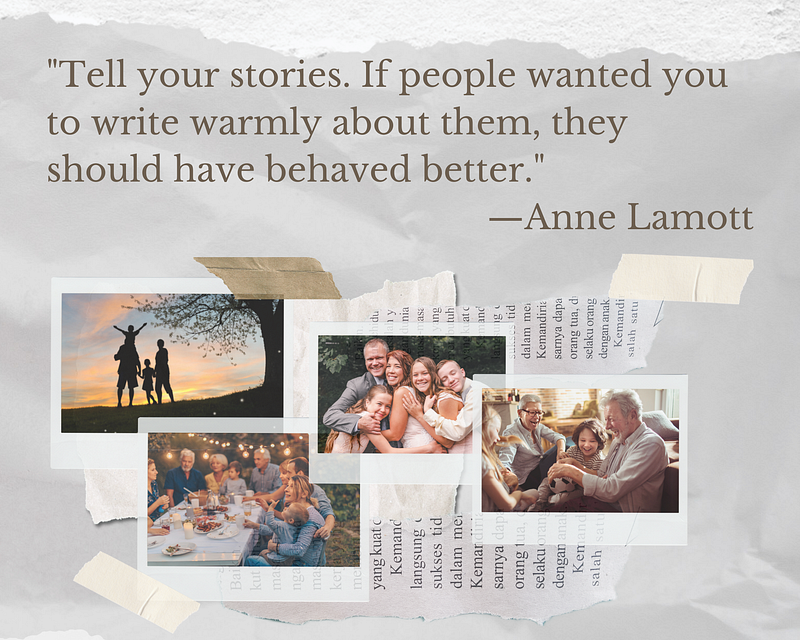
There is also the perception of writers that memoir writing is just journaling. “Who wants to read about their/my boring life?” This simply isn’t true. Not if the writing is approached creatively and with the flare of any other type of writing. Memoir writing is not journaling. It requires crafting, character development, dialogue, format, style choices, and a flow. This isn’t putting a journal out to the world. This is storytelling in its rawest form using actual experiences and characters from your own life.
That’s what I love about it. Great memoir pieces leave you feeling all the emotions of the author. You’ve taken a trip into the past along with them. You’ve watched a home movie, and your heart and mind have gone along with it. Perhaps you laughed, cringed, cried, held your breath, nodded in agreement, or something else — but it elicited some sort of internal response.
Memoir Writing Tips
If you are new to writing memoirs or looking to improve your craft, try not to think too hard about the process at first. All that worrying and comparing yourself to others is just going to block you up. Get it out of your mind. Now.
To best trigger your memories for a particular story you have in mind, or to even look for ideas, reach into your sense memory: music, photographs, smells — surround yourself. If there is a particular song that brings out that memory, put it on a loop. Don’t think, just begin to write. Looking at old photographs is a great way to find ideas for a new story. You never know where you’ll find inspiration or what will dig up a tale to tell from your past that had been long buried.
Remember, you are telling a story. A good story has a beginning, middle, and end — and it should be compelling. A memoir is not an essay where you are giving your thoughts or opinion about something. A memoir is a creative story from your past. You are entertaining. You are creating. You are weaving. You are painting.
Think about the story you want to tell but also think about the creative way you want to tell it. Think about the dialogue. Yes, you can create the dialogue to fit the narrative. No one expects you to remember exactly what was said thirty years ago. Think about your style and format. Will it be interesting to your readers and does it fit your story? Do you have an emotional arc?
As with anything, the more memoir pieces you write, the easier it will become and you’ll find your own answers regarding your approach to family and friends. And I assure you, there’s nothing like the reward of putting your creation out to the world.
Memoir writing is storytelling in its rawest form.
Your experiences. Your story. Your tapestry. You.