
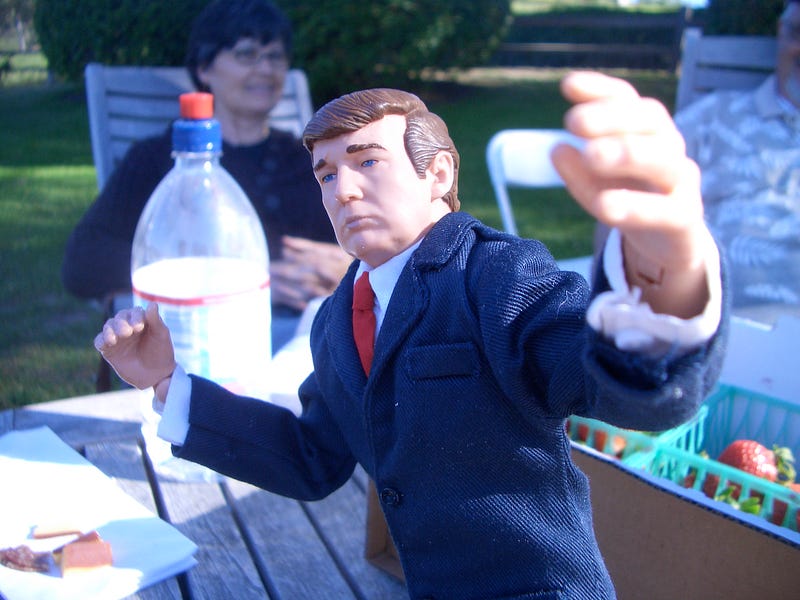
Donald Trump and the politics of nostalgia
Everybody’s gonna be very, very happy.
Let me start with a grand statement because, you know, what the hell, it’s election season: it’s a fact that the defining spirit, the zeitgeist, of contemporary politics is a profound and deeply embedded narcissism which, it turns out, blossoms from a sort of really sad and in certain ways poignant emptiness that’s really, really tough to talk about with anything like clarity or coherence.
The gist, to just go ahead and frontload our discussion, is that nostalgia functions as a societal dark matter: it’s invisible, it’s basically primitive (or it’s born from the interactions between the lizard part of our brains and our neocortex), and it binds us together with its Force-like mystique. It’s nostalgia that explains why Adele and her pop ballads about pining for long-lost lovers (you could make the argument that she’s just singing a single extended song and that, Christ, this must’ve been one absolute hell of a guy she let slip away) are so massively popular, and it’s nostalgia which governs the plotlines and story elements of blockbuster films and pretty much ensured from the very first pitch that Fuller House would be a hit, and it’s why, to make this relevant, Mr. Donald J. Trump’s campaign has been so brutally, and surreally, successful — the slogan, of course, is MAKE AMERICA GREAT AGAIN, and it’s that last word that offers the clue: it’s steroidal conservatism, George W. Bush if Bush were Godzilla, Trump through a neat trick of physics taking us into The Future via The (Golden) Past. Even the way he speaks — the cadence, the repetitions, the Trump Stump — bears his basic message of Return out.
That message, to be succinct, is this: Remember when things were simple and we were all happy? Well, if you elect Trump, we’ll go back to that again!
Again.
It’s a message that resonates — and not just with Republicans: witness the rock-star popularity of Bernie Sanders, whose super-reductive corporations-are-evil-and-so-are-rich-people sermon (which he’s been preaching for decades) has connected with his supporters in what feels like a much deeper way than Hillary Clinton’s pragmatic protect-Obama’s-legacy message has with her supporters. Bernie’s message is extremely simple, it’s Manichean, in fact, and his disheveled, angry appearance* is consistently prophetic. Hillary’s politics, on the other hand, are (let’s call it) complicated and really sort of Republican at times, and she smirks a lot, and her presidency would be dynastic in a not-so-subtle way. And too, frankly, Fighting for us is nowhere near as fun a campaign slogan as #FeeltheBern.
That message, to be succinct, is this: Remember when things were simple and we were all happy? Well, if you elect Trump, we’ll go back to that again!
The argument advanced here, albeit in a roundabout way, is that simplicity is central to political rhetoric, and that it’s connected to the nostalgia used to deflect and/or distract from our Big Deep Terrors about Life, the Universe, and Everything. That (mostly white) anger that Trump has used to propel his campaign, that’s got pundits and politicians on the left and the right making comparisons to Hitler and various other twentieth-century fascists — it’s fueled, I think, by fear. Not of socialism or terrorism, but of reality itself, which is both way bigger and much tougher to see or talk about, of the complexities involved with daily living.
A society is a wickedly difficult thing to explain — just go ahead, if you don’t mind, and think about it for a minute or two. If someone asked you what a society is, how would you respond? Even explaining why it’s tough to explain is tough: there are just too many moving parts to grasp the whole; it is a massively complex enterprise, both noun and verb, process and the sum of that process. And basically, socioeconomic issues derive directly from misinterpretations or malfunctions of society, malfunctions that are inevitable because, as we’ve said, society is massive, an ocean of interlocking gears performing a near-infinity of functions — society, American society in particular, is really, really big, is the point.
Okay, fine, I can see that you’re saying, but come on, what’s this esoteric mumbo-jumbo have to do with Donald J. Trump’s campaign for the presidency?
Well so, the point is, it’s this complexity that’s at the core of what Trump is suggesting: his plan to MAKE AMERICA GREAT AGAIN is to make America understandable again (whether it ever actually was is, of course, probably not even debatable: it wasn’t). Societal complexity is framed as an issue that needs resolution, and Trump’s suggestion to resolve the complexity-of-society-and-its-resulting-malfunctions is, in a neat tautological trick, to just make it simple again, duh!
There’s a little more to it than that, actually. By “simple” and by “understandable,” what I really mean is that Trump’s goal is to sell us something (“everybody’s gonna be very, very happy,” and “you’re gonna love it,” he keeps insisting, in that super-eerie won’t-take-no-for-an-answer tone of voice, like a used car salesman’s attempt at flirtation). A simple America is America-as-product — at the heart of his message, in other words, is the businessman’s belief in the voter-as-consumer. That massively complex enterprise we term society is reduced to an item on a shelf. The deeper implication is that we know consumerism: we understand it and we’re comfortable with it — e.g., the way everybody just sort of intuitively knows their way around Target, or like how Thanksgiving’s really just become the prelude, the Christmas Eve, to Black Friday. Framing his message this way artfully slides around the basic fact of our existence: that it’s complicated, and often unpredictable, and scary for precisely that reason. Managing this complexity is what a government is supposed to help its citizens do. And I’m struggling to explain this, but I think there’s a distinction that needs to be made between managing complexity and ignoring it (or neatly substituting some bullshit origin myth of America as populist-paradise), as Donald J. Trump appears to be proposing.
A simple America is America-as-product — at the heart of his message is the businessman’s belief in the voter-as-consumer.
Possibly this line of thinking doesn’t strike you as particularly profound or new. You could make the argument that ALL politicians are attempting to sell something: that this is just the way our election process works. Of course you’d be right on, but I’ll submit this: What’s frightening about Donald J. Trump is how very open he is about the election as a transaction between seller and buyer. The fear is that, if this ultimately works as a strategy, then every election going forward will be framed in these terms: we’ll have a new default worldview, in other words — one that’s based on laziness, and selfishness, and the complete inversion of JFK’s famous ask-not-what-your-country-etc. formulation. Words and phrases like service, like community, like the common good, already greatly diminished in meaning, already probably going the way of the dodo for an enormous share of the voting public, will basically, finally, drop off the cliff, replaced with rhetoric that is undeniably empty, with a campaign process that makes for really good and compelling reality television: imagine the Republican primary debate of the future, in which ten Donald Trumps take the stage, each fervently defending the size of his dick and threatening to “open up” libel laws. **
But guys, this is already happening.
On the Trump for President website, which I think everyone should visit despite the fact that it’s whitewashed and nearly wholesome compared to his stump speeches and tweets, you will discover a number of brief little video clips of Trump, with skin so orange that his hair actually looks blond, talking about the “issues.” The following is what I mean when I say empty rhetoric:
(1) Trump on drug addiction: “Believe me, I’m gonna solve the problem…The people that are in trouble, the people that are addicted, we’re gonna work with them and try and make them better, and we will make them better.” (2) Trump on gun-law reform: “We’re not gonna let it happen, we are going to protect our second amendment. If I’m President, you can count on it, one hundred percent.” (3) Trump on unifying the nation: “I will unify and bring our country back together. It’s something I’ve done all my life. I get along with people. A lot of people don’t know that about me…we will be unified, we will be one, we will be happy again.” (4) Trump on the military: “I’m gonna make our military so big, so powerful, so strong that nobody, absolutely nobody, is gonna mess with us.” *** (5) Trump on how he will create jobs: “I will tell you this, and I can say it with certainty: I will be the greatest jobs producing President that God ever created. I love the subject, I love doing it, and I love helping people.”
That these are the messages resonating with a surprisingly large segment of voters is disheartening — Trump is perceived as “telling it like it is” and to be fair, every once in a while, he actually does — his routine about politicians as puppets to special interest groups, and his surprisingly progressive (for a contemporary Republican candidate) tax policy proposals have scared the GOP establishment shitless — but more often he says stuff like what’s quoted above or else just outright lies (a full 77% of his statements evaluated on Politifact have rated as Mostly False or worse), or he calls journalists and fellow candidates “dumb,” or he claims Mitt Romney would have “gotten on his knees” for Trump’s endorsement in 2012, or he takes a disturbing amount of time to disavow the endorsements of his campaign by white supremacists, and etc. Or else he speaks of an America based on his interpretation of the past, his nostalgia: an America that’s classless, sure, but also white — very, very white — and exclusionary and belligerent; an America that openly commits war crimes to keep its citizens safe, in which Mexico will somehow fund the construction of a yuge wall along the southern border of the US, and Iran’s economy will be sanctioned to death, and Obamacare will be repealed and replaced with a totally free-market healthcare system, which in theory would drive down the costs of healthcare, but in reality, look no further than the Great Recession if you’d like an example of how well an unregulated market could work.
It’s precisely this unhappiness, formless and deep, and ball-clenchingly scary, that Donald Trump preys on, as a salesman.
And above all else, he tells us, we will be happy, we will love it, because he will take care of everything: the implication being, of course, that there’s no need for you to struggle with the details, not anymore, don’t sweat the small stuff, citizen! — Donald J. Trump will be your Father and your Mother, a vote for Trump is a vote for America as idyllic childhood, as basically one long Peter Pan movie, in which the fears and anxieties of daily adult living are nonexistent because Trump via sound free-market principles and artful dealing has resolved them away and has even built a literal wall around you, and the idea of Death, of real death, is not just absurd but inconceivable, and so now, sweet child, it’s nap time, lay down and rest your eyes, and listen to the soothing sound of Papa Trump’s voice as he sings a lullaby just for you and for no one else.
The other implication of Trump’s We Will All Be So Happy Together message is that we are, at the moment, not so happy, nor are we particularly together. This one is serious and true, and it’s what makes Trump’s campaign so dangerous. You already know the details: the widest income inequality since just before the Great Depression, the “patriarchal capitalism” which increasingly rewards born-winners and is engendering a real life American oligarchic class and, on the flip side, punishes those already losing in so many social, economic, and psychological ways that I’d just rather not even go into it. If there’s such a thing as happy, it’s not us. And it’s precisely this unhappiness, formless and deep, and ball-clenchingly scary, that Donald Trump preys on, as a salesman. And what’s so sad and poignant about all this is that we’ve reached a point, as a collective and as individuals, at which just the phrase “you’re gonna be so happy” resonates with a full third of US adults. Because that’s how profoundly unhappy they are, a term I take to encompass personal and political frustration, and existential fear, anxiety, depression — that dreary, industrial-era-Britain-in-winter region of the human emotional spectrum. When this fact is fully grasped, is it any wonder that Trump’s empty, childish promises of happiness, and his juvenile behavior in debates and at rallies****, have resonated with a large population of people disillusioned with the rigors and difficulties that go along with trying to be a grownup person in an incomprehensibly big society? Is it any wonder that, as one’s faith in America as a benign and opportunity-laden and meritocratic and basically fair system is eroded, and one’s complaints and concerns go unheard, that a vulgar temper tantrum starts to seem like, if not a good idea, then at least maybe a promising new tactic?
Donald Trump, unlike his opponents, both Democratic and Republican, is asking a very simple question: when, my fellow American, were you last happy — like truly, brainlessly happy?
Then hell, why not, he’s suggesting: let’s be children together.
NOTES:
*Both in demeanor and appearance Bernie Sanders seems like a guy who’s just had a LOT of trouble getting through the security checkpoint at the airport
**Like something out of a Mark Leyner novel.
***How he plans on doing this, while also slashing the tax rate across all income brackets dramatically (Trump’s tax plan does have a couple of kind-hearted/reasonable proposals: (1) closing the corporate loopholes (although, again, this is less of a big deal when you’re also dropping the corporate tax rate a full twenty points, as Trump is proposing to do), and (2) a zero percent tax rate for families with $50,000 or below in annual earnings), and balancing the budget, is along with the inner workings of black holes, among God’s great mysteries.
****Equally telling are the just-as-juvenile reactions of his opponents.