
Don’t Gobblefunk around with words.
Rudyard Kipling said words are ‘the most powerful drug used by mankind.’ He was right. The use of words to create stories is one of the most distinctive things about us. Academic literature differentiates between humans and chimpanzees by saying that ‘chimps are unable to talk about things that are not present’. We, on the other hand, evolved language to enable us to ‘share episodes….about who did what to whom, where, when and why.’
For eons, we’ve used words to tell tales that touch us, move us, make us laugh, make us think and occasionally reach into our chosen means of carrying money. Elegant yet simple language has been the hallmark of some of the greatest storytellers in history — from Shakespeare to modern brands. ‘All the world’s a stage’, ‘Just Do It’, ’That’s one small step for man….’, ‘Because You’re Worth It’ and other phrases have, through simplicity and repetition become ingrained in our brains and in our culture.
Yet recent years have given rise to a sort of linguistic barbarity. We squeeze every ounce of meaning out of a word or a phrase. We’ve created a dystopian landscape where words like disintermediation, gamification, paradigm shifts, ideation, intrapreneurs, bleeding edge, mavens and their obnoxious and overused bedfellows don’t just exist — they’re thriving.
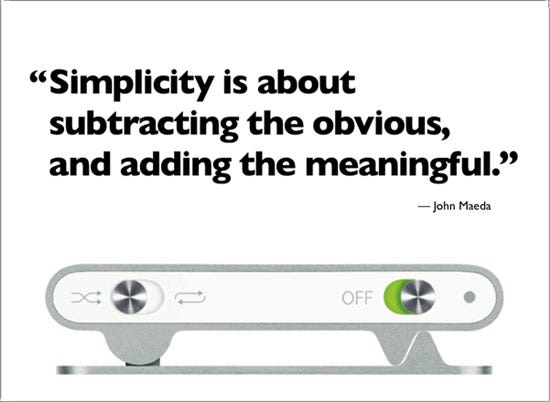
It’s the polar opposite of what John Maeda advises in the Laws of Simplicity. We consistently subtract the meaningful and add the obvious. More syllables. More clutter. More management speak. More buzzwords. Less clarity.
It’s as if we’ve forgotten why we use words and language. Every business, whether it’s B2B, B2C, Fintech, AgTech or another hashtaggable portmanteau needs to tell stories. Who are they? What do they do? Why should I trust this group of people with my personal data? Why should I try this? Why should I buy this?
Using buzzwords and management speak might make people nod sagely in a conference scenario in between yet another case study about user acquisition and a ripoff of a Ben Evans /Mary Meeker presentation. When it comes to talking to real users, real customers and real people, this morphological mangling is more like to make people pull a McKayla Maroney.
People give out about companies describing themselves as ‘Uber for x’, but at least a significant chunk of the world will understand what they do. If they were to read about a paradigm shift in disintermediated, crowdsourced platforms that curate listicles, they would perhaps be slightly more confused.
We’ve had 10x engineers. We’ve had growth hackers. We’ve watched gamification’s journey around Gartner’s Hype Cycle. Along the way, we’ve Hannibal Lecter-ed the English language. We’ve dissected, disassembled and degraded it. That needs to stop.
It’s time to make things clearer. It’s time that we made the language we use in business simpler, more meaningful and more effective. This applies to everything from app descriptions and Facebook posts through to user-lifecycle emails and every line on every page in presentations, documentation, websites and elsewhere.
Need some help with that? Let’s call in two of the greatest writers ever to advise — Roald Dahl and George Orwell.
The BFG is one of my all-time favourite novels. It also contains one of the most prescient pieces of advice that you’ll ever read about language. The eponymous character tells the heroine, ‘don’t gobblefunk around with words.’ It’s confusing, counter-productive, off-putting and it doesn’t make you look smarter, funnier, more investable or more innovative. Frequently, it does the exact opposite.
George Orwell created six simple guidelines for writers to follow ‘Politics and the English language’:
- Never use a metaphor, simile, or other figure of speech which you are used to seeing in print.
- Never use a long word where a short one will do.
- If it is possible to cut a word out, always cut it out.
- Never use the passive where you can use the active.
- Never use a foreign phrase, a scientific word, or a jargon word if you can think of an everyday English equivalent.
- Break any of these rules sooner than say anything outright barbarous.
That’s worthwhile advice.
It’s time to end the bloodsport that is linguistic barbarity. It’s time we stopped gobblefunking around with words. It’s time for simplicity and clarity. Your users will thank you. Your prospective clients and customers might just buy from you. The wider world will understand you. They might even end up loving you.
—


