Domain Specific Languages: Introduction
A simple definition of a DSL, an example in both Java and Kotlin, and a demonstration of the unexpected way a DSL actually becomes a DSL.
— — — — — — — — — — — — — — —
THE CURRENT VERSION OF THIS ARTICLE IS PUBLISHED HERE.
— — — — — — — — — — — — — — —

Tags: #FUNDAMENTAL CONCEPT
This article is part of the Kotlin Primer, an opinionated guide to the Kotlin language, which is indented to help facilitate Kotlin adoption inside Java-centric organizations. It was originally written as an organizational learning resource for Etnetera a.s. and I would like to express my sincere gratitude for their support.
It is recommended to read the Introduction before moving on. Check out the Table of Contents for all articles.
To some, DSLs — domain specific languages — can appear to have a mystical quality. One of those things that you hear about, but maybe treat as a form of esoteric programming knowledge which has no business being used in the real world. This is actually far from true, and in fact we will see that DSLs are just a special name for something you already do every day. However, in order to banish any sort of black magic feelings you may have associated with DSLs, let’s start by giving a simple definition that strips away the magic:
A DSL is a set of functions which are named after intuitively clear behaviors in a given context.
That’s it. For instance, in the context of list creation, we might have the functions add, addAll, addIf, addUnless, which together would constitute a DSL. It is intuitively clear what they do.
What’s important to understand is that Kotlin has no special features that somehow allow you to design DSLs that are not possible in other languages. The only thing that’s special about Kotlin is that it allows DSLs to be used really nicely. And you might be surprised to learn that you already know everything you need — there are no new Kotlin features involved.
To really drive home the idea that DSLs are nothing special, and “can be done” in almost any language, we’ll first implement the above-mentioned list-creation DSL in Java.
Simple Java example
There are two steps to creating a DSL — design and implementation. Designing a DSL basically means deciding which words to use, and that requires some thought about the problem domain. However, we will see later that it is in fact very similar to the thought process that goes into (or should go into) designing a class. Indeed, we will see that in fact, every properly-designed class basically defines its own DSL.
Implementing the DSL is the “easy” part — you just implement the words you decided on, and bundle them together somehow. And since the only way you can bundle functions together in Java is by putting them in a class, that’s what we’ll do. I’m going to syntax-highlight this example, to make it easier to read.
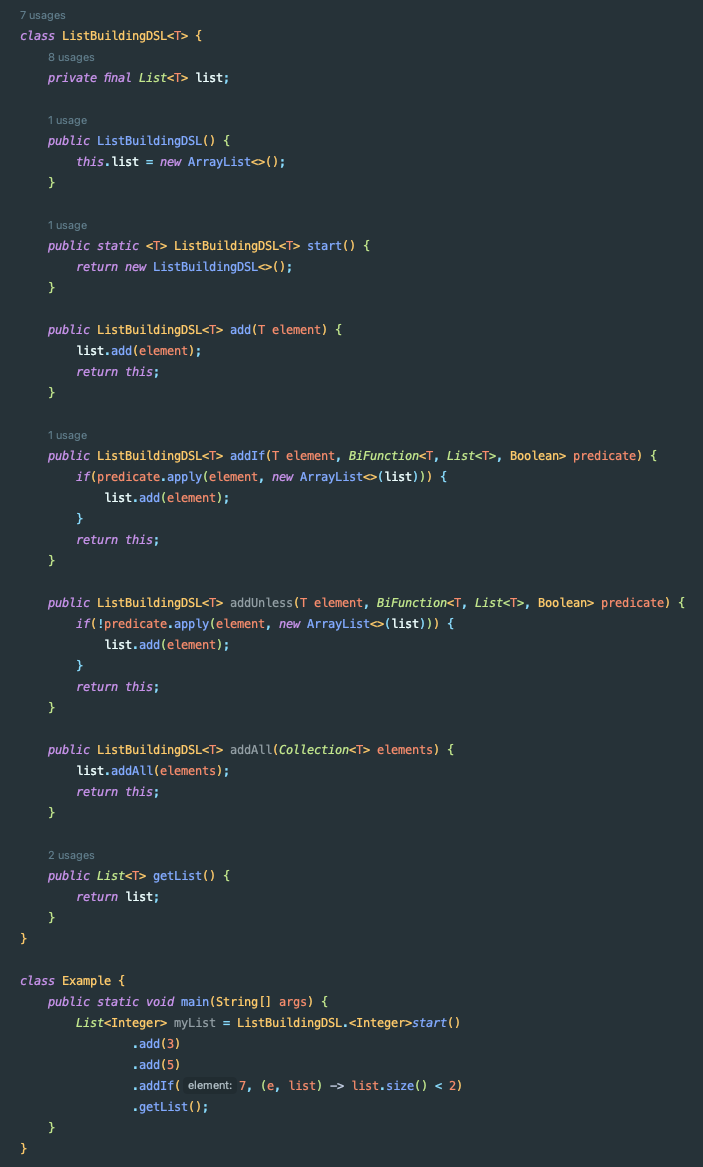
Ta-da.
At this point, you’re probably overwhelmingly underwhelmed. Basically, what we did is create a builder. Woo.
Kotlifying the example
Let’s migrate this to Kotlin, and see if we can make things prettier and more “DSL-like”.
(Just a quick aside, even though this is only a direct migration of the Java version, notice how much cleaner the code is already? Kotlin is awesome!)
It still seems like we’re nowhere near what we would consider a DSL.
Now, let’s make one small change:
Woah, that escalated quickly. With one small change, we went from “nothing-remotely-like-a-DSL” to “sort-of-like-a-DSL”.
We’re still not quite there. One thing that really looks just horrible is having to return list at the end. So let's fix that:
And while we’re at it, do we really need to pass a new instance of ListBuildingDSL every time?
And, frankly, we could pretty much say we’re done — this is a DSL by any reasonable definition. It allows us to build an immutable list using “mutable semantics”, which is cool (in fact, it’s cool enough that it’s part of the standard library).
Crucially however, notice that we didn’t touch the class definition at all. Everything inside the class stayed exactly the same and in fact, almost nothing would change if we just used the previous Java version and called it from Kotlin (apart from nullability).
So what exactly happened? Continue to the next article to find out!
Go back to Scope Functions: Closing Remarks & Exercises, jump to the Table of Contents, or continue to Domain Specific Languages: How To Make Your Own.