
Dogs Behaving Strangely
Do our four-legged friends have psychic abilities?

I was once helping an old lady with her garden when her neighbour walked past with his two black Labradors. We said hello, and then I continued helping the 92-year-old with her work. When the gentleman returned ten minutes later, I noticed one of his dogs was missing. So I asked him what had happened to it. He told me it had died the previous week.
Feeling perturbed, I commiserated with him and told him that a few minutes earlier, I had seen two black dogs at his side. Had he recently acquired another one? He looked at me amused and then told me no, there was only his one dog. I apologised for my mistake, but he saw the funny side and then became somewhat pensive. Perhaps, he said, the late departed dog was still by his side, in spirit, as it were.
I spent the rest of the morning working in the garden, worrying about my hallucination. I had already seen this gentleman with his two dogs, many times in the past. Perhaps I’d conjured up his late dog as an expectation. I was, after all, fatigued at the time. I kept looking up every few minutes, expecting to see a ghostly mutt staring at me from behind the fence. But I never saw it again. I’m glad to say I’m not the only one who sees departed dogs. But in most cases, it’s the grieving owner of the dog who sees its ‘ghost’ and not some random person like myself who’s unconnected to the loss.
A Telepathic Dog?
Sometimes it works the other way round, and it’s the dog who ‘sees’ the death of its owner. Here’s a typical example from a Swiss veterinary surgeon about a fox terrier. He tells the story of a woman he knew who was walking to her village with her terrier. Suddenly the dog stopped walking and let out a series of howls and whines for no discernible reason.
After a while, he stopped howling and then resumed his walk with the woman to the village. When she returned home later, she found her husband dead, lying on the floor. She imagined the dog had let out its strange howls at the moment of her husband’s heart attack.¹
Carl Jung’s Psychic Dog
Carl Jung had a psychic dog, or at least, he did if you happen to believe his friend, Barbara Hannah. Jung was told by his doctor to take long walks to help him recover from an illness. So he went off to his country retreat to recuperate. He left his dog in the care of his secretary at his house in Küsnacht. It was a large Schnauzer with a mustache, by the name of Joggi. Jung considered his dog too old for long walks. Plus, it had a habit of getting up and wandering about in the night asking to be let out. The family believed it was kinder to allow the elderly dog to remain in its familiar environment.
When Jung was off at his holiday home, one of his fellow analysts asked Barbara Hannah to stop by his house in Küsnacht to collect some papers from Jung’s secretary. Hannah went to his house and parked her car. She then entered his house to collect the notes. When she returned to her car, she found Joggi sitting in the passenger seat. She’d left the door open, not expecting the dog to enter the vehicle. It wasn’t prone to jumping into cars. She couldn’t get the dog out, so she asked the secretary for help. They both failed to remove the large beast from the car. They finally had to bring in the gardener to heave him out. Barbara thought that the dog was aware of her destination and wanted to go with her.²
The Dog That Led a Family to Safety
Some dogs can have the strangest sense of foreboding. Let’s go back in time to the second world war. It’s June 1944 in London. The city is suffering its first wave of bombing by V1 cruise missiles. They’re later to become known as buzz bombs and doodlebugs. Early bomb shelters have already saved many lives in the blitz, but local shelters are often neglected and damp. Family garden shelters haven’t been used since the early bombing raids of the war. A family called the Baines, are so disheartened with the mould growing in their shelter, that they’ve decided to use their house shelter at night. But this shelter is nothing more than a weak table in the dining room.
As news (and noise) of the V1s spreads through London, the family’s cocker spaniel, named Merry, decides to return to the garden shelter. During the day, it returns there three times, and each time it is picked up and removed outside. The mother of the family is at her wit’s end as to why the dog keeps returning. That night, the family decide to follow the dog’s example. Together they take shelter in the underground bunker. They’re not the only ones unnerved by the dog’s behaviour. The Baines’ neighbour, Mrs Gearing, also joins them. You’ll guess what happens next. A missile takes out part of the street, including the Baines’ family house and Mrs Gearing’s home.
The dog’s unusual behaviour saved several lives, or rather, how the family followed the dog’s lead, saved their lives.³ I imagine that Merry then became a local celebrity.
Dogs Who Know When Their Owners Are Coming Home
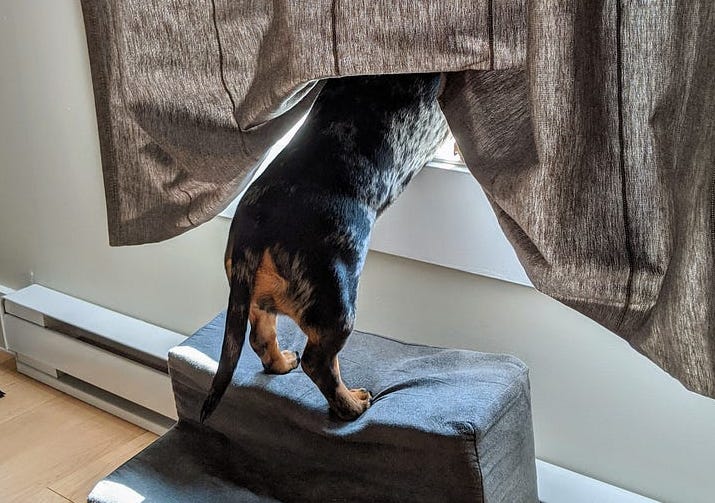
Dogs are known to wait patiently for their owner to come home. But some families find they’ll go to the window just before their beloved friend appears at the gate. Cynics would point to a dog’s remarkable keen sense of smell and how each dog in question may have an internal clock.
Regarding the keen sense of smell, the wind direction is not always blowing from the side of an approaching owner. As for internal clocks, the same odd behaviour occurs with owners who turn up randomly from work. This is something which especially applies to the self-employed.
Research scientist, Rupert Sheldrake, conducted experiments in which he studied the dogs’ behaviour. His results backed up the view that the dogs in question appear to know when their owners are coming home. He summed up his results in his book, Dogs That Know When Their Owners Are Coming Home. He cites various examples, including packs of dogs who behave similarly. For example, Elizabeth Windsor used to set off her dogs by visiting them at her Norfolk estate. They’d start barking when she entered the main gates half a mile from the kennels. According to the head gamekeeper, they never did the same with anyone else.⁴
Sheldrake retells the story of a German woman married to a forester. She had no idea when her husband would be home. But her dog knew and it would become restless and sit by the door. She used its behaviour to time the making of their dinner. More striking examples occur with spouses coming home from leave, after months at sea.
The strangest example from Sheldrake’s tests was one in which a cross-terrier called Jaytee, was videoed. The dog didn’t just anticipate the irregular return of its owner. It even seemed to respond to the owner’s intention to return home. The test results for this dog and owner show a notable deviation from the anticipated statistical mean.⁵
Bistami’s Dog of Humility
Dogs have much to teach us about humility. With no sense of self-importance and little sense of language, they rely on instinct and intuition. Perhaps it is for this reason that they are seen as guides to the dead and the underworld. Although certain aspects of a dog’s behaviour may repulse us, we cannot deny our connection to their animal nature.
According to the Sufi tradition, there was a man called Bistami who conversed with a dog. The dog asked him why on earth he should hoard a barrel of wheat for the future. ‘Look at me,’ said the dog, ‘I don’t even hoard a bone.’ The idea of seeking guidance from a talking dog was too much for Bistami. He cried out in dismay, ‘I am not even worth being the companion of a dog, how then can I be the companion of the eternal? Honour to God who educates the best creatures (humans) through the lowest one’.⁶
So it’s the dog who brings the mystical Bistami off his high cloud and back down to earth. Jung summed up a similar relationship with his views of Brother Klauss: ‘Thus the saint casts an animal shadow’. Our experiences with ‘telepathic’ dogs also have this same humbling effect. They put our clumsy ego to one side and help us to wonder about the nature of unseen forms of communication.
Dogs have been with us since Mesolithic times. So is it any great surprise that they also turn up in relation to possible psi phenomena? They are, after all, part of the family.
References: 1 — Aniela Jaffe, An Archetypal Approach to Death Dreams and Ghosts, pp. 125 — 126, Daimon, 1999. The account is taken from the Schweizerischer Beobachter, mid-1950s. 2 — Barbara Hannah, Jung — His Life and Work, pp. 255 — 256, Perigee, 1976. 3 — Andrew MacKenzie, Riddle of the Future — A Modern Study of Precognition, pp. 99 — 105, Arthur Barker, 1974. 4 — Rupert Sheldrake, The Sense Of Being Stared At — And Other Aspects of the Extended Mind, p. 83, Hutchinson, 2003. 5 — Sheldrake, p. 85. 6 — The story is retold in ‘The Speech of the Birds’, Jacquie Flecknoe-Brown, Harvest, pp. 57–58, C.G. Jung Club London, 2017.