
Dogs
Dogs Assign Different Meanings to Words and Then Train Us
They understand more than we think
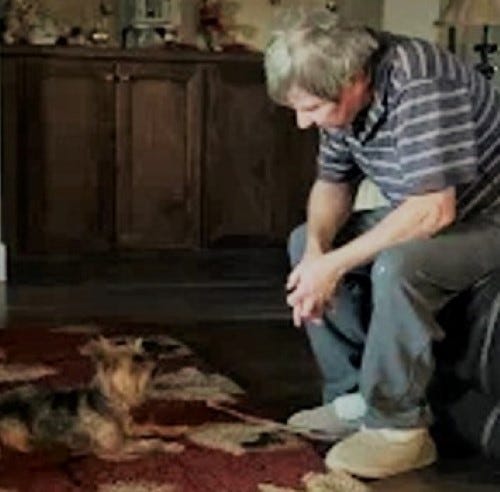
While talking to my daughter, I asked her if she would like to join me on a W — A — L — K. A pause interrupted the conversation and then she asked, “Mom, why did you just spell walk?” I explained that once I say the word aloud my little girl becomes a permanent appendage until I follow-up on her expectations. Simply hearing the word “walk” translates to “I have leash in hand. Let’s go.” I had forgotten my daughter’s dogs are English Bulldogs, therefore they have a stronger command of the language.
When I explained this to my daughter, she pointed out the error in my logic. Yorkshire terriers originated from England; therefore, Dagney should have an equal command of the language. Something for later thought. I have determined Dagney is a smart girl, top of her class. Her intelligence astonishes me daily. Though she does not speak words in English, she understands. Thus, we either spell “walk” or substitute a synonym such as stroll. My husband and I like to think we outsmart her, but it seems we are the ones changing our behavior, not her.
Vocal commands
Come
Training our puppy proved difficult in several ways. Thank goodness potty training was a breeze because the synonyms for potty are not great for public use. She still struggles with the command “come.” It does not prompt her to advance towards us. Unless the word is joined with an incentive, usually a piece of a peanut, she remains deaf. I believe she learned selective hearing from my husband who also requires motivation to perform. Though through trial and error I have learned a beer is a more effective bribe for him than a peanut.
To teach Dagney to come, we went to the extreme of sitting on the living room floor, saying come, and rewarding her with tiny treats. She had us trained in no time. She was eventually jogging between us to get her snack; we did not even need to say the word. Then when she went outside, we called, “come” expecting to be rewarded but instead observed absolutely no reaction from her. Well, there was a reaction as she chased a squirrel up a tree, just not the desired reaction.
Treat means come
During training, when Dagney wandered away chasing squirrels, collecting pinecones, peeing on each and every shrub within the boundaries of our underground electric fence, she lapsed into a trance and didn’t hear us calling. Interesting though if I shouted, “Treat” she ran with feet barely hitting the ground. It seems this “treat” means “come” in her vocabulary. Clarification for anyone who just read “underground electric fence and panicked; she never gets shocked. As mentioned, her critical thinking abilities are amazing. After a trench was dug around our half-acre plot, the wire placed underground, and flags staked to mark the boundary, she has shown no desire to cross the boundary line. She quickly identified the beeping sound that emitted when she was close as a do not enter warning. Now, there is no need to even turn on the electricity because she stops at the flags. If we had known this would work so well, we would not have had to work so hard and could have saved a lot of money by investing in a beeper and some flags. Maybe our lesson will help somebody else.
Stay, lay, and roll over
She learned to stay, lay, and roll over easily. In fact, when I say “sit” she instantly does all three without further commands to get her reward, something deliciously edible. Now, when showing her skills off to friends we simply say sit, watch the whole routine and then act like her response is exactly what we planned. Anyway, based on this response I claim she understands all three commands.
Sit means hover
The most valuable command she knows is “sit”. Each day on our walk, we practice it at each intersection. Dagney has learned when the sidewalk ends, she is required to sit. She translates the word “sit” to “hover” because her butt never touches the ground. Unless the area beneath her posterior is carpeted, she performs an Olympic quality squat, front legs firmly planted and back legs bent just far enough to appear like she is sitting but without contacting the surface. She hates hard surfaces.
Her ability to perform this command quickly and effectively make me happy. However, she has not demonstrated an understanding of how long to hold this position. Of course, I want her to sit until she is released by my voice. She looks both ways, that’s good, but then as soon as a car passes, she ventures into the road. We are still training her on the importance of knowing if a second car is approaching before she bolts forward.
Body Language
Dagney’s greatest strength in communication is her ability to understand body language. If I open the treat jar on the counter, she appears at my feet. When I walk to the mudroom, she sits — on the carpet — waiting to be adored in her vest and attached to a leash. She seldom bothers moving from her state of relaxation to sit on my lap until the chair is reclined and my feet are raised because she understands my relaxation is temporary until I assume the position. Then she jumps up and lays between my legs.
When my husband lost the TV remote in the cushions of the recliner, and he stood up to retrieve the flashlight, Dagney jumped down to help. She climbed under the chairs, jumped on the circle of light on the floor and licked my husband’s nose. She understood the beam of the flashlight beckoned her assistance. While Randy did not see her behavior as helping, he couldn’t help but laugh at her urgency to participate.
Our little girl is spoiled; however, we established one boundary, maybe the only one, she doesn’t eat when we eat. She gets her treat immediately after we finish. She may be laying on the bed in the backroom, seeming aware of what we are doing, but the moment we stand up to place the plates in the sink, she appears. We never ask if she wants a treat, instead our body language signals doggie dessert time.
Her communication skills
I would go so far as to assert we understand Dagney, or least we obey her commands better than she does ours. If our legs are crossed, she scratches one time to demand they stretch out to accommodate her body. When she wants to crawl under the blankets, one scratch on our pillow alerts us to what we must do, raise the comforter. A scratch on the rug where her food dish rests means she is hungry. I have finally determined her running in the opposite direction when I am calling her name or saying “come” means she wants a treat.
A dog understands what is being said. They understand what their humans want then they change the meaning of the words and teach the humans the new meanings. With close observation, the truth is clear, as soon as we do what the dog wants showing we are trained to their liking, our dogs have completed obedience school.
If reading about pets brings a smile to your face and swells your heart, I invite you read more stories about Dagney. She provides non-stop entertainment in our home.
You might enjoy Dagney’s new book. A collection of stories with Dagney as the main character.
Live a Satisfying Life by Doing it Doggy Style is now available on Amazon.
Between the covers readers will enjoy
· 28 chapters
· 87 colored pictures
· 40 inspirational quotes
· Dozens of life lessons
· Journaling activities
· Tons of laughs
Perfect Christmas gift for a dog lover or yourself.