Dog Food
The phone rang, pulling me from an insentient sleep. My first good night of slumber in a long time. I rolled over and covered my head with a pillow, hoping it would go away. It didn’t.
“Hallo.”
“It’s Bill. Carrie has a fever, and the hospitals won’t accept her.”
“What do you mean the hospitals won’t accept her?”
“It’s the virus. They don’t want to risk the publicity of having a case.”
Nothing seems real until it’s close. My sister had the Columbus virus. Aptly named because it went from continent to continent, leaving destruction in its wake. I didn’t know anyone who had been infected, but the news covered it twenty-four hours a day. We spent a lot of time pointing our fingers at the media, blaming the messenger.
Now my sister had it, and only some hospitals offered treatment, while others advertised no cases and kept their government funding as well as their select clientele. Only healthcare workers knew that hospitals were turning people away, and hospital administrators had forced everyone to sign NDAs. NDAs had taken a new life in this climate to hide everything from fraud to responsibility.
I pulled myself out of bed. The room was warm and humid, and the sheets stuck to me as I sat up. After slipping into a pair of jeans that I had left next to my bed in a drunken stupor, I proceeded to pull a t-shirt over my head and stopped.
My thoughts went to my sister but mostly to myself, and I removed my shirt, turned off my phone, and went back to bed. I wasn’t proud of it and stared at the ceiling until I fell asleep.
The woody tang floated atop the icy breeze that gusted toward me. Swaying drapes in tatters signaled its approach. It stopped me, and I took in the chill. The voice seemed to travel with it.
“Here!”
A table, set with silver and a covered platter, flickered into existence. With a spark, the room savored of steak, freshly baked bread, and a buttery sauté. A waiter appeared and removed the plate’s covering. When he did, I smelled decay, and a rotting head lay on the plate. It’s eye torn from the socket and dangling beside its swollen blue nose.
I woke sweating and gasping.
That morning, the phone remained off, and I posted nothing on social media. It would have to be this way for a while. In the news, rats were feeding on cats and cats on the corpses in the street. I lived on the twenty-third floor, and some smells that wafted to my apartment carried the undeniable stench of death. It had been a long time since I had been out, but I knew I’d have to brave the apocalypse at some point.
Water and electrical services faded in and out, and many of the news outlets were down. My generator was ready if I needed it. I had stocked the pantry well before the crisis, but the dwindling cans alerted me to the possibility that I might have to leave my sanctuary to find food. The truth was that I wasn’t eating much. One meal a day, straight from the can.
My phone had been off since my sister’s husband called, so I never heard how my sister had faired. Sometimes, I thought about her, but most often, I thought about myself. I wondered what I would do when I ran out of food. I thought about facing the people outside, and I wondered whether the power, water, and internet in the building would hold out. Everything had changed over the past three months, but the violence hadn’t affected me yet.
Every morning, I woke, read the news, ate a can of beans, and exercised by walking up and down two flights of stairs for a half hour. My days wasted away as I sat before a tablet on the internet, reading hyped news and shock stories.
The dreams continued. Always the same house. Always the same voice. Only the food and decay were different. The voice was growing louder with each dream, and its owner felt closer.
On day one-hundred-forty-seven I woke knowing that my last can of beans was waiting. I didn’t open it. Instead, I went for my stair walk and checked my news feeds. I think everyone had become numb to the violence and death. Watching the news had become almost entertaining.
I had decades of TV, movies, and video games at my fingertips, but the news — that gave all of us a rush. Watching people wave weapons at each other defending their property, or watching cops take down a peaceful camp, usually driving people out but sometimes slaughtering. It had become a form of entertainment that we craved.
I went to bed that night without opening the last can of beans.
Once again, I took in the cold bluster. Stopping, I waited for the food to appear. The room trembled as it always had, but this time, there was no food, only a man. He stood tall and thin with a narrow smile.
“Here!”
The voice echoed in my head.
“Here!”
There was no food, only the man.
The room melted, and I stood outside. Decay hung in the air. I looked over an ancient city. Seeing the crosses, I realized I was standing atop Golgotha, looking down on Jerusalem. The man hung from the center cross, and whispered my name.
The landscape trembled and warped, and I found myself on a dirt road. A meteor whistled through the sky crashed ahead of me. It exploded in a blinding flash that brought with it heat and pain. The skin on my arms felt heavy, and I writhed in pain as it slipped from around my arms like oversized gloves falling to the ground.
I woke and sat up in bed.
Instead of going to my news feed, I put on a pair of jeans, a long sleeve shirt, mask and gloves, then headed into the stairwell. The stairs were dark in some places where lights had gone out and not been replaced. Where they weren’t dark, the lights flickered against the grey walls and steel steps.
I creaked the door open and stood in the toxic world I had so long avoided.
A crow sat on a deserted Pontiac station-wagon. It cawed, studying me while its talons scraped against the roof of the car. Then it hopped to the luggage rack and stared at me, like it knew something I didn’t.
The fetid odors of rotting flesh crept into my senses, spawning a burning in my eyes. Some buildings were still on fire, and the smoke hung in the air.
The local grocery store was gutted. Windows broken, and the sign had a looney-tunes like hole. Murdocks now was just rdocs. I opened the door and went in anyway.
Lights hung gnarled from the ceiling where cork had fallen, revealing the structure’s entrails. Cords hung through the squares, and the lights had long been off. There would be nothing here to eat.
I moved up the road. The violence had long since subsided. Most had left the city or succumbed to the virus. Occasionally, I would hear something that sounded human — or at least alive — but I minded my own business.
Cars had been left in the street, some doors left open. Probably looters.
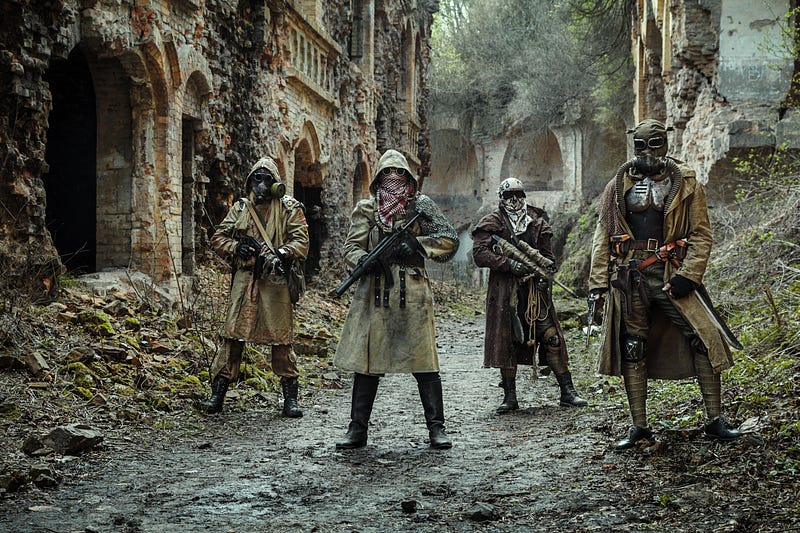
That’s when I saw her. She walked toward me, the sun at her back, and a large wolf-like dog at her side. She held a shotgun and had a holster with a pistol.
“Did you have the dreams?” She asked, looking like she might set the sights of the rifle on me.
“The dreams?”
“Yeah. Decaying flesh dreams. Over and over.”
“Yeah.”
She let her guard down a little, and when she relaxed, I sensed the dog relaxing as well.
“How long has it been since you’ve eaten?”
“Two days…maybe three.”
She moved toward me and looked into my eyes. She walked around me while the dog sat five feet away, observing our interaction.
“Three days? Why the mask?”
I started to answer, but she continued.
“You don’t know yet, do you?”
“Know what?”
“The virus is catabolized when we don’t eat, then used for food. Some are calling it the next stage in human evolution. No need for agriculture or processing. We’ve each become our own farm.” She smiled, petting the dog as she talked.
“And the dreams?”
“No one is really sure. It seems that people who don’t have the dreams can’t catabolize the virus.” She continued, “Whatever you do, don’t eat. That’s how you get sick. The body will go to the food first, and won’t have the energy to eat the virus. You’ve changed already. Otherwise, you’d be hungry. You’re not hungry, are you?”
“No.”
She knelt and gave the dog some food. “These guys still have to eat.”
Standing, she walked toward me. The last thing I remembered was her raising the barrel of the shotgun to my face.