
Does your dapp need a token?
Is it required for the systemic functioning of the system, that without it, it would not work? Like ETH to pay for code execution or REP to have dynamic membership for reporting on outcome of events?
Yes.
If it is not required, would it make sense to engineer one in anyway?
Yes (mostly, but it’s a bit more complicated).
Why?
The usual thinking is: add a token. This token becomes valuable by charging additional fees, which the token holders have rights to. The token is required to pay/dispense for services that the dapp provides. This adds additional complexity and cost to the functioning of the system in order to hopefully create a system of ownership in the dapp. Adding in ownership, means the owners can earn from the services that the dapp provides.
Would this be sustainable if the dapp can just be forked and the token structure ripped out, resulting in less complexity and lower fees?
I would argue that for dapps that require coordination to succeed it is indeed sustainable and that dapps that have tokens will succeed over those that don’t, as long as the cost introduced isn’t more than the gains in coordination.
The reasoning is that tokens have historically provided a way for people to socially coordinate. In fact, some argue it is the main reason why money exists in the first place. tl;dr Hard to collect tokens in tribes represent the in-group, and reduces costs to socially coordinate.
Let’s take the following example.
You have a decentralized exchange that’s going to launch. It’s exactly the same software. One has a token and requires additional complexity & fees. Token holders can earn from those fees. The other has no extra fees, but no token. Exchanges are coordination games, because they have to vie for liquidity (and by extension a network effect).
Which one will win?
It’s likely liquidity will drift towards the exchange with a token *and* that has extra fees. Why?
- Those that own the token will want to make their token worth more, and thus want to promote it (in-group vs market).
- Due to the nature of tokens representing an in-group (those affiliated with the dapp), they might actively at their own cost even create liquidity. They will also at their own cost promote the dapp.
- They would want the other exchange to not have liquidity, and could even try to undermine it (*cough* see some Bitcoiners hate towards Ethereum *cough*).
Once the token-based exchange has liquidity, it will be difficult for the non-token exchange to win out.
Excuse, this extended metaphor: building a wall keeps people from easily getting in, but it also reduces the cost to protect from outside. Those within the walls of the city can then specialise, and not all need to be warriors *as well* in order to protect themselves. This is at the cost of potentially, say, allowing a beneficial trader into the city, because the wall was an obstruction. In organisational terms, it’s like equity in a company (a wall around shared goals), reducing social coordination. If the market was fully efficient, and humans could contain the intricacies of market dynamics in their head on a greater scale, then less organisations would exist.
Putting a token in our hands, is a primal brain hack to make us incentivise that solution. No one is immune.

That is beneficial. However, it adds a cost. Services that don’t need coordination has more to lose from adding costs.
Take another example on Ethereum. A contract provides on-chain services to other dapps (say Nick Johnson’s String Utility library). Is there deep coordination required around a string utility library? No (not really).
Given this paradigm, it’s not obvious what these cost levels are. If you charge 1000 ETH as a fee to do a trade, it’s obviously not going to work vs the free exchange. Thus, there’s increasingly marginal return at which point, introducing *more* fees (and complexity) would reduce coordination.
Additionally, having extremely low fees might not produce enough incentive to bother going through the paces of the additional complexity.
It is thus likely to look like some bell curve.
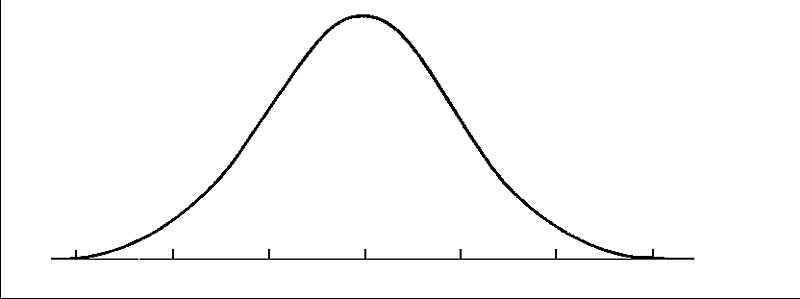
The cost to coordinate increases coordination, until a point where it starts to reduce coordination (this is a weird sentence, isn’t it?).
Figuring out what this optimal point is, is unclear to me. It’s likely that it depends on the service itself and the requirement for coordination. It’s likely that a string utility might have marginal usefulness for coordination: a more tested, more used string utility library would be useful, and figuring out what string utility library to use is a game of coordination. But, in the string utility example, the curve might be different. It could reach its peak substantially faster. Automation of tokens will also change the curve. The additional complexity of just adding a token, might already be too costly.
It might also be that as the service grows, the costs needs to change as well. A good example of this, is novelty production in information sharing systems. An IRC channel can’t grow forever. Adding costs as it grows, means coordination can remain at a novel level (less spamming when it reaches critical mass).
One can also see this tango/difficulty in coordination games in businesses, correlated to market caps. When EBay split into EBay & PayPal, the combined marketcaps were worth more than before. Coordinating around only one token won’t *ever* represent the smaller network effects completely, and it’s likely that actively attaching tokens to small network effects will empower them, and represent the proper value. It’s a function of coordination fitness.
My hypothesis around this could be incorrect, but I’m busy experimenting with this: designing a system that allows these costs to express themselves naturally, instead of there being a guessing game for coordination costs. It’s a system called Meme Markets, and it allows, natural coordination around *any* meme (#ethereum, #football, #simondlr, etc). The first version should launch in early January. I’ve finalised a *good-enough-to-test-the-hypothesis* protocol design and busy coding.
Conclusion:
Even if a token has no technical reason to exist, it can aid social coordination. Figuring out the cost of the coordination requirements for the type of coordination you want (how high to build the wall), is difficult. Building a system that could express that coordination cost naturally might help. If this works, maybe can we design coordination games that can gut Moloch itself.