
Education
Does the Classroom Create Great Minds?
When we think of the great minds that have graced our planet, one word comes to mind. That word is freedom. The ability to freely express thoughts is vital to making an impact on an intellectual level.
These individuals were often quick to question the status quo and used creativity to think differently to others. It is through having no boundaries they were able to explore landscapes that we had never tread.
In the UK, students spend 16 years in the classroom being spoon-fed educational content we have decided for them. On top of that, we encourage them to spend another five years more in education to get their degree.
After graduating, our students wear their gowns as a badge of honour. They can say they have completed education and are now intelligent individuals.
But, Albert Einstein had something different to say about graduating from university. He stated this after leaving the education system:
“I found the consideration of scientific problems distasteful to me for an entire year.”
Imagine that! Albert Einstein, one of the greatest scientists in history, hated the subject for a year. Why you might ask? Well, like many other intellects, he hated the schools for their forced ways of teaching. He believed it dimmed curiosity and made us less likely to question things. He writes:
“It is, in fact, nothing short of a miracle that the modern methods of instruction have not yet entirely strangled the holy curiosity of inquiry….”
I would have to agree with Einstein here. I have been public schooled my whole life, and I never thought to question much. It was only until I had a period away from the education system I found my intellectual curiosity.
So here is why public schooling is hindering the progression of great minds in society. It has to do with two things. The first being passive learning, and the second is authoritative leadership.
Passive Learning Dims the Mind
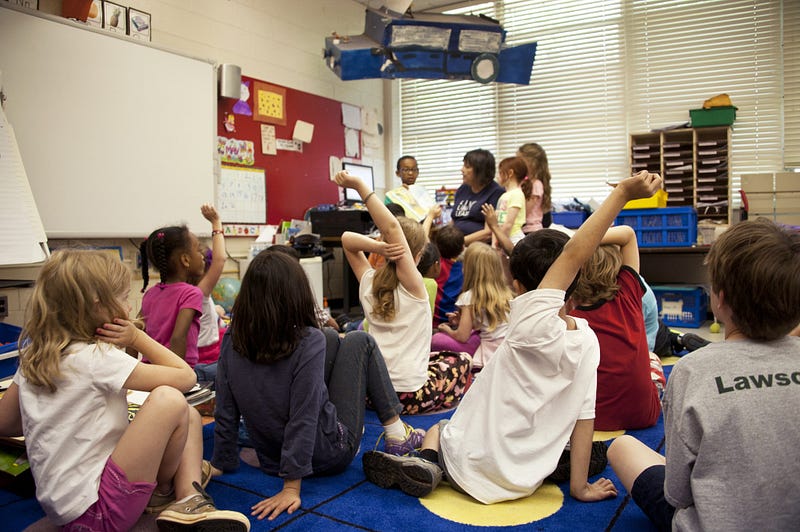
The whole education system is built on the structure of passive learning. Students are to listen and take notes down. Many students who ask tonnes of questions are viewed as disruptive or annoying.
The classroom is not the best place to ask questions anyway. For shyer students, they are less likely to raise their hand. And students may feel anxious to ask questions as they may be considered stupid.
Although it is not the aim of education, this rigidity only leads to the dimming of the mind. We find that in early childhood, curiosity is at its peak. Kids are absorbing loads of information whilst learning on their own through their journeys.
At this stage, the mind is open for exploration, and no barriers are put in its way. However, as we age, our curiosity is dimmed. Society begins to give us rules to live by that shrink our scope of exploration. Before we know it, we are adults having to learn how to be curious again.
Sitting in a chair for several hours taking notes does not allow for further exploration. Students understand the concept of a curriculum and lessons. So even if they have a curious thought, they dare not share it lest they hold up the rest of the class.
We may teach our students to ask questions, but following a regime will cause them to take a passive approach to their learning. They will become dependent on you and feel no need to question anything.
The best minds took an active approach to pursue knowledge. They delved into realms that had not yet been discovered and found the answers.
Passive learning may work to educate society, but it kills great intellectual minds in the process.
They Learn to Obey Authority
You will find that the best organisations tend to steer clear of authoritarian leadership. Instead, they try to encourage collaboration and diversity to allow for innovation.
Authoritarian leadership is an easy model to operate. All it takes is one person who appears to be more competent and a crowd. After that, the leader sets the rules and governs everyone based on their aims and motives.
In the classroom, the teacher is authoritarian. Once again, teachers do not try to lead their classrooms in this way. But when you spend most of the time at the front, it becomes like this.
The problem with this model is that it teaches obedience over everything else. Questioning authority is seen as a bad thing, and complying is seen as rewarding.
However, great minds tend to resist authority. They challenge their views and go their own way. In doing so, they can find new paths and continue to progress society.
All the positive things that come from great minds, such as new ideas, creativity or innovation, are disruptive. They call for a new way of thinking or theory that often shapes the future of the way we do things. In the great words of Walt Whitman,
“Resist much, obey little; Once unquestioning obedience, once fully enslaved; Once fully enslaved, no nation, state, city, of this earth, ever afterwards resumes liberty.”
Resisting authority is part of our expression of liberty. It helps us think outside of the box and question the things told to us. In the classroom, children are guided by authority and told to never disobey. And we wonder why we have created a society where adults seem to have as little direction as a child?
Becoming dependent on authority to guide and lead us causes our minds to be dimmed. We are no longer curious or seek to do something new. Instead, we are quiet and listen to the superior.
So then, you may ask what will be of our students if we let them rebel and disobey? Would that not lead to more harm than good in society? On the contrary, these individuals tend to stand up for what is right when society is being misguided.
CP Snow writes:
“… you will find more hideous crimes have been committed in the name of obedience than have ever been committed in the name of rebellion.”
Closing Thoughts
Today’s article was inspired by a video titled, “Why Public Schools and the Mainstream Media Dumb Us Down”. I would advise you to watch it as it is an extremely insightful video. But, I have done my best to sum it up in this article. You can find the video below.
If we seek to create more great minds in society, we must do our best to tackle these two problems. As educators, we must try to spark curiosity and reduce authoritarian leadership. Then, and only dead, will we become a nurturing home for great minds.
If you enjoyed this read, you may like these articles:


