
Does Passion Lead to Your Life’s Work, or Is It the Other Way Around?
Three truths I discovered about the myth of finding your passion
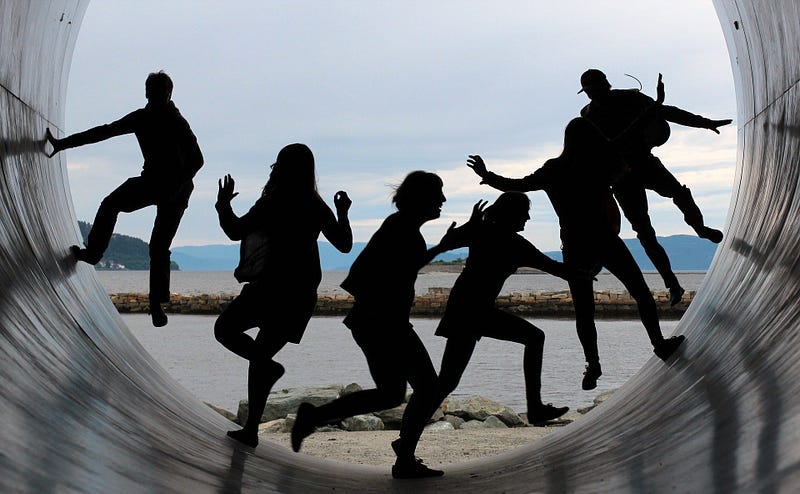
Follow your passion! Let it lead you to your life’s work.
That’s the message. And it’s been repeated by authors, bloggers, and career gurus ad-infinitum. But it comes without a warning — and it definitely needs one!
In 1987, Marsha Sinetar’s book told us to Do What You Love, And The Money Will Follow.
At the time, I’d just ended a fourteen-year career with a large corporation and I was looking for my next challenge. Her book appeared to be a godsend.
There was just one problem:
I didn’t know what I wanted to do.
Not because I didn’t have a penchant or inclination for a particular activity. Just the opposite. I had too many interests. Too many passions.
And now, it was time to make a choice — time to get serious. I was in my mid-thirties, and the years were passing. I had to get it right. I couldn’t afford to waste more time with false starts and trial jobs that weren’t right for me.
There was something else bothering me: the consequences of a wrong choice.
If I made a mistake, what price would I pay for ignoring my inner voice?
According to the career gurus of the time, intentionally disregarding my dream of doing inspiring, rewarding work would resign me to another soul-sucking desk job — just another worker-drone destined to live a life without meaning, accomplishment, or hope.
So I read every page of Senitar’s book, deliberating over each thought, each point. I took notes. Like a loyal parishioner, I devoured every word originating from this new guru who dared preach the holy message of career liberation.
Because I wanted to believe.
I desperately wanted to learn the secret, the hidden code, the short-cut to finding exactly what I was supposed to do with my life.
Supposedly, following your passion is an act of independence, of liberating self-rule, of asserting your wants and needs over that of the enslaving employer.
In a larger sense, pursuing a personal passion means striking out on your own — leaving the crowd behind in deference to your own interests and aspirations.
And that’s where it gets tricky.
The word “passion” is congruent with only the highest callings.
You seldom hear anyone say their passion is to work for the city as a water meter reader, or to ride on the back-end of a trash collection truck.
Passion brings to mind a choice of vocation that is organic, originating from a soul-deep desire to do work that is more calling than obligation — with the implication that doing anything else would be to live a lesser life, plagued by frustration and quiet desperation.
We typically associate the idea of passion with those who know what they are meant to do from a very early age. These are the artists, photographers, dancers, singers, actors, musicians and writers, who would never consider doing anything else.
Some are driven to live life on the edge, craving the competition inherent in professional sports. Others yearn for a career that places them in the limelight, opting for the stage, the silver screen, or a place of influence in shaping public opinion.
For them, there is no other option.
But what about the rest of us? Where do we look for clues? What options do we consider?
Sinetar’s advice was motivating, but lacked specific direction.
I needed a plan, a series of steps leading me to a career choice that would satisfy the majority of my objective needs, and when I looked back at my life in thirty years, would leave me with the least number of regrets.
I read more books. Lots of them.
Books like Jerry Greenwald’s Is This Really What I Want To Do? and Search by Harold Kushner, Enough Is Enough by Carol Orsborn, and What Color Is My Parachute? by Richard Bolles.
I listened to recorded seminars and lectures by Jim Rohn, Brian Tracy, Nathanial Brandon, and Zig Ziglar.
Each had a slightly different message, said in a slightly different way. But like authors sharing a common genre, there were commonalities . . .
“Look to your past for clues to your passion,” they suggested. “You’ll likely discover an old interest that holds the promise of a rewarding and satisfying career.”
With their collective voices recommending an objective look backward, I began recalling the activities I enjoyed in my youth.
I started making a list.
What about a job in broadcasting? I’d been a weekend radio announcer during my sophomore year in college. But I’d found the job boring. Sitting behind a microphone all day, playing records or reading the news now seemed like a huge waste of time.
Music? I’d played in bands in high school and, later, done backup work for recording sessions. But the paydays were few and far between.
How about a career in retail? Starting at age twelve, I’d worked in my father’s grocery store after school and on the weekends. I’d also spent lots of hours helping out in my uncle’s Western Auto franchise store.
I knew the basics of retail and face-to-face customer service. But repeatedly selling a five-dollar gizmo to an often discourteous and sometimes surly public didn’t appeal to me.
I kept searching, hoping to find the core drivers from my youth that would merit a second look.
That’s when I remembered my interest in astronomy.
As a fourteen-year-old, I’d marveled at the photographs of star-studded nebulas and distant galaxies. I’d built an eight-inch reflecting telescope, and after learning to identify the brightest benchmarks in the sky, I was able to navigate to the less visible objects.
My obsession with astronomy lasted for three years. Then I sold my telescope and moved on to other interests. I’d enjoyed the experience, but convinced there were no more celestial objects I could find with my relatively small scope, I was done with the hobby.
Ironically, I was dissuaded from pursuing a career in the field by an Arizona State University professor — who taught astronomy.
“The field is overcrowded,” he’d said. “The job prospects are slim to none. And the money? You’ll barely make a living — if you can find a job.”
I wondered if the ratio between supply and demand had changed. I looked up the current salary range of a professional astronomer. In today’s wages, the average annual income was $105,000.
I could live with that. But there was a problem. I couldn’t compete with graduate-level candidates. Because I lacked the advanced classes in cosmology and physics, I’d have to consider a related job in the same industry.
My first thought was to research the possibility of being a factory rep for an optics manufacturer.
Celestron and Meade were respected manufacturers of amateur and professional telescopes. Surely, one of those companies could use someone with an engineering background, coupled with fourteen years of technical sales experience.
I began fantasizing about using new, state-of-the-art digital imaging equipment. I remembered all those nights I’d spent outside, and how much I enjoyed finding the deep-sky objects by using the brighter stars as compass points on a huge, velvet-black canvas.
One night in particular kept coming back to me: the night my ninth-grade science teacher had invited the class to view the heavens through the school’s new fourteen-inch telescope.
About fifteen of us took our place in line, waiting for our turn at the eyepiece. Each student was allotted half a minute to peer at the object, then return to the back of the line to wait for the teacher to point the scope to a new position.
And who was standing next to me? Joyce Newburg, one of the prettiest girls in the entire school.
Too shy to say anything, I managed a few stolen glances, but conversation was out of the question. Standing in silence, shuffling a few inches at the time, we moved closer to taking a turn at the telescope.
Upon reaching the front of the line, I took my place at the controls and re-focused the image. As I looked down into the eyepiece, Joyce touched my arm and asked, “What do you see?”
Her voice came from just inches away. She was hovering, right next to me. Her shoulder brushed against mine. A few loose strands of her long, perfectly straight blond hair found their way across my face.
The magnified cluster of stars I’d been observing became a blur, the dim image of an impossibly distant object unable to compete with the overwhelming presence of Joyce.
My mind was racing. She was so perfect. So close.
Suddenly, the reality of that night — the truth — became much too clear.
I didn’t want to sell telescopes. I wanted Joyce Newburg!
I wanted to smell that intoxicating combination of ivory soap, Breck shampoo, and Shalimar. I wanted to re-experience that warm spring night, when Joyce’s forehead found mine as she suggested we share the eyepiece.
My search for meaningful activities from my past had sent me time-traveling.
I’d gone back to a precious moment of adolescence, when at fourteen, a one-minute exchange had left an indelible impression on my young, inexperienced mind. And that vivid, sensory-filled memory (and the emotion attached to it) had influenced the circumstances surrounding it, including the use of a telescope to look at the heavens.
Confusing a nostalgic pull from the past with a renewed interest in a topic or subject from the same time period — especially one that occurred when we were most impressionable — is not uncommon.
But when it subconsciously influences our search for untapped interests from our youth, the conclusions we draw can be less than accurate.
Yes, our earlier interests may leave clues about the activities we enjoyed as children and adolescents. But the reason we remember them as being positive may have more to do with the time, place, and circumstances surrounding the experience than the activity itself.
What did I learn from the experience?
Consider any possible options that emerge from a memory-search with a healthy dose of caution. Instead of regarding positive events from the past as irrefutable indications of new job possibilities, look closely at the circumstances surrounding the situation.
Ask yourself: Who was present? What were you doing immediately before and after? Try objectifying the experience by stripping away the emotion.
Here are three truths I learned about the myth of finding your passion:
1. Passion results from perspiration, not inspiration.
Passion is an acquired state of mind.
It’s work first, then passion. Feeling positive about a job or career is the result of doing the work, otherwise, the desire to perform a specific job is often based on fictional media representations, third-party suggestions, and projected assumptions — influences that are unrelated to the day-to-day work.
Unless you’ve spent time involved with the trivial and repetitive aspects of the profession, your “passion” is little more than a constructed fantasy.
2. Having a singular passion is an invitation to failure.
Instead of trying to discover our one true passion in life, we should look for a trend.
For example, do you like working with your hands? Or are you more cerebral, with a talent for math or science?
Putting all our attention and concentration on a singular profession creates a make-or-break situation: If we fail, we’re done. But knowing we have multiple paths to success increases the odds of achieving our goals and objectives, and gives us far more flexibility in how we arrive at our destination.
3. Don’t wait for passion to strike.
There’s opportunity in every industry and profession.
Passion comes from doing the work. It comes from dealing with the challenges, making the sacrifices, and doing everything you can to create a desirable outcome.
Passion is a result, not a guide.
Don’t let an initial absence of so-called passion keep you from finding a sense of satisfaction and achievement in whatever job or career you ultimately choose.
© 2020 Roger A. Reid. All Rights Reserved.
Listen to the Podcast of this article at Success Point 360
Roger A. Reid, Ph.D. is the host of Success Point 360 Podcast and author of Better Mondays and Speak Up. A certified NLP trainer with degrees in engineering and business, Roger offers tips and strategies for achieving higher levels of career success and personal fulfillment in the real world.