
Does “Midwest Nice” Breed Racism?
George Floyd’s murder and Jacob Blake’s shooting happened in the heartland
I was born in Iowa. I grew up in Minnesota less than an hour and a half from where George Floyd was murdered. I live in Wisconsin just two hours from where Jacob Blake was shot. Yes, police brutality against Black people happens across the country, but as a lifelong Midwesterner and person of color, I wonder what about the conditions here make them ripe for racism. How can the land of “Midwest Nice” be home to such atrocities?
Growing up, “Minnesota Nice” was an oft-quoted term to describe the specific congeniality that defines the state— a polite and courteous temperament, emotional restraint, and an aversion to conflict. “Minnesota Nice” manifests as constrained niceness to your face and brutal judgment behind your back.
The abiding reserve of “Minnesota Nice”, and “Midwest Nice” culture more broadly, lends itself to a particular type of passive-aggressiveness that defines the region. As Paul Kix describes in his tribute to “Midwestern Nice,” “It constitute[s] the most sincere, malicious, enriching, and suffocating set of behaviors…. [We] experience two realities: the first, all sunshine and bland pleasantries…the other, a red-lit underworld where people relay vulgarities through…euphemism, eye rolls, and loaded silence.” In the Midwest, we avoid direct conversation in order to maintain a semblance of pleasantness while subtly expelling our disapproval.
Locals credit Scandinavian settlers with sowing the seeds of “Midwest Nice” throughout the region. In Andrea Plaid’s 2015 article, she explains the Law of Jante — the Nordic social ethos of conformity — which underpins “Midwest Nice.” Under the Law of Jante, everyone is on the same level and no one is distinct. With a focus on the needs of the collective rather than the accomplishments of the individual, the Law of Jante keeps people in check. It’s about keeping up appearances and maintaining the social order. It’s an unspoken rule that permeates the region.
As Phil Christman describes in his 2017 essay, Americans also attribute a lack of distinctiveness to the Midwest itself. He said of the region, “If it is to serve as the epitome of America for Americans…the place had better not be too distinctly anything.” To his point, in the imagination of many Americans, the Midwest serves as the average, real, normal America. He suggests that the pressure to be normal leaves Midwesterners repressed as high emotions threaten the status quo. He quotes Minnesota writer Carol Bly.
You repress your innate right to evaluate events and people, but…energy comes from making your own evaluations and then acting on them, so…therefore your natural energy must be replaced by indifferent violence. — Carol Bly
When Midwesterners avoid voicing their judgments of people who violate their sense of normality, people who are different from the collective (and the whiteness associated with the region), their frustrations show up in other ways.
For many people of color living in the Midwest, the passive-aggressiveness of “Midwest Nice” translates into microaggressions. As Andrea Plaid explains, “Microaggressions…allow for plausible deniability, which fits perfectly with the passive-aggressiveness that is ‘Minnesota Nice.’” It’s easier to deny a dirty look or a slur mumbled under the breath than a direct statement or action.
Elijah Smith, who is Black, describes how microaggressions affect his experience living in Fort Dodge, Iowa in a July 2020 article in The Washington Post. The article states, “[What’s] bothersome to Smith…are the words he cannot hear when he sees a shopkeeper monitoring him more closely than a white customer, or the instances when he notices a white pedestrian cross the street to avoid him.” Smith himself says, “They say little things under their breath…. You can’t always see it, and they don’t necessarily say anything to you, but you can just feel it.”
For others, “Midwest Nice” goes beyond microaggressions — it is bold-faced racism. As Adnan Ahmed commented in the MinnPost in 2019, “For many people of color… [Minnesota Nice] is reminiscent of the racism we have experienced in our lives. The racism of being snubbed, the racism of being ignored…the racism of being penalized.” Diversity consultant Vivian Jenkins-Nelsen stated it more directly. In her 2016 address to the League of Women Voters in Minneapolis, she remarked, “…we’ve got to talk about ‘Minnesota Nice’…. It is very real in race relations — and has become our own version of political correctness. We don’t…[speak] up even when [someone is] doing something reprehensible. We don’t talk about race when we should. We let ‘Minnesota Nice’ become ‘Minnesota Nasty.’”
Even Paul Kix admits that “Midwest Nice” is “the restraint from speaking ill of others, even if others should probably be ill-spoken of.”
In the absence of real dialogue, many Midwesterns turn to social media to express their true feelings. As Andrea Plaid points out, “‘Minnesota Nice’ crystallizes into Minnesota racism when, for example, white people indirectly [express] their vitriol on social media.”
Early last week, I woke up to find an email from Nextdoor — the neighborhood social media platform. It was titled “The Kenosha shooting…it’s too quick to call it an overreaction.”
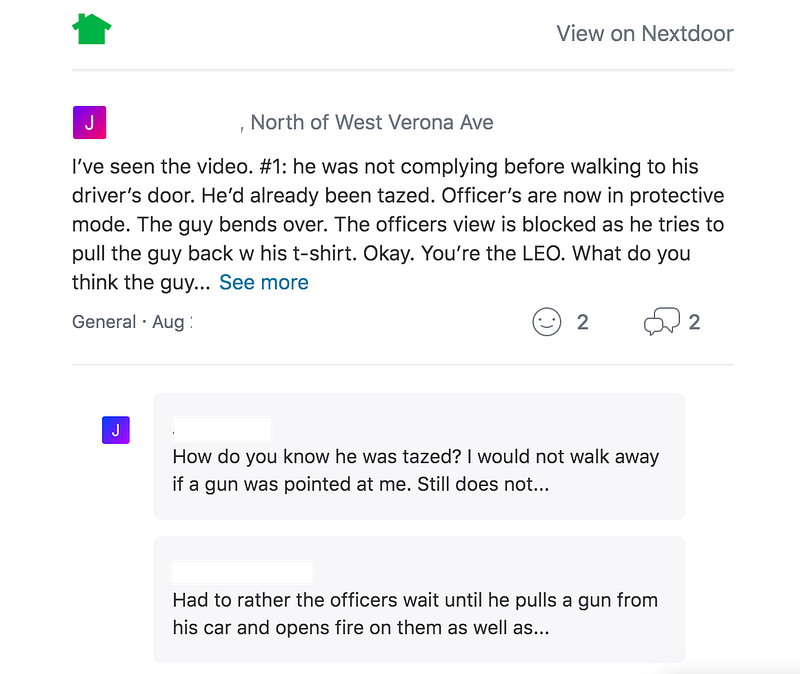
Up until now, our neighborhood’s Nextdoor page included requests for recommendations for plumbers or local photographers, offers of piano lessons or babysitting, discussions of whether to reschedule the annual neighborhood garage sale, and complaints of killer hornets.
I was surprised to stumble upon this politically-loaded post on Nextdoor (administrators took it down shortly after it was posted). In reviewing the post, the original poster wasn’t looking for suggestions or input from his fellow neighbors. He merely needed a platform from which to spew his frustrations.
For others, Twitter serves as their platform and a repository for racist slurs. A 2013 study from Humboldt State University mapped the geographic location of 150,000 racist, homophobic, or anti-disabled tweets. Researchers found a high concentration of hate speech — like the n-word — in isolated areas in the Midwest. While some researchers have called into question the study’s methodology, it’s still illustrative of a specific type of communication coming out of the Midwest.
To many Americans, all of this may come as a surprise. Laura Dresser, the Associate Director of the Center on Wisconsin Strategy (COWS) explains when considering racism in the U.S. from a historical perspective, most people think about the South. However, she says the 2019 Race in the Heartland report COWS contributed to “dissolves the misconception that racism and segregation is a Southern issue.”
Colin Gordon, the report’s lead author, added, “While many Midwestern cities appear in viral ‘best places to live’ lists, they are also among the very worst places to live for African Americans.” The report examines the origins of racial inequality and the current impacts of racial segregation on the Midwest. It asserts that “historical patterns of segregation and uneven economic opportunity — alongside continuing patterns of discrimination — yielded a legacy of deep and lasting racial disparity and inequality in the Midwest.”
Historically, Blacks from the South migrated to the industrializing Midwest during the early-mid 20th century to pursue economic opportunities. With their arrival, discriminatory housing and educational policies in cities like Milwaukee and Minneapolis encouraged white flight to the suburbs and kept Black residents in segregated communities in the cities. John C. Austin from Brookings elaborated, “racism in the North — manifested in practices such as redlining, deeded covenants, and shifting public school boundaries when Black children began to mingle with white children.” When deindustrialization leveled the Midwest during the latter part of the 20th century, Blacks were disproportionately affected.
Vanessa Taylor, a Black writer who grew up in Minnesota, details this history in her 2018 essay.
Minnesota was meant to be fertile ground. Economically, politically. People followed promises like they were the lights at the end of a tunnel, only to discover they were tricks. But can you blame them for wanting something to run toward? And can you blame them for staying? ….Black Minnesota is like the Bottom…it remains as unforgiving as the laws that threaten us…. Minnesota is my home…even when home is cruel…. — Vanessa Taylor
In 2017, Phil Christman elaborated further, “Midwestern whites often see people of color as ever new and out of place, decades after the Great Migration. …[For many], people of color threaten the cohesion [of the Midwest]. Thus, while Southern history yields…the most savage, intimate racist violence…Midwestern history is a study in racial quarantine.” By relegating people of color to the status of outsiders, the Midwest perpetrates its own racial quarantine.
This pattern of racial segregation and discrimination bears out in the data. Statistics comparing quality of life indicators for Black and white people in the Midwest are particularly unforgiving. States in the upper Midwest hold the following unenviable titles.
Wisconsin, Iowa, and Minnesota:
- Top 7 Worst States for Racial Integration
- Top 5 Worst States for Disparity in Incarceration Rates
- Top 5 Highest Median Income Gap
- Top 4 Highest Poverty Rate Gap
- Suspend Black students at more than five times the rate of white students
Wisconsin and Minnesota:
Top 2 Worst States for Disparity in Black and White Unemployment
These rankings suggest that the upper Midwest, on the whole, does not treat its Black citizens equitably.
For some Black Lives Matter protesters in the Midwest, the hope is simply for their white neighbors to acknowledge the racism that so many Black and Brown people in their communities face. Zac Nuzum, 24, a Black resident of Fort Dodge, Iowa states in The Washington Post, “We are saying there is a lot of unconscious bias, and there is still a lot of racial, racist tolerances that one generation has passed down to the next. We are saying the buck stops here.”
Nuzum mentions intergenerational racism, which is becoming increasingly problematic as populations all over the country become more Black and Brown. The Washington Post reports that the number of young people of color living in the Midwest has increased in the past decade, as the older white population has flatlined. According to its review of census data, “minorities make up nearly half of the under-30 population nationwide compared to just 27 percent of the over-55 population, signaling that the United States is on the brink of seismic changes in culture, politics, and values.” Much of this change is happening in the upper Midwest. And as populations become younger and more diverse, clashes between the old guard of “Midwest Nice” and the new guard of Black Lives Matter are coming to a head.
Headlines of police brutality of Black men by white officers have brought national attention to cities like Minneapolis, Minnesota, and Kenosha, Wisconsin. The causes of these altercations are complex — sociological, psychological, organizational, and situational. The upper Midwest’s culture of repression through “Midwest Nice” and homegrown racism may have contributed in some way. If we can’t talk to one another directly across differences, how can we view each other as human and worthy of protection? As Vivian Jenkins-Nelsen recommended, “we have to start real dialogue.” It requires us Midwesterners to let go of our restraint and engage in honest, straightforward, and messy conversations about race in order to move forward. “Nice” won’t cut it anymore.