
Death on the Nile: Period Films Are Progressive Now, and I Don’t Know How To Feel About It
Representation is good. But does it conveniently gloss over history’s ugly realities?
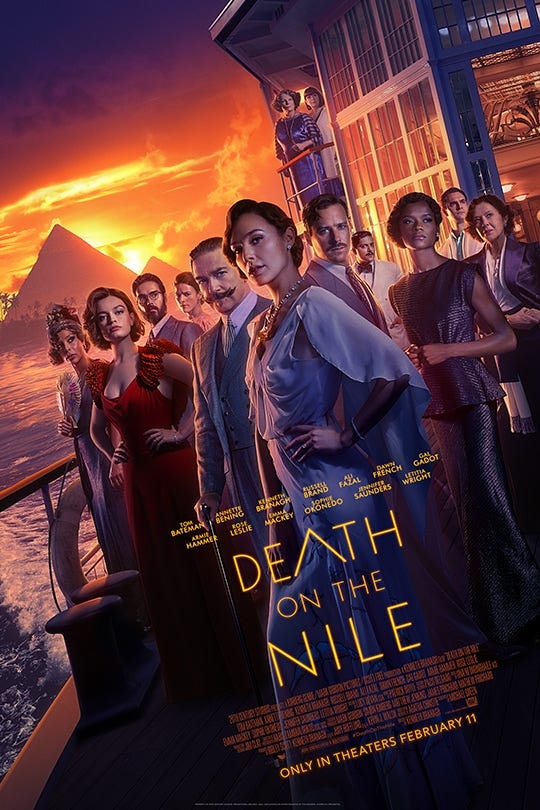
Warning: mild spoilers for Death on the Nile (2022) ahead
Last week I saw the latest iteration of Agatha Christie’s classic Death on the Nile. The book was originally published in 1937, and the opulent film looks to be set around this time frame. But like many modern period pieces, director Kenneth Branagh makes some intentional changes to reflect today’s more progressive culture.
Most of the film is set on a glamorous honeymoon cruise. Female deckhands abound and do some seriously heavy lifting (of dead bodies, but still). The distinctly upper-class crowd includes multiple people of color. There’s a lesbian couple “outed” (but then fully accepted). There’s also a white male heir openly in a relationship with a Black woman, something that in real life still raised eyebrows thirty years after this film was set.
None of this happens in the book or the 1978 film.
Modernizing history isn’t a new trend. In 1996’s Romeo and Juliet, director Baz Luhrmann reinvented the Montagues and Capulets as mafia families and incorporated modern weaponry. Lurhmann’s Moulin Rouge, set in 1899, featured an eclectic late 20th-century soundtrack including songs like Lady Marmalade and Your Song.
At that time, the trend focused on incorporating anachronistic pop culture references. More recently, historical dramas have intentionally become more diverse and inclusive. Broadway smash Hamilton cast Black actors as white historical figures like George Washington and Thomas Jefferson. The Netflix hit Bridgerton and upcoming film Cyrano portray Black men as potential love interests for high society white women.
As a viewer, I’m torn on this trend. I don’t need a period piece to be 100% accurate to enjoy it. So yes, from that perspective, let’s be more diverse and inclusive. It makes the film more interesting and opens up new opportunities for talented but traditionally marginalized actors. I loved Hamilton, and blues singer Salome Otterbourne and her niece Rosalie were two of the more compelling characters in Death on the Nile.
I also recognize that for some, seeing characters that better represent themselves in period films may feel empowering, and that’s important.
So, we’ve resolved the issue and everything’s great? Well, no. Giving marginalized people more agency in a film doesn’t erase the actual past. The truth is that these groups, as well as some that still don’t get much period representation, like queer people, neuro-divergent people, and differently-abled people, were at these times experiencing outright oppression. Does putting people in a swish period costume and pretending that in that era they had power and social approbation among the insulated and unaccepting white upper class of the day erase the wrongs of the past?
We know it doesn’t.
From that angle, this trend has a bit of a “your fave is problematic” flavor to me, where we struggle to reconcile a performer whose talent we admire with their bad behavior. For example, if you were a big fan of comedian Louis C.K. but deplore how he took advantage of his power over aspiring female comedians, how were you supposed to feel when he attempted a comeback? Does his apology mean you’ll watch his comedy specials moving forward?
If you love a good period piece but recognize that that era was brutal for the majority of the population, is the solution to simply make the casting more diverse and pretend things were different?
Hamilton’s original casting director Bernie Telsey says the casting: “was created with the idea that anyone can do anything, and we should be open to that. But now it’s much more about consciously making a choice to do something, being seen for the color you are.”
So there was intention behind Hamilton’s casting beyond making American political history more diverse. Can the same be said of these other productions?
Full disclosure, I haven’t seen Bridgerton. But in Death on the Nile, all of this inclusion comes with only the slightest of nods to what these individuals’ actual lives would have been like in this era. So the film seems to say, we’ll empower women, people of color, and queer people in an unrealistic way, so in exchange, we can focus on love and murder and intrigue and just gloss over the social issues of the day. Sound good?
As I said, I’m fine with historical films containing inaccuracies. But this seems like a big stretch.
I’m not sure there’s a right or wrong here, but what I would like to see, in addition to these diverse historical re-imaginings, is more films that portray the obstacles and challenges these groups faced in a more realistic way. Fine, let’s have the gauzy feel-good diverse period pieces where everyone now gets to wear rich silks and puffy shirts. But let’s also tell more Black stories and women’s stories and queer stories and other stories in history the way they actually unfolded.
Re-imagining period dramas may make us feel better, but it doesn’t actually change history. Nor should it.
Thanks for reading. If you love film, here’s another good one.
Medium is full of great lifestyle content like this. You can get access for only $5/month by clicking here. If you join using this link, I’ll earn a commission.


