
Does FEEL Have A Place in Business?
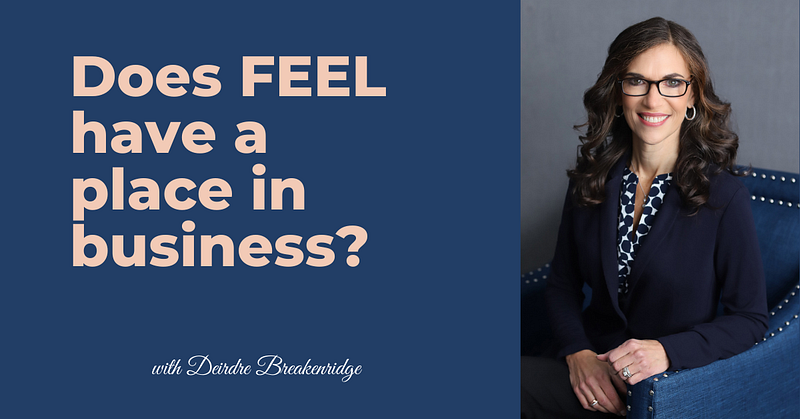
The business world is changing. Millennials and GenZs are bringing change to the workplace. Empathy and care are the new ways of doing business.
I sat down with Deirdre Breakenridge, executive media training expert, PR and marketing leader, and a dear friend to discuss where the business world is heading and what impact will millennials and GenZs have.
Get ready for a different way to look at your job and business.
What does FEEL stand for? And why FEEL?
FEEL is an acronym that formed after a 52+ week passion project on what millennials were thinking and feeling about their professional and personal relationships. After compiling data from about 100 one-on-one interviews, four distinct buckets or groupings formed, from their answers to questions and stories, which spelled the word “FEEL.
FEEL stands for:
F: Face FEARS
E: Have EMPATHY
E: Live with ETHICS
L: Unleash LOVE
From my research, it was evident that millennials wanted to build relationships with people who were able to FEEL in their interactions and communications. However, the ability to FEEL is not just for millennials. It goes across all generations to deepen relationships through communications.
The research revealed that you can take a connection, through any channel, and when you apply a FEEL lens the relationship has the potential to grow stronger.
However, before you can tap in or tune into someone else’s emotions or feelings you must be present and self-aware in your own communication. The ability to FEEL is your capacity to be emotionally intelligent. What used to be a nice to have soft skill is now a critical skill for leaders in business and for communications professionals.
Emotional intelligence is part nurture and part nature. Regarding the former, professional training helps to draw out the balance between rational and emotional thinking patterns and how it can create positive impact in your business.
How much do you FEEL in you communication? Your FEEL FIRST training program asks your clients how much they FEEL when they communicate. How about you, Deirdre?
The genesis of my research is the exact reason why I asked myself this question, early in the research study. How much do I FEEL first before I communicate? Realizing that I didn’t have a framework to answer the question, meant the FEEL framework needed to be developed. My team and I quickly created an online test using the data and stories from the initial FEEL one-on-one interviews to build this framework with a set of questions to evaluate a participant’s ability to FEEL First.
Today, there are over 11,000 answers in the test’s database, which focus on all four parts of the FEEL model. The 32-question test probes how much a person faces Fears, has Empathy, lives with Ethics, and unleashes Love for a cause. The test evaluates and scores test participants, and then recommends different exercises to help each person to FEEL more.
Like most professionals who take the test, you realize you need some work. I discovered how I should be facing Fears more. My FEEL roadmap in 2022 will focus on the “facing Fears” part of the model. I’ve also discovered that I’m not always operating on the highest level of empathy, in some of my interactions.
However, I was pleased to learn I achieved high Ethics and Love scores.
Does FEEL have a place in business? Why?
FEEL has a tremendous place in business. Just look at the statistics of the organizations who are losing employees at a rapid pace. The U.S. Department of Labor reported that approximate 34.5 million workers resigned from their jobs at the end of September 2021.
There’s another statistic that stands out in my mind, which goes back to a Pew Research study in the 2019 timeframe. The report stated that about 80% of the millennials surveyed would leave their current organizations to work for an organization that was more empathetic. During the Great Resignation, or what we’re calling the “Big Quit”, employers will be working harder to retain their employees and to show they care. They’ll need to demonstrate more understanding and offer flexibility for their work situations, and institute company policies and programs to help employees cope with stress and anxiety.
In general, professionals of all generations, not just millennials, want employers who understand their work and life priorities, due to COVID-19, caring for their families and the increased numbers of people who want to work remotely. The leaders and the businesses that show they’re investing in their employees’ well-being will not only keep their workforce intact and but also attract new talent, with a culture that blends career and life goals.
Where do you start incorporating feeling in one’s business or job?
Incorporating someone’s feelings into work is a conscious choice and effort. It also takes practice to become self-aware, as a part of the journey to emotional intelligence (EI). At the same time, a part of the practice also requires being self-regulated or practicing self-management by not allowing emotions to overwhelm you.
Your ability to become self-aware helps you to realize how your values, goals, beliefs, opinions, and emotions affect other people in the workplace. Then, with a focused and heightened awareness, and your ability to self-regulate and / or manage your own emotions, especially during tough situations, you can more easily tune into what someone else is experiencing.
Of course, a critical component to understanding someone else’s feeling is also how well you listen. Listening is key to considering how others feel. The more you listen, the deeper the understanding you will gain, and the stronger the trust you will build.
People recognize and feel better when you can give them your undivided attention. For example, in your meetings, having good eye contact, facing someone who’s speaking, asking relevant questions, and sharing related information demonstrates that you are actively listening.
It’s the combination of the self-awareness, self-regulation and active listening that builds the trust and which helps to ignite the feeling process.
One of the Es in FEEL is about ethics. How does ethics and ethical behavior look like in 2022 and beyond?
Yes, the 2nd “E” in FEEL is an important part of the model. If you were to remove ethics from your interactions, then you would break the trust, relationships might end, and true feelings would no longer shared.
What you say, how you act and what you feel are based on your ethics and values. In 2022, we’ll see a lot of passion in communication, whether it’s online or in-person around hot button issues in the news and business. With passion comes quick responses or knee-jerk reactions. Unfortunately, the speed to communicate often removes the ethics and values filter, which should be a priority. In addition, when the filters are removed different parties tend to leave the civil discourse behind. They also retreat to their opposite opinions. We saw a lot of polarized topics in the news from the US election to a global pandemic.
As business professionals and leaders, you best serve your stakeholders and important constituents when you’re ethical in your decision-mailing and in your communications. You’re taking a “do no harm” approach. When in doubt regarding a situation, or how to communicate a pressing issue, hit the pause button and breathe deeply.
Now, is not the time to fire off communication, and offer that quick response. Instead, it’s important to step back, ask questions, involve other people, evaluate a situation more deeply and seek additional details, if possible. As you do, your values will shine through and the choices you make will create the ethical decision-making and conduct to guide any situation to a more positive outcome.
The bottom line … relationships are built on trust and trust is easily broken when unethical behavior comes into question or is uncovered. As a result, your brand and your reputation may suffer.
If you want to learn more about Deirdre and her work, find her at Website or connect with her on LinkedIn and Twitter.
Originally published on LinkedIn.