
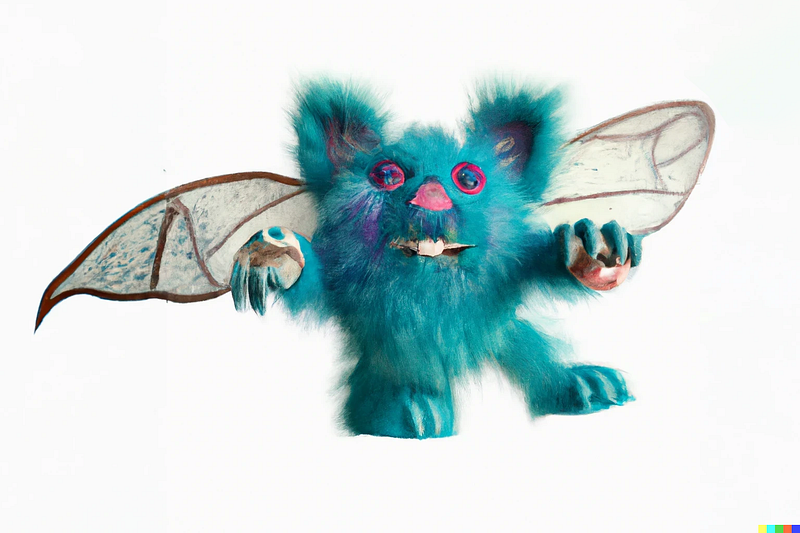
Does DALL-E image generating leave the artist in the dust?
The speed of creation is scary and addictive
Generative AI is happening. How do artists, trained to work with their hands, pencils, brushes, and tactile materials, deal with this enormous digital change in visual culture?
How does it feel to see an image generated instantaneously based on a word prompt?
It feels strange, alien, disconnected.
Two paths
Artists have only two options: 1) stay away from AI image generation and continue one’s hands-on work in the studio, or 2) embrace AI, explore it, learn from it, and ultimately thrive with it.
Explore the narrative first
I decided on option 2. I put my brushes and pencils to rest for a while and entered the prompt creation room on the AI floor.
Generative image AI, such as DALL-E, flourishes with wittily prompted stories, associative surround-scenarios, emotional descriptors, color-ranges, and many additional details of embellishment.
When we write the prompt, we’re pitching the story to the AI image generator. The image is rendered referencing the word input. It is the language-based model that defines the image.
Thus, choosing your prompt descriptors precisely and narratively is the basis for AI image generation.
Elements of the narrative
Remember the three primary UX tools we define in research to tell the users’ story, goals, pain points, and aspirations? The mis-en-scène we need to have before we embark on anything design-related?
Persona (hero), story, scenario, conflict, goal
If we use this formula in the image AI prompt, results will follow.
Learn how to
My first few image prompts were lame. Not much happened. The story was random, the descriptors not precise enough. The output was stylistically weird.
I was looking for something smooth, well rendered in a 3D style, fresh colors, cute, and lovely. The prompt needed a hero (the goldfish), a surrounding (the water), an expression (smiling), and a directional input (looking at me). And above all, it needed an open-source style reference.
Frozen, that’s it!
The movie Frozen. That was the genre reference that AI can pick up on. This prompt got me the result I was envisioning.
“A Frozen-movie style 3D render of a gold fish looking at me in a blue pond and smiling”
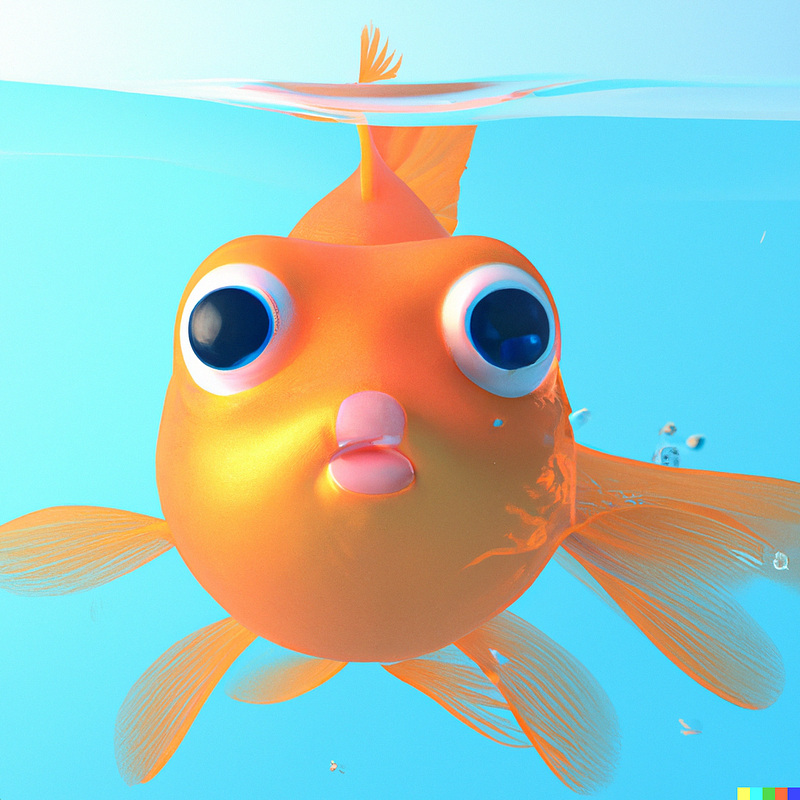
This output is fantastic. Granted, it took me a few tries to get my prompt to reference Frozen. Luckily, the Frozen movie reference nailed it and produced what I was looking for.
I really like this goldfish even though it’s not really real. It’s a render of an idea that could propel my story forward.
With the help of DALL-E, I can now visualize what my story protagonist can look like. That’s amazing.
Let the story thrive with your heroes
Generative AI needs heroes. Figures, people, animals, people who can define the narrative. In that sense, as artists, we’re challenged to think beyond the paper or canvas (for instance, Mondrian’s minimalist color compositions) and think of our art in terms of telling the story.
My next hero was my goldfish’s buddy, a queen angelfish. My prompt was as follow:
A Disney mermaid-movie style 3D render of a full-size queen angelfish looking at me in an open turquoise ocean and smiling”
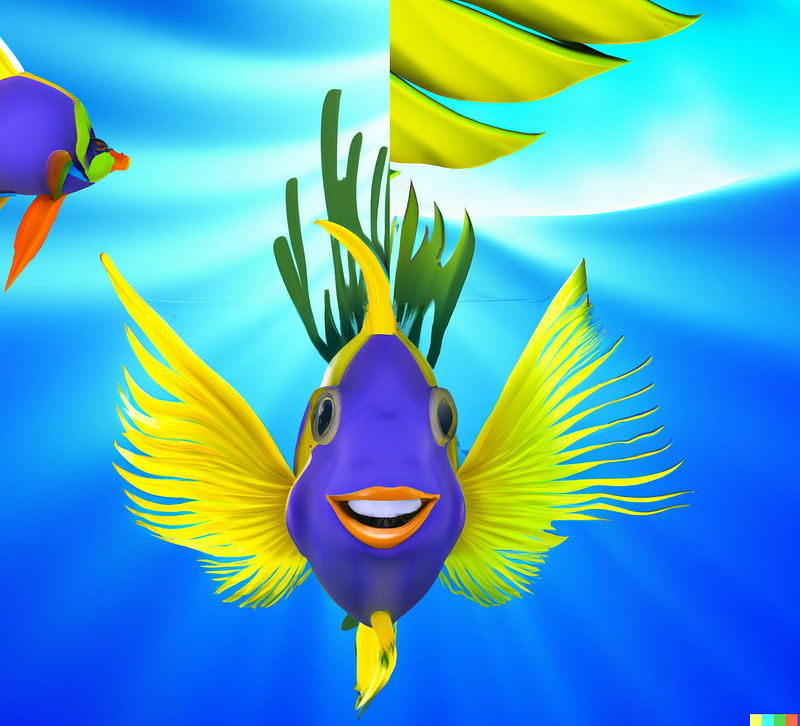
So, while I love the render of the queen angelfish and the blue background, the follow-up editing, adding the finishing touches to the fins left and right as well as the top background, is not perfect.
I will need to bring this AI image into Photoshop and manually retouch. Also, the colors are not exactly what I was looking for. So, the AI image generator is not always ready to logically complete a render.
All that said, it’s still pretty darn good. But only after about 20 tries.
Drawbacks of generative image AI
Here are the aspects of image AI I didn’t like as an artist:
It’s suggestive, not definitive
The image, the figure, the object, whatever it is, does not exactly render as one wishes. Rather, the image remains suggestive of what can be done.
Running out of patience
Clearly, after editing in a simple background with many rounds and only getting lackluster results, my patience ran out. There is not much control over how the image generates its own larger environment.
Glossy over artistic
I prefer a glossy 3D animation look over a historical genre style, such as impressionism for example. I’m not loving these genre-art rendered images.
A van Gogh-style creation of a still-life of a vase with flowers, apples, and peaches on a wooden table returns a jumble of thrown-together objects in an unidentifiable style.
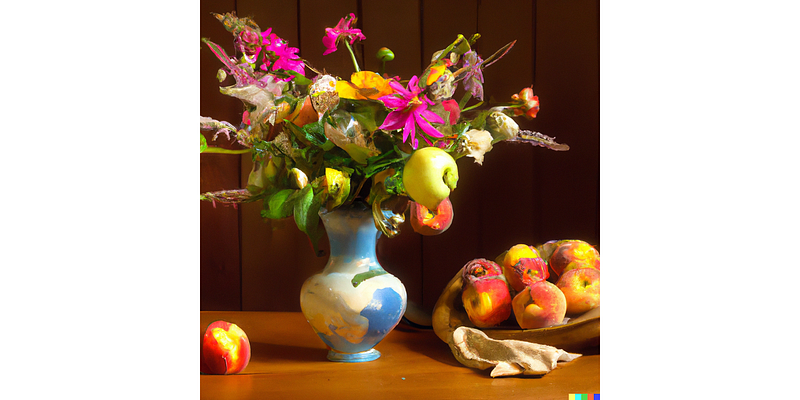
Hello, there is an apple in my bouquet of flowers!
DALL-E charges for the privilege of exploration
DALL-E works with credits. 50 credits are free in your first month of exploration, then 15 per months, after that, one has to buy the credits. I used up my 50 credits within a few hours. 1 credit basically renders 4 variational images based on the prompt.
The good news about DALL-E generative image AI
Creators retain copyright over their AI generated images.
<
So that’s pretty good. If you are an independent creative entrepreneur, the time and money put it to generate an AI image will have an ROI.
Speaking as an artist, the promise of being able to build an ownable and sellable collection of AI images is fair and promising.
Bonus image: The dancing hippo
And after many more explorative prompts, at last, I was able to create another successful hero.
A 3d-render in manga animation style of a blue hippopotamus holding a flower against a blue sky, dancing, smiling [variation]
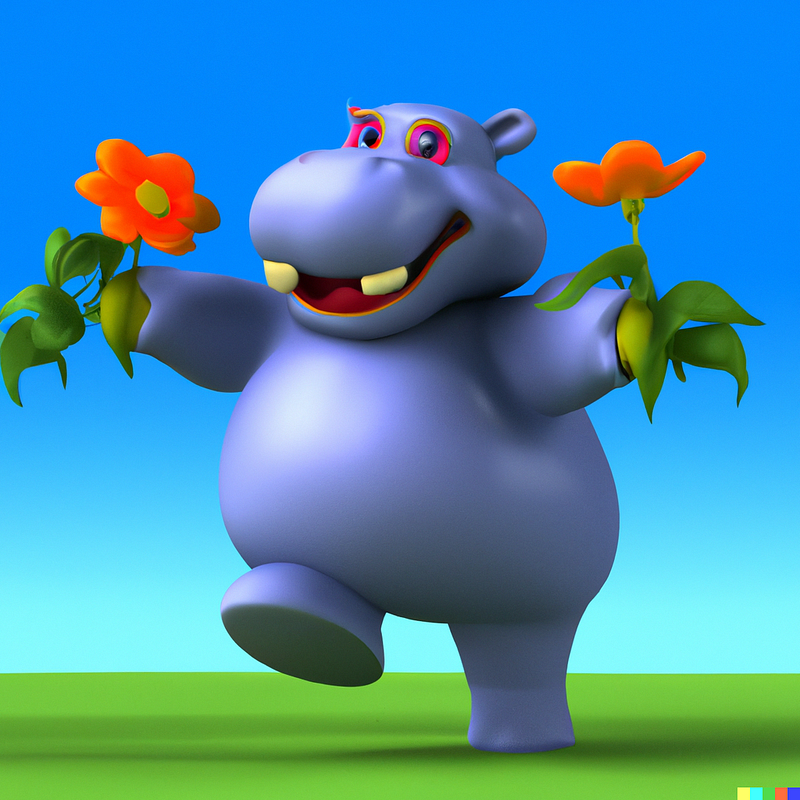
I’m happy with this one. It’s cute, and I can develop a story about it.
The future
Artistically speaking, generative image AI is weird. It’s more about the narrative evolution of the prompt coupled with associative genre styles than it is about original drawing, photography, or art making.
Still, there are many positive aspects about creating in AI. For one, it’s nice to have a render of a persona or scene we are thinking about. Usually, we do time-consuming searches. Here, we pro-actively describe what we are looking for.
Art referencing will become super-important. Styles, genres, palettes, and techniques will be increasingly referenced.
Unique story descriptions and scenarios will become the artistic writing secret.
So, for now, access DALL-E or any other image AI generator, and try it. It’s an open source adventure with interesting outcomes.
Interested in learning more about UX design, AI, design tools & trends, and art endeavors? Join Medium with this link, and support my future writing. Thank you! ✍️🧡
All images created with DALL-E ©Eva Schicker 2023.
Reference:
{1} Link to DALL-E copyright statement: https://help.openai.com/en/articles/6425277-can-i-sell-images-i-create-with-dall-e