
Documenting as You Go: The Empathetic Way to Share Your Work
Invite people into your workspace.

People love to see what other people do.
They want to see a creative story or process unfold right in front of their eyes. If that doesn’t happen, what we share comes across as just another piece of content begging for attention.
No one gets to see what it’s like to create from your unique point of view.
When you share only the finished product, that “thing” is now void of human connection. That’s why telling a story, while remaining true to yourself, is the way to go.
Sharing your journey, even the ugly parts, inspires people to follow along. Only then will they listen to what you have to say. Just remember the secret ingredient: empathy.
No one wants another desperate ad
If you exist in the world as much as I do, you get bombarded with ads and promotional content on the daily.
It’s almost sickening how many things get tossed in our faces from one moment to the next. But that’s the world we live in. It’s a race to get the next person to buy the next big thing.
The funny thing is, the best advertisements are the ones that don’t come across as advertisements. It’s like you’re reading your favorite novel or watching your most cherished movie.
They seem to speak to a certain audience in a relatable way, encapsulating their feelings and needs. No matter how hard you try, you can’t shake the way the content makes you feel.
That’s because someone sought to do more than sell a product or an idea. They wanted to connect the “thing” to the human it meets on a deeper level.
Empathy belongs at the core of what we create.
Why does that matter to me, you say? Because we respond to what we can feel. We react to content that fits the missing piece of the puzzle we’ve been searching for.
It doesn’t matter if we’ve gone through the same experience or not, we connect ourselves to the storyline.
And as we consume that kind of empathetic material, the focal point becomes less about the “thing” and more about how it helps people. How it solves their problem.
Here’s my point: you don’t have to be another annoying ad. You get to do something different, something better than cramming your creation down people’s throats and hoping for a profit.
You get to tell a story about how you help others.
The transactional effect of sharing views and money
There’s always another side to the same coin. We see ads that are clearly ads. They come at us in the same kind of desperate attempts to empty our pockets and fill their own.
These stories operate in the opposite way: focus more on the product and less on the problem it aims to solve.
I always skip these. I don’t even think twice. It sucks even more when I don’t have the option to skip them.
These empty stories do nothing to me. There is no emotional response that causes me to buy into the idea that this tool or strategy will improve my life. Instead, I just sit there realizing I’m never getting those 15 to 20 seconds back.
There’s a transactional approach to sharing that we somehow assume people won’t notice. But they always do.
Our schemes and shortcuts to wealth are often so transparent, that viewers can see deceit oozing from the content itself. The result usually doesn’t work out in our favor.
News flash: the viewers aren’t the problem.
You may have the best idea known to man. If you don’t share the journey that led to the idea, or the reasons behind it through story-telling, no one cares.
Your first step is to be genuine.
One of the most profound pieces of advice I’ve received in my life was to be myself, no matter what I choose to do. Attached to this was the notion that if I could just get one percent better every day, that would change my life.
We sometimes chase fifty percent growth in income and a two hundred percent increase in views. In the process, we do more harm than good.
Aim for one percent. If you improve more than that on a given day, awesome. But keep that as your target as you move forward.
When you teach people how to improve their lives or create a product or idea that does the same, you won’t have to worry about the money. It’s a byproduct of solving real human problems.
Invite people into your workspace
We all love a good story. But not just any story, we love stories that bring us along on the journey.
From the ugly starts to the magical moments that reshape our perspectives, we feel like we’re right there with the main characters.
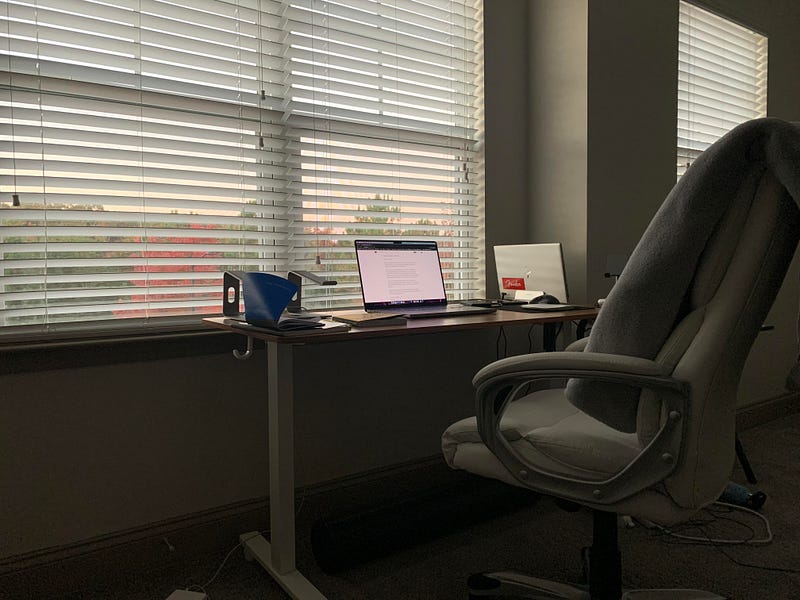
This is where I write at around 6:30 AM from Monday to Friday. Some days, getting to this chair isn’t easy. I could sleep in or squeeze in time later in the day. But honestly, I wouldn’t want it any other way.
When I started writing, all I wanted to do was write. I didn’t care about stats. The views didn’t matter to me as much as everyone said they did. I just wanted to share my words with the world.
But if I could go back, I would document more of the process. I’d share pictures of my writing desk and photos of the books I’m reading. I would bring people along for the ride.
When you document your creative process, you establish a human connection outside of your work.
There’s an attachment we can relate to, a feeling of intimacy that makes it feel like we somehow know the creator personally.
People are more receptive to a product when they can see the people behind the curtains. When they can not only follow the bread crumbs but see the creator take a bite.
No matter what your next big idea is, invite people into your workspace. Share the whole story and not just the thing.
Sharing your ideas doesn’t have to be transactional.
You can stimulate more engagement with what you create by documenting as you go. By capturing the moments most people don’t get to see.
While you’re doing that, stay true to yourself. That’s how you win the long game. Pretending to be someone you aren’t only stunting your growth in the end.
Regardless of where you are in your journey, shoot for one percent improvement every single day. Then, teach people how to do the same.
Forget about the stats and the money. As cliche as that sounds, it’s never been more true to me than it is right now.
All you need to focus on is telling your story and bringing people along for the ride.


