Do You Want To Learn About North American Tundra Swans?
Visitors to Conesus Lake twice a year on their migrating journey
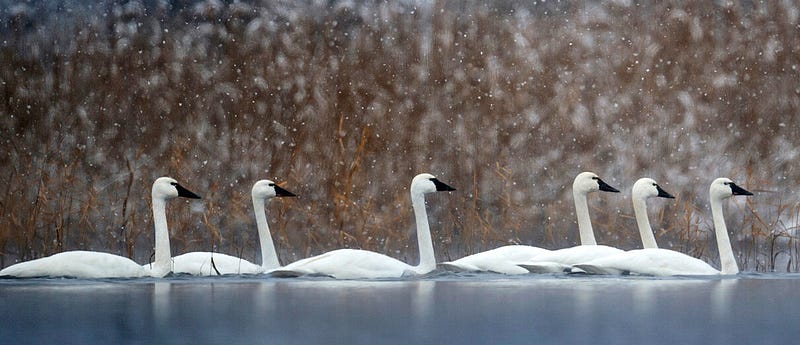
I look forward with anticipation each spring for a short visit by Tundra Swans as they migrate to their summer home and breeding ground.
Then in the late fall or early winter, they stop again, heading for their winter home. I always look forward to seeing them as they fill a large area at the head of the lake.
I have seen them fly over our home, alerted by their distinctive sound, which is quite different from the Canadian Geese, which are common in our area in the spring, summer, and fall.
Tundra Swans make high-pitched cooing sounds. Click the link below to hear the sound of their calls:
Tundra Swan Sounds, All About Birds, Cornell Lab of Ornithology
Tundra swans are mainly herbivorous and will forage for food in shallow wetlands. They eat aquatic plants and roots. They also eat arthropods such as crabs, spiders, worms, and insects.
Tundra swans are adaptable and feed on planted land and graze on harvested winter fields.
I have seen them in large cornfields in a nearby county busy foraging. When I saw them there, it aroused my curiosity. I wanted to know what type of swan they were.
They are beautiful with pure white plumage; their legs and feet are black. One way to distinguish them from other swans is their black bills with a small yellow spot at the base in front of the eyes, called Lores. The yellow lores can be difficult to see from a distance because of their small size.
The Tundra Swan was once known as the Whistling Swan. The explorer Meriwether Lewis named them for their whistle-like calls. In the early 1800s, Lewis wrote the first known description of the species during his expedition with Willian Clark.
Their Latin name is Cygnus columbianus.
They are the smaller of the two swan species native to North America.
The average length is 52.0 inches for the male and 51.5 inches for the female. The average weight is 16 pounds for males and 13.9 pounds for females.
The male and female Tundra Swan are identical in appearance. The only difference is their size.
They are monogamous, and a mated pair will stay together for life.
The adult male is a cob, the female is a pen, and the young swans are called cygnets.
Tundra Swan cygnets hatch fully feathered with open eyes and can immediately leave the nest; this is called precocial and is common to other waterfowl species, such as Wood Ducks. The cygnets cannot fly for several months, and both parents care for the cygnets, which stay with them for two years.
In the fall, groups of Tundra Swans will merge to migrate south in large flocks of approximately one hundred swans. They fly in a V formation just like Canadian Geese. They fly at airspeeds of up to one hundred miles per hour and travel about four thousand miles each way.
The Tundra Swans have natural predators such as foxes, weasels, and eagles, which threaten their eggs and young.
Sadly, like so many other species of birds and animals of all kinds, the biggest threat they face is climate change. Science predicts that there will be an ongoing loss of their breeding grounds and habitat. https://climate2014.audubon.org/birds/tunswa/tundra-swan
They face the loss of wetlands and pollution and are also affected by lead poisoning. The lead shots used by hunters are ingested by the swans when they forage for food on the bottom of rivers and lakes, which causes lead poisoning.
The Tundra Swans are beautiful creatures that add grace and beauty to our world. I hope they, like so many other, birds and animals survive climate change. I hope we will survive too!
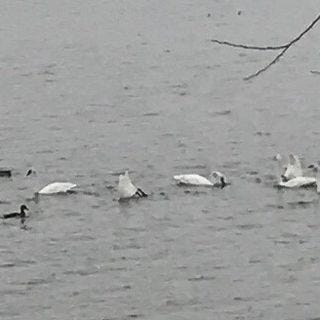
I was able to capture the above photo this year in the late fall on the shoreline of Conesus Lake. This is the last day I saw them. I am anticipating the end of this winter weather and their return as they migrate to their summer home.


