
Social Media | Writing | Youtube
Do You Want to Know What Warren Buffett's Love of Talking to Orang Utans has to do With Your Writing on Medium?
Then read this article.
Why should I talk in a podcast, produce videos, or write articles on Medium?
Why should I post anything that runs through my head?
Do you know people who hold themselves back because they think what they can produce isn't good enough?
The big question behind the above list is:
Why should anybody produce content?
Isn’t that something only gifted people should do?
Why should people care about content?
Gary Vaynerchuk's 64 pieces of content
The King of Social Media — Gary Vaynerchuk — recommends putting out 64 pieces of content every day.
Well, he can talk easily. Running a social media agency that works with Fortune 500 corporates provides teams with sufficient resources to post daily.
But what about small businesses and private people?
Online brand awareness is becoming increasingly important since everybody is using the internet. Not only for big corporations but also for SMEs and private people.
The online personal brand of everybody in a corporation adds to the company's value.
But how can everybody make use of this excellent opportunity?
Gary Vee's simple advice:
Don’t produce content. Document your life.
In his words, authenticity is what win's the game in this decade.
Since, especially in the last two years, more and more people have gotten fed up with fake news, fake people, and fake content.
The hunger for real people, accurate news, and authentic content are there.
But still, why create?
Warren Buffett and his Favorite Animal: Orang Utan
In his recent shareholder letter, the Investment Guru describes his partners Charlie Munger's words about content creation.
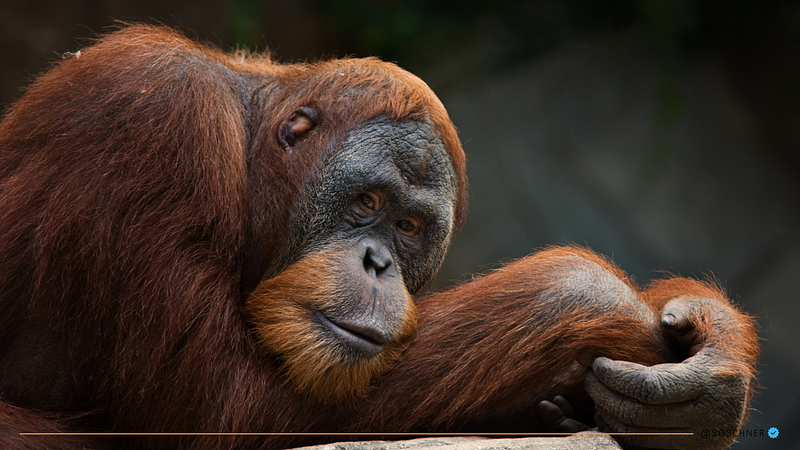
Charlie Munger and Warren Buffett share a love for Orang Utans regarding content creation.
No, it isn't made up.
I swear. He writes about Orang Utans in an official document officially published to his shareholders.
Here is what he writes:
Teaching, like writing, has helped me develop and clarify my own thoughts. Charlie calls this phenomenon the orangutan effect: If you sit down with an orangutan and carefully explain to it one of your cherished ideas, you may leave behind a puzzled primate, but will yourself exit thinking more clearly.
It is a lovely anecdote about the craft of producing content, beautifully pictured in a setting in which the creator sits down for a conversation with an Orang Utan.
Whenever I get nervous the next time because I believe my thought processes and the content it creates isn't good enough, I will re-call this picture in my mind that I am having a serious conversation with an Orang Utan.
But what is behind this OrangUtan-method?
What is more important? Quality or Quantity?
In his book Atomic Habits, James Clear describes a university teacher's experiment in a class about photography.
On the first day, the teacher, Jerry Uelsmann, divided his class into two groups.
One got the task to produce the perfect picture.
The other group got the task of forgetting about quality and producing pictures at scale.
The group with the perfect picture only needed to hand in one shot to get an A, but it must be perfect.
The quantity group got graded by the number of photos. Hand in 100 and get an A, 90 for a B, 80 for a C, etc.
What do you think was the result?
Which group performed better at the end of the semester?
The group that had to produce only 1 picture or the group that "were just taking many pictures without overthinking about it?"
Jerry Uelsmann was surprised that the "quantity group" produced better pictures than the one that needed to create only a perfect one.
James Clear concludes in his blog:
Start With Repetitions, Not Goals
… but I am not good enough to publish …
Impostor syndrome (also known as impostor phenomenon or impostorism) is a psychological occurrence in which an individual doubts their skills, talents, or accomplishments and has a persistent internalized fear of being exposed as a fraud. — Wikipedia
It is a common human trait that venturing out into the unknown is exciting, but it holds people back. Meaning they don't do it. Why?
My explanation is that it was vital to be part of a tribe throughout the history of humankind. In a hostile environment — which earth was for most of human history — roaming the planet alone was likely a death sentence.
Fitting in, being part of a tribe, was essential to ensure the survival of people and their children. Maybe it is deeply epigenetically engrained in our DNA to stick to the waters that we are used to.
These are the roots of questions like:
- Will people like what I write?
- Will I ever be good enough?
- What if nobody likes what I am doing?
On the other hand, the same people also needed to acquire new skills to ensure the survival of the tribe.
In this dichotomy of human nature, every person needs to exist.
The reality is:
Everybody sucked at the beginning. There are no born masters. Starting something new is scary and exciting at
Let's look at the masters.
Do you believe Bruce Lee was a born martial artist?
Sources say he had an insane training schedule of 7 days per week, 12 hours each: no born master here, just a strong work ethic.
What about writers like James Clear?
This is why I force myself to write a new article every Monday and Thursday. I can’t predict which articles will be useful, but I know that if I write two per week, then sometimes I’ll hit the bullseye.
Also here — habits and work ethic.
And Seth Godwin?
The author of 17 bestselling books has made it a habit to post one polished thought on his blog every day.
Also here — work ethic and daily habits.
Gary Vaynerchuk?
64 pieces of content have become his battle cry. Post daily, and you will get better at it, is what he recommends to his clients.
When you google Gary Vaynerchuk, you come across hundreds of thousands of posts — work ethic and habit.
Warren Buffett?
He created a habit of reading 500 pages per day about investments. Mostly quarterly and annual reports.
The result? Over 20% consistent fund performance since 1965. No fund manager has ever created such consistent performance.
I could add thousands of more examples. Every artisan and artist has created a routine in which he indulges in his craft.
Human beings get better through high repetitions.
It must not be complex.
The martial artists who train Bujinkan always start training with rolling, falling exercises, and Sanshin no kata — which teaches fundamental fighting principles.
The Shaolin monks have their forms that they also practice in high repetition.
Painters and musicians all have routines that they practice daily.
Master practitioners of these art form practice daily without worrying about other people's thoughts and keep the habit alive for decades. That's how they achieved mastery.
So, what has Warren Buffett and Orang Utan to do with it?
Success in life needs one thing:
Communication with people in written and spoken language
Nobody ever became successful as a loner.
- Jeff Bezos has built a company that employs 1,5 million people and delivers goods to everybody.
- Elon Musk employs 100,000 people and entertains millions on social media.
- Warren Buffett screens thousands of companies and talks with investors and entrepreneurs.
Every successful person in all walks of life has developed a motivational speaking and writing skill that makes people want to engage with them and not run away.
Like all skills, those need practice.
Medium is a great place to start practicing writing in front of an audience.
Don't start with the goal to make 10,000 dollars per month. It would only lead to frustration. Only 10% of the writers earn more than 100 dollars per month on the platform.
Writing needs practice, a lot of practice.
Sinem Günel, who often hit the 10,000 dollar mark on Medium, wrote over 550+ Articles on the platform, besides other writing activities.
Making money needs publishing, and a lot of publishing, in the case of Medium, when someone wants to make a living with writing.
And this is usually the breaking point where the frustration starts.
In the beginning, nobody will read the articles, and the first people that stop by often are haters who enjoy putting beginners down.
Money flowing in? Not at all.
At best, a few cents, but most of the first 12–24 months will be with a limited number of dollars coming in — for new writers.
Where should you take the motivation from, knowing that on top of no readers, no money, the beginner's writing sucks?
In my opinion, Warren Buffett's Orang Utan example brings a lot of motivational perspective to the writing-table:
You don't do it for other people. See Medium as an Orang Utan to which you explain your ideas.
Teaching, like writing, has helped me develop and clarify my own thoughts. Charlie calls this phenomenon the orangutan effect: If you sit down with an orangutan and carefully explain to it one of your cherished ideas, you may leave behind a puzzled primate, but will yourself exit thinking more clearly.
Make Medium your Orang Utan that helps you clarify and polish your thought processes.
Trust in the process of training and publishing. You will become better as long as you stick to the art and eventually make sufficient money.
Did you enjoy the content?
Then you can do the following:
- Clap a couple of times and leave a comment.
- Check out my other profiles,
- Join 7,000+ DeepTech Enthusiasts
- Subscribe to my medium profile for frequent updates
This article is for informational purposes only. It should not be considered Financial, Investment, or Legal Advice. Consult a financial, investment, or legal professional before making significant decisions.


