
Do you want to get lost in history?
A glimpse of my motherland’s glorious history
Do you want to get lost in history?
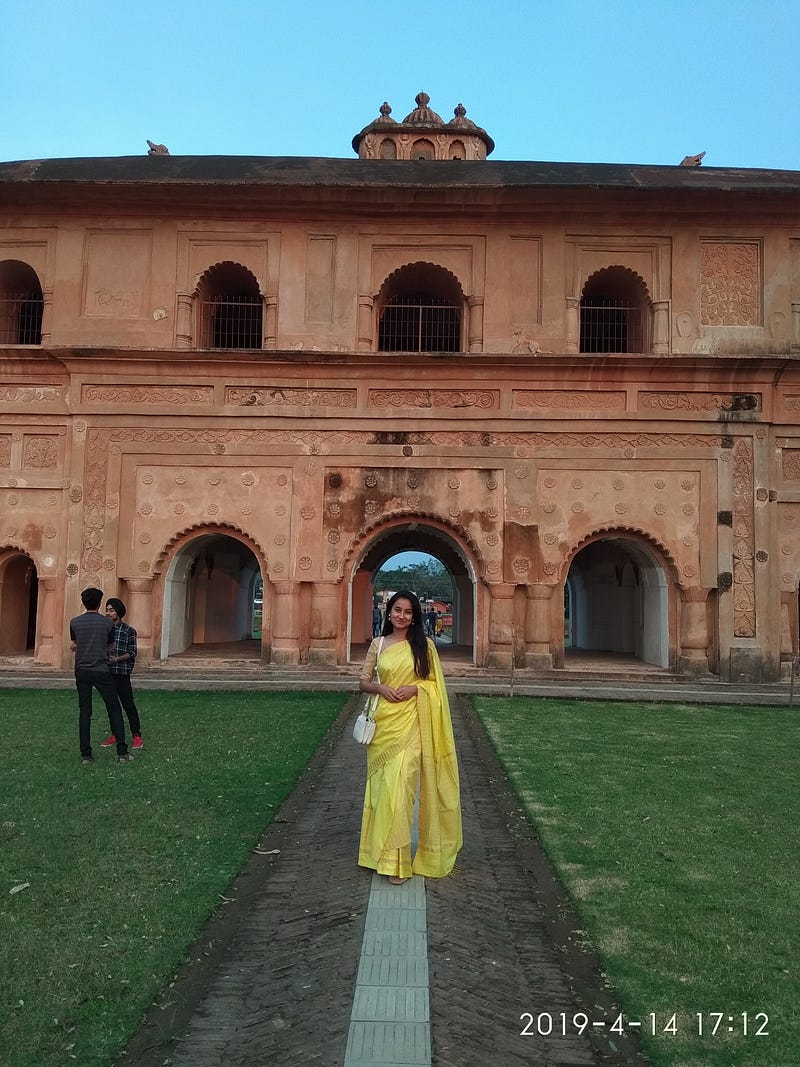
No, I am not talking about Outlander, although Jamie would be a delightful companion. I am talking about Assam’s very own history. I often remember the beautiful Bihu days I spent in Sivasagar back in 2019. Apart from the fact that I finally got to meet my online bestie Gayatri, I spent the majority of my time there amidst the remnants of our illustrious past. Don’t you wonder how the Ahom Swargadeos lived? Did their queens have retinues of servants and lady companions to keep them happy? Did the princesses frolic about in the beautiful and lush gardens of Assam? Did the princes learn to hunt and fight alongside their fathers and uncles? But then again, I go back to thinking about the harshness we associate with the story of Gadadhar Singha’s ascension to the throne and the torture and death of his beloved wife, Joymoti. Because that is what we think of when we think about royalty, do we not? Did these Ahom royals live resplendently or did they have an ounce of normality in them, like us Assamese today? The very perception of royalty brings a very Western or central-Indian picture into our minds. But what were our very own royals like? History books will never be enough. Because the bravery we associate with Lachit Borphukan does not seem to warrant a careless and frivolous living. Life in Assam was and is beautiful, but I also like to think that life here was kind. I imagine the laborers toiling under a shining sun, mixing the natural indigenous paste to make the wonderful Rang Ghar, Kareng Ghar, instead of the cement we use today. I imagine the laborers digging and digging to make the immense Joysagar. Did they ever imagine that one day their hard work would put them on the charts of world history? Did they reckon their perspiration would ultimately create the world’s largest man-made tank?
I could perhaps go on and on about the illustrious past of my land. I could list out the temporal and spatial remnants of the historicity that have eventually shaped our state into what it is today. And as the magnificence of my history drowns me, it also makes me soar on the waves at the same time. So tell me. Do you want to get lost in history?
A Brief Historical Note:
Ahom Swargadeos — The Ahom dynasty ruled the Ahom kingdom (present-day Assam, India) from 1228 to 1826. Swargadeos (literally, “Lord of the Heavens”) were the kings who ruled this bountiful land for nearly 600 years. Established by Sukapha, a prince of the Mao Kingdom, the Ahoms were a formidable people, who successfully defended Assam from the Mughal invasion, or rather, 17 invasion attempts. This long rule however ended with the Burmese (present-day Myanmar) invasion and the subsequent annexation by the British East India Company, following the Yandabo Treaty in 1826.
Gadadhar Singha and Joymati — Gadadhar Singha was an Ahom Swargadeo whose story is talked about to this day. Also known as Godapani, Gadadhar Singha had to go into exile following his father, the previous king’s execution. The opposing party had installed another Prince on the throne and begun a campaign to inflict wounds on the various other princes who were eligible for the throne. To escape this, Godapani went into hiding. Unable to find him, the usurpers physically tortured his wife Joymoti. But she was brave and never disclosed her husband's whereabouts, which ultimately enabled him to rise in revolt and assume kingship. After suffering continuously for 14 days, Joymoti died. Later, their son Rudra Singha built the Joysagar Tank at the place where she breathed her last. The first Assamese film Joymoti, directed in 1935 by Jyoti Prasad Agarwala, was based on her life.
Joysagar/Joysagar Tank — Considered the largest man-made tank in the world at 318 acres, the Joysagar lake was built by Swargadeo Rudra Singha in memory of his mother Joymoti Konwari.
Lachit Borphukan — Lachit Borphukon was a military commander of the Ahom Kingdom. He is famous for his bravery and leadership during the Battle of Saraighat, of 1671 when Mughal forces attempted to take over the Ahom Kingdom.
Once, during the Battle of Saraighat, Lachit Borphukon and the Ahom soldiers were constructing embankments to black the passage of the oncoming Mughal army. He had also ordered a wall to be built within the night, the supervision of which he had told his maternal uncle to do. However, when it was late and the progress still unsatisfactory, Lachit Borphukon had questioned his uncle and his negligence. This disregard of duty, especially amidst battle, was intolerable to the great commander who then beheaded his uncle and cried out, “Dexot koi mumai dangor nhoi” (My uncle is not greater than my country). The soldiers then clearly got the message and finished the task in time.
“Today, Lachit Borphukan is revered as the greatest military hero of Assam. In 1999, the then Chief of the Indian Army General VP Malik instituted the annual Lachit Borphukan Gold Medal Award for the best cadet of National Defence Academy (NDA).”
Source: https://www.livehistoryindia.com/story/snapshort-histories/lachit-borphukan/
Rang Ghar, Kareng Ghar— The Rang Ghar is one of the oldest amphitheaters of Asia. A glorious building of the Ahom kingdom, the Rang Ghar was used by the Ahon Swargadeo and his queens as well as other noblemen, as the sports pavilion. During the Bihu festival, there would be games like buffalo fights and others that would be carried out on the grounds.
The Kareng Ghar is a part of the Rangpur Palace, a huge seven-story complex that is to the southwest of the Rang Ghar. Also known as the Garghgaon Palace, this palace was rebuilt around 1752.
Nayanika Saikia graduated summa cum laude with a Bachelor’s degree in English Literature and was also a Dean’s List student. She is currently pursuing her Master’s degree. At the moment, she is working as a Booktuber, blogger, and reviewer with various national and international publishers. She can often be found on her Instagram account Pretty Little Bibliophile.