
Do you think education is fit for purpose? #2
Schools are under increasing pressure to teach students how to be good citizens whilst teaching a mountainous body of knowledge: here’s why the system isn’t working.

Reason #1: we don’t know what mass education is actually for.
The next thing we need to think about is whether our model of education works. By model, I mean the means by which we educate. Our education largely centres upon groups of students working with a teacher, within schools, followed by higher education largely consisting of lectures in Higher Education institutes: teachers working with groups of students. Let us ignore Reason #1 and say, for arguments sake, that education is about teaching some body of knowledge. Does education work with such a large number of students to teachers? Well firstly, how many students are in a classroom?
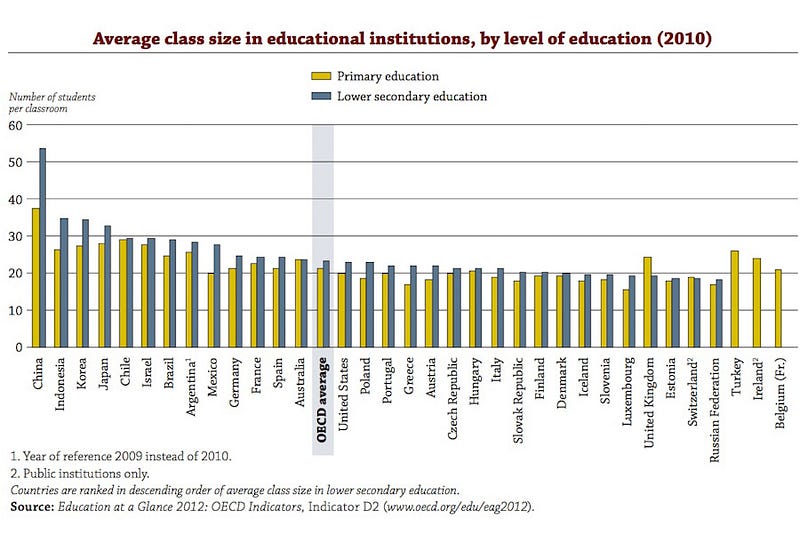
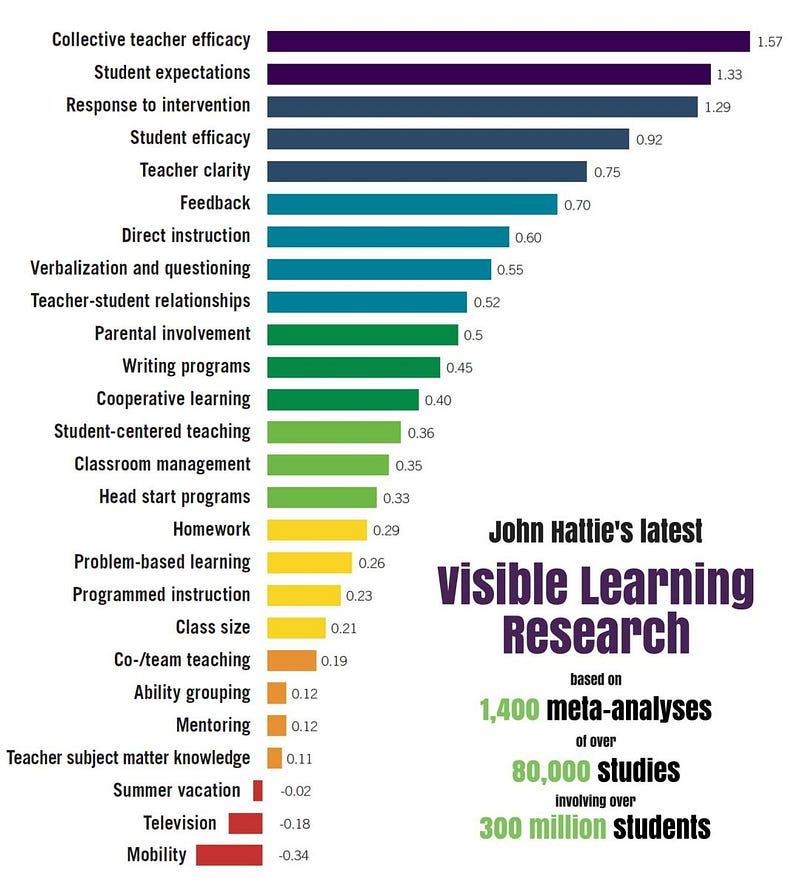
Across the world the number in a classroom varies significantly and will be a compromise between education quality and cost. Is there a direct correlation between class size and educational outcome? John Hattie’s famous meta-study, Visible Learning, showed that the effect of class-size. Looking at the graphic below the effect size for class size is 0.21, which is a measure of how much effect the academic interventions had on test results. The average effect for all interventions was 0.4 and Hattie suggested that anything below 0.4 was insignificant. To summarise this point, looking at over 300 million studies gave no significant evidence that class size improved academic outcomes in classrooms.
However, this seems like nonsense; surely, the fewer students you have in the class, the more help they can be given by the teacher and the better academic outcome? In Malcolm Gladwell’s book ‘David and Goliath’ he argues that that class size’s effect on academic outcomes is an ‘inverted-U curve’. What does this mean?
The graph below gives an example in which our performance is not always linear (more is always better or always worse) with our levels of arousal. Activation of hormones like adrenaline is needed to get us going in certain situations, like a difficult presentation we have to give, a performance in music or sport, or when sitting an important examination. Adrenaline helps our performance, but not linearly, it only helps to a point (the top of the ‘inverted-U’ on the graph below), after this it actually makes us get worse. After the tip of the U the extra adrenaline can make us shake, divert our thoughts to ‘flight’ (instead of fight) or even to ‘freeze’ and too much arousal can make us physically ill. More is better, but only up to a point.
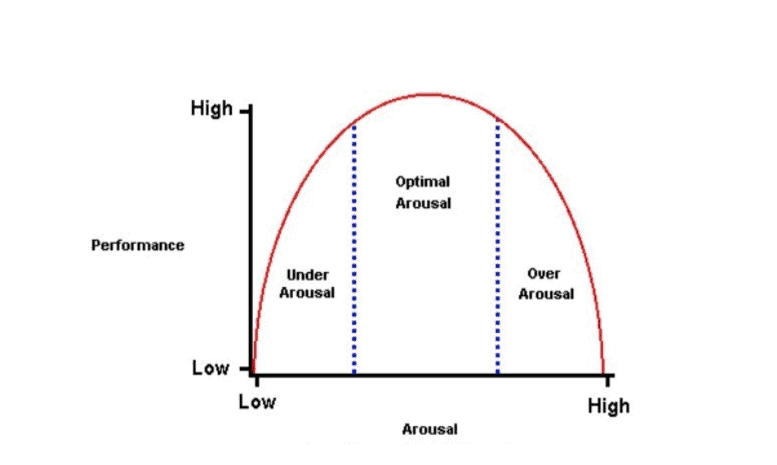
In Gladwell’s book he looks at a number of different things which people assume are linearly correlated, but are actually an ‘inverted-U’ like arousal and performance above. He starts with thinking about money and parenting. Of course, parenting with no money is incredibly difficult as you can’t provide the basic needs for your child, even for yourself. However, having too much money has it’s own problems. How, for instance, do you teach a child to clear up after themselves if you have cleaners? How do you tell a child they can’t have the toy they want if you have a Rolex on your wrist and drive a Ferrari to the shops? There is a ‘sweet-spot’ in the relationship between money and how easy it is to parent. More isn’t always better.
Gladwell then looked at crime and punishment and spoke about a ‘three strike system’ which was introduced in California in 1994. This meant that a felon convicted of a third offence, no matter how small, would be sentenced to a minimum of 25 years. He argues that this severity of this law had negative effects and that more punishment did not always lead to better outcomes in that state:
“But remember, the logic of the inverted-U curve is that the same strategies that work really well at first stop working past a certain point, and that’s exactly what many criminologists argue happens with punishment.” — Malcolm Gladwell
Here more didn’t always mean less. Some relationships are more complicated. So, how can this inverted U graph help explain away the lack of effect size found by Hattie?
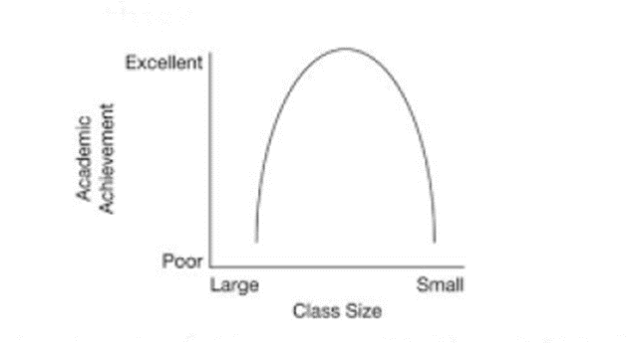
If Hattie’s study only looked at the top of the U, where classes are between 15 and 30 students, then, rightly, small changes in class size will not make much difference, but reducing a class from 50 → 20, i.e making changes to the extreme right of the U, must make a difference.
Then again, perhaps the problem is not with the class size at all but the way in which students are taught. Aristotle famous said that ‘we are what we repeatedly do’ and so learning must also be about doing, so what do we do in big classrooms?
I have worked in a big range of schools: from comprehensive, private, co-ed, single sex, big and small, in multiple countries and I have observed a huge number of lessons across the globe in my leadership roles. Although plenty will know more, I’m in a pretty good position to say what students ‘repeatedly do’ in the classroom. So what is it?
The answer is that it depends on a number of things, pre-dominantly the teacher. I have seen incredible teaching in which students are active in a number of different ways within 30 minutes of learning, using skills like negotiation, team-work, practicing empathy and constructing arguments. However, for the majority of lessons I have seen, students are using passive skills such as listening and copying. I would argue that the greatest difference to learning is in the quality of the teacher, and the size of their class size pales into insignificance. Going back to Hattie’s diagram above, Teacher ‘collective teacher efficacy’ is the number one effect size with a number of other ‘high impact’ results being within the remit of the gifted pedagog.
So do we get the best teachers teaching our kids to make our model work? As this is a highly controversial subject I will just ask us all to consider some questions:
What incentives do we give to the best students to go into teaching?
This is especially important when we compare the West to the East. In the East teaching is a high status job and teachers are well respected. For myself, as a physics graduate my choice to go into teaching meant that I had to pay to study an additional year (whereas my peers went straight into paid work) and then receive a salary a fraction of my friends who went into banking. or industry. Of course, I had more holidays, but no money to do anything in them!
If we do not incentivise the best into teaching we will not get the best teacher.
What are the pathways for our best teachers?
When I went into teaching I had to turn down an offer to be an accountant. If I’d been an accountant, possibly the least glamorous alternative open to me, I would have had a series of exams and planned career progression over the next decade of work. As a teacher, I had no progression or promotion until I moved across the country for a new job. Even when I finally made a promotion, years ahead of many who entered the profession with more talent and energy than me, what was the result? The reward, it turns out, for doing more teaching is to teach less. As teachers get better their administration increases and they are required to do more management, taking them out of the classroom.
If we promote the most talented practitioners away from the classroom, what will happen to the average quality of teaching?
How do university lecturer work?
For the most part, university lecturers are people that have gone into academic research. As part of their funding they are required to take on lecture courses with little or no training. They present to a large number of students who have varying interests, abilities and language levels. They generally present in the morning when students are least able to concentrate.
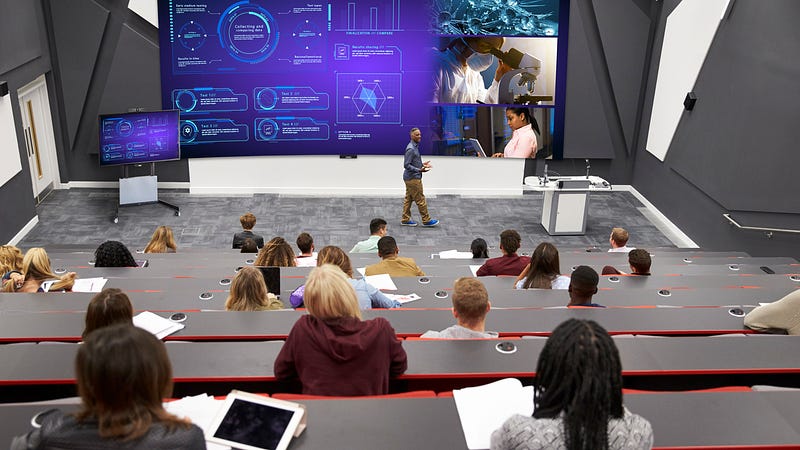
If we truly believe that lectures work why then why don’t we teach children in this way? If we don’t believe this is the best way to educate then does our system work for those in high education?
So, does our system work, even if we ignore the fact that we have no consensus on what we’re trying to achieve within the system? Well the fact that we have no clear evidence to answer simple questions like ‘how many students should be in a classroom’? Compounded this by the failure, in the West, to attract, train and develop the best teachers and lecturers, means that our model is unlikely to succeed. The very best we can say is that there is not enough evidence to show us how best to run mass education which is exactly why education differs across the globe. This is Reason #2:
Reason #2 we don’t really know whether our model of education work.
Part #3 of this article will be linked below in a few days and I’ll post the link below and send to all subscribers. If you’d like to read more thoughts about education have a look here:


