
Do You Need an Injection of Sacred Foolishness Every Now and Again?
Sometimes we just need to laugh to keep from crying

April, the month of fools is over.
Why not let it just quietly fade away? After all, there’s a lot of horrific and spooky stuff going on out there in the big bad world. Most of which is not particularly funny.
Precisely.
Sometimes we have to laugh to keep from crying.
Humor helps us cope with life’s challenges and absurdities.
But there’s nothing wrong with crying. It’s good for us. We release toxins through tears as well as our skin and eliminative organs.
Crying soothes, providing release and relief from pain. It may not heal the pain, but many report feeling better after a good full boar, no holds barred cry. Myself included. How about you?
We also say laughter is the best medicine.
Laughter Yoga is a thing. A big thing. Classes spring up everywhere–senior and community centers, churches, and fitness spas.
Laughing for ten minutes is the equivalent of a 30-minute ab workout. It tones and strengthens those same muscles, in a fun and pleasant way.
According to the Mayo Clinic:
Laughter enhances your intake of oxygen-rich air, stimulates your heart, lungs, and muscles, and increases the endorphins that are released by your brain. Laughter may ease pain by causing the body to produce its own natural painkillers.
No wonder comedy is so popular!
After watching the news, who wants to watch an intense drama. Well many of us, actually.
But some of us prefer to lighten up. This is why Trevor Noah, Stephen Colbert, et al are so popular. Hard, cold truths are easier to stomach when we’re splitting a gut over them, right?
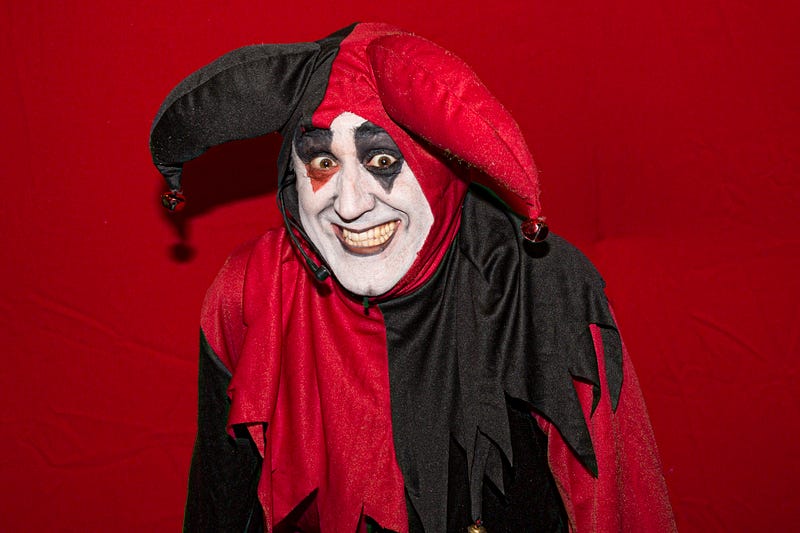
Trevor, Stephen, and the others are the modern version of the fools of old.
In Shakespeare’s time and plays, only the fool could disagree with the King and live to tell. If a Duke or Lord so much as suggested that a contemplated action, say an invasion into a neighboring kingdom to steal horses–which is why it’s called neigh-boring — was unwise, they could lose their head.
I mean that literally.
As in off with theirs. Put your sweet keppe on this nice, hard block and let Mr. Axe give you a massage. That kind of losing their head.
But for some reason, the fool had the sire’s attention and, perhaps by speaking in riddles, jokes, and parables could get the point across. Ix-nay on the vasion-inay. They had their own private language even if it wasn’t Pig Latin. But how do we know it wasn’t?
Then there’s the art of satire.
Defined as the comedy of outrage, satire takes real situations to fantastical and absurd extremes. So gross and far out, the point is made via quite dark humor.
For example, Jonathan Swift’s essay, A Modest Proposal, dealt with dire poverty and starving children with a uniquely cannibalistic solution. A solution that underscored the problem and got the attention that a dry didactic tract might not.
The film and TV show M*A*S*H underscored the horrors of war by showing Army surgeons pulling prank after prank on each other. And cracking jokes while operating on the perennial incoming wounded. Even my Air Force career officer Dad loved that show.
We need one like that today. Only instead of the Korean War, it should be set in the hallowed halls of the U.S. Congress. Right?
When these stories and shows stop being popular, we’ll know our society is in trouble. If it’s not okay to laugh, we’re no longer in a democracy. Just ask an older German person.
But even that horrific bit of history, with time, was able to be laughed at if Mel Brooks is any indication. The Producers — two films, and one Boardway musical — proves the formula comedy = tragedy + time with its crazy song, Springtime For Hitler.
Mel Brooks reminds me of Commedia.
The physical comedy we love to laugh at started with Commedia dell’arte in the Italian renaissance era. Starting as funny bits to wake up theatergoers attending long, serious dramas, its slapsticky, pratfall-full humor became a sought-out art form of its own. Based on exaggerated stock characters that poke fun at the rich and famous, it was the Daily Show and SNL of its time.
It caught on and spread. Commedia gave birth to such bouncy offspring as Punch and Judy, the Marx Brothers, the Three Stooges, Charlie Chaplain, Lucille Ball, and Monty Python. Physical comedy, where the bawdy body rules over the mind.
This is why I love it and take classes in it. I toss aside my computer-riveted chair to play Zanni.
Who’s Zanni?
My favorite member of the Commedia Parthenon–a clueless country bumpkin who works hard, plays hard, eats hard, and farts hard. He’d do something else hard if he had the opportunity. But his romantic overtures are mostly met with guffaws of rejection.
Harlequin the clown evolved from the Commedia character, Arlequino, and spread throughout Europe and found a new home in British melodramas.
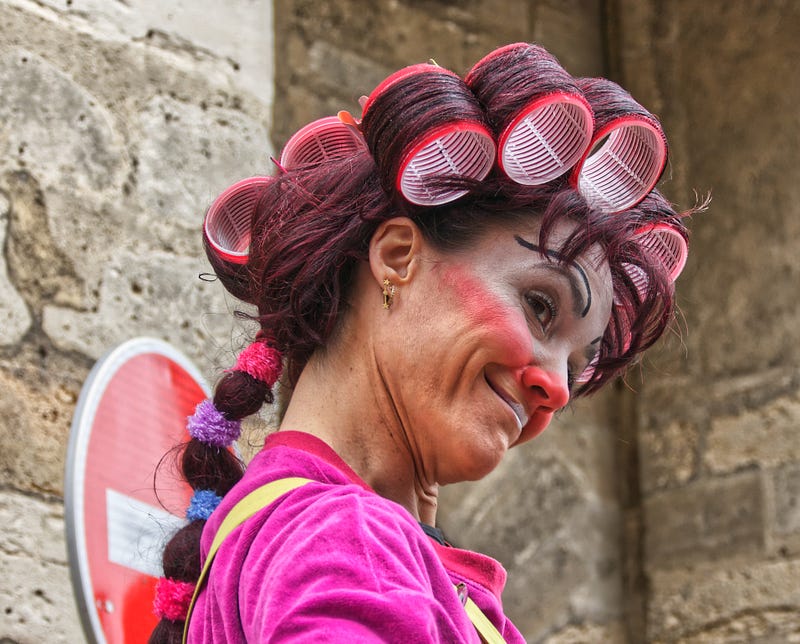
Speaking of Clowns, my sacred foolishness includes Duddles. She emerged in a somatic clown workshop. Somatic means of the body, bawdy and otherwise.
I discovered her by walking and noticing. When I exaggerated my unique gait and movements such as hunched shoulders and splayed out feet, Duddles was born. A sad clown possessed by outbursts of curious joy and a naive sense of wonder.
Sacred Foolishness
You can keep up with this and all my foolish adventures in my free Substack newsletter, Sacred Foolishness.
It’s where I get to explore niching down in an area I want to be known for–humor and comedy. It comes to your email inbox twice a week. You can read it all right there without having to click over to another platform. Yay!
Let me say thank you ahead of time. Your support means a lot to me. And it may mean I have a chance in Coffee Times Challenge #6. But who’s counting? Moi! Can I count on you to check out my foolishness?
It’s okay if you say no. It only hurts my foolish pride, as the song says…
Here’s Yana Bostongirl’s post about this Challenge to check out and consider participating in:
Marilyn Flower’s the author of Creative Blogging: Ninja Writers Guide to Character Development and Bucket Listers, Get Your Brave On. Clowning and improvisation strengthen her resolve during these crazy times. Follow her Sacred Foolishness and Stay in touch!


