
Do You Live In The Best Neighborhood For You Today And Going Forward?
Never Retire Checklist: #13
I spent 2002 to 2008 in college as an Urban Studies major (2002 to 2006 at San Francisco State University) and a Planning, Policy & Design graduate student (2006 to 2008 at the University of California, Irvine).
I decided on this course of study after falling in love with cities around the time I visited Boston for the first time, then subsequently moved to San Francisco in 1999.
The decision to go to college at an advanced age (27) and what/how I studied in college — unintentionally — seems to have foreshadowed what I do and the things we discuss in this newsletter today.
Either I’m rewriting history to tell a better story or one thing does lead to another in life even if you don’t see it happening in real time. Probably a mix of both.
In any event, we tie the things I did and learned between 2002 and 2008 to our discussion of living the semi-retired life, working less now so you can work less longer and Never Retiring in 2023.
Next to the present day, the time I spent in college was probably the best time of my life.
And college wasn’t even the highlight.
In 2003, my daughter was born. Definitely the best — and most stressful — day.
Funny story around that —
When my ex-wife was pregnant I didn’t have a mobile phone.
It was a different time. If somebody needed to get a hold of you, they had to call your house. If you weren’t there, they left a message. It’s anxiety-inducing to think we once lived this way! Without being able to get into immediate touch with friends and loved ones.
Because I needed to be reachable, in mid-2003, a few months before the due date, I went to Radio Shack. Yep, Radio Shack. On Market Street in San Francisco. I told the guy who helped me I needed a prepaid mobile phone, but only for a few months. Once the baby was born, I’d stop making prepayments and let my plan lapse.
He told me no problem with one condition.
Because he was certain I wouldn’t be able to live without a phone after having one for the first time, he made me promise I’d come back to him to purchase a better phone (than the Nokia model I started with) and secure a standard pay-by-the-month plan.
You know how that story ended.
It’s interesting because, as I was entering the 21st Century technologically upon the birth of my now almost 20-year old daughter (!), the decision to stop working and go to college looks a lot like the way I’ve been living the present chapter of my life. On one hand, I gave in to one now indispensable element of typical, modern life. On the other hand, I took a chance because I wanted something more than working 40-plus hours a week.
The parallels between then and now are intriguing.
The events of September 11, 2001, sealed my choice to quit work and go to college.
Sounds a lot like how the pandemic made people rethink life, then live it differently.
9/11 made me slow down and do something I always wanted to do, but never thought I’d get to. Because of work.
The pandemic prompted me to put the final pieces of my Never Retire puzzle into place. After meeting my partner of two years and three months, exactly how and why I will live a semi-retired life now and for the duration became clearer and more exciting than ever.
Maybe it was always in my blood. To slow down and do something different. To not let work — and the need to work — dictate my life.
Then there was college.
I’m glad I didn’t go when I was 18.
Long story short, at 27, after having worked full-time for the better part of the last nine years and at least part-time since I was 17 (more on that in April!), I had the mindset necessary to get the most out of my time in academia.
After only a couple of years in undergrad, I started doing my own original research, focused on how our built environment impacts our behavior, health and well-being.
Several professors suggested I apply to PhD programs. So I did and ended up at UCI.
In between the end of undergrad and beginning of graduate school, I completed my research in San Francisco and published two peer-reviewed articles in academic journals.
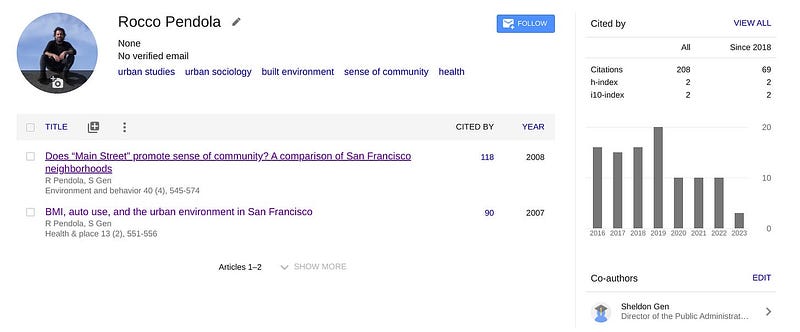
The first, (finally!) published in 2007 about the link between physical health and the built environment. The second, published in 2008, on how the physical differences between distinct neighborhoods within a city, impact our behavior and sense of community. It’s pretty cool to see scholars still citing these articles in 2023!
After dropping out of my PhD program in 2008, I wondered was it all worth it? Would the education I received ever be something I could use going forward in life?
Fifteen years in the rear view mirror that sounds like a dumb question because —
- I enjoyed the experience immensely.
- I got a lot out of it at the time. If it ended up only being a memory, that’s a win.
- Maybe most importantly, I developed my writing skills. My work in college allowed me to seamlessly transition to the freelance writing career I’ve enjoyed for the better part of the last 15 years.
Then there’s Never Retire checklist items #14 and #15, which we’re combining in today’s installment.
The Impact Of The Built Environment On Housing And Transportation
The Impact Of The Built Environment On Health And Well-Being
Without my education, I would not see the links between the places we live and our overall quality of life and well-being.
My research concluded that —
- The type of neighborhood you live in dictates the modes of transportation you’ll use most.
- The more people drive, the higher their body mass index tends to be, compared to people in neighborhoods where walking, biking and public transit are their primary modes of transportation.
- Residents of urban neighborhoods in San Francisco that resemble Main Street towns (a central, walkable commercial street within walking distance of surrounding residences) report a stronger sense of community than people who live in more traditional, high-density San Francisco neighborhoods.
It’s not just the cost of housing we need to think about as we enter relative old age. While that might be the most important piece of the Never Retire puzzle, how your neighborhood impacts your daily routine, physical health and psychological well-being matters just as much.
Illustrating it with my situation —
I love city living. It not only makes me happy in the day-to-day thanks to the walkability and abundance of things to do and see, it keeps me healthier than I might otherwise be. City life makes walking — one of my main forms of exercise — a built-in component of my daily routine most days. I don’t have to drive to run errands. I can choose to walk.
I know a lot of people who love(ed) city living as much as I do. However, around the time they had kids or wanted to buy a house (or both!), they moved out of the city because they could no longer afford it. I never did that. I credit my education and financial choices over the last 5-to-7 years with my decision to buck the trend, say screw home ownership and stay in the city.
This said, I know city living as we live it now can’t work for my partner and I as we prepare to enter relative old age. Technically, it could work. It just wouldn’t be optimal. It would be too expensive and require more work than we want to do to continue to afford life in Los Angeles, even on our rent-controlled, below market rate rent.
Here again, a move to a less desirable city neighborhood or suburb just isn’t in the cards because (a) it wouldn’t be that much, if even less expensive at all and (b) it would make us both — as much as we love one another — miserable.
So, we’re planning a move to a place where we can live in the type of urban setting we love and crave and pay less for housing than we do today. That place will be Spain, where the neighborhoods are far better suited to our tastes — and, dare I say, needs — than they are even in the best examples we have to offer in urban America.
It’s about money. But it’s also about health.
Our best chance of matching our health spans to our lifespans comes from living an active urban lifestyle and eating a Mediterranean diet. We want to be in the best possible position to do — and optimize — these things when we approach relative old age.
So we’re planning today and aim to get there in a tomorrow that’s hopefully no more than five years down the road, if not sooner.
That’s the question to ask yourself —
What type of neighborhood puts me in the best possible position to live my best life, financially, physically and mentally, now and for the duration of my semi-retired life?
Doesn’t have to be in a classic urban place. You can check the same general boxes I check with very different specifics in your favorite type of suburban or rural setting.
It’s about realizing the importance of and thinking about these factors sooner rather than later.
Receive a notification each time I publish a Medium article by going here.
Today’s article, a version of which appeared in my newsletter, is part of a month-long series on Medium. For details, here’s a link. Medium readers can receive 50% off a one-year subscription to my Never Retire newsletter.


