
Do You Like the Cozy Feeling of Waking Up and Cuddling Your Warm Blanket?
That’s cool. But don’t approach your life like this.

With all its historical events, the last year has been intense for many people. For me, however, the lockdowns in Germany meant that I would be staying in the comfort of my home for a quite prolonged time. Without the need to drive to the university or my workplace, and no possibility to work out in the gym, I started to become complacent. As a result, bad habits crept back into my life, and the urge to achieve my goals rusted.
This year poses a crucial crossroads for my life. At the end of this year, I will sit my final law exams, which will heavily impact my further pursuit. And although I was able to study rigorously during the lockdown — since there wasn’t much else to do anyway — I don’t want to stay in my comfort zone for the duration of this crucial year. To change this, I want to think about what discomfort means, how I can use it to improve myself, and develop ground rules, that we all can apply.
Discomfort
“Be not afraid of discomfort. If you can’t put yourself in a situation where you are uncomfortable, then you will never grow. You will never change. You’ll never learn.” - Jason Reynolds
The benefit of leaving one's comfort zone and seek discomfort is based on the human ability to adapt. When exposed to proper stressors, the human body and mind can adapt to the circumstances, and grow respectively. This basic concept makes our muscles grow after a workout or improves our endurance after jogging for a while. Our body adapts to the stressor, to handle future similar tasks with more ease and efficiency.
This works as long as the stressor is proper. Improper stress, however, can hurt us more than it helps. While bicep curls with appropriate weight will make us stronger, using too much weight can lead to a ripped bicep tendon, leaving us weaker than before. This means that we have to leave our comfort zone to experience growth but shouldn’t push it too far too fast.
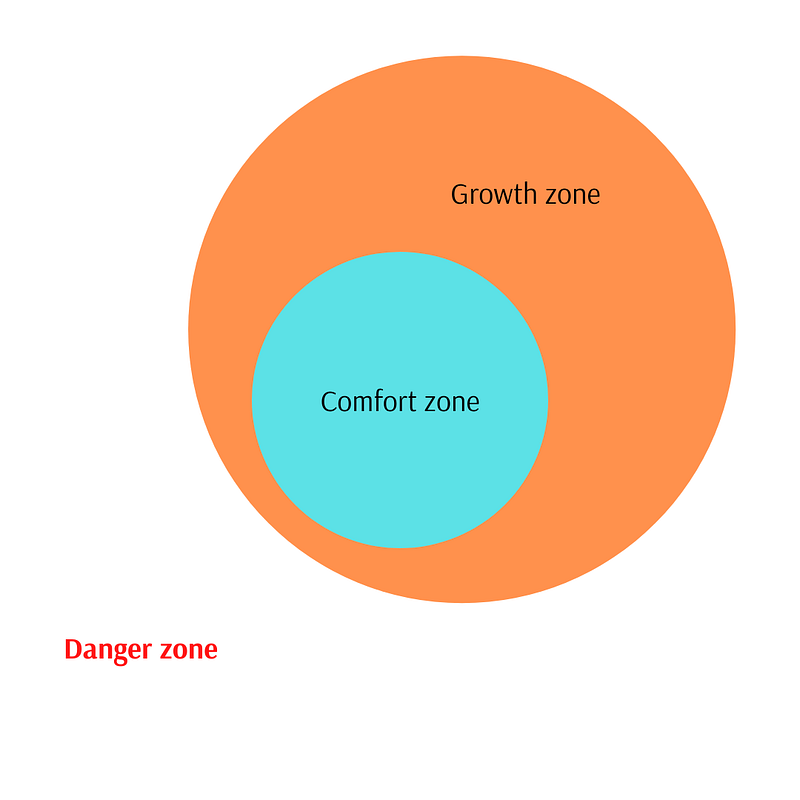
As we continually walk the limits of our comfort- and growth zone, they will expand respectively. Meaning that we will be comfortable with things we weren’t comfortable with previously and that we can push even further, without the risk of hurting ourselves.
The further we move into the growth zone, the larger our comfort zone will become. You could experience this for example when you are suddenly looking forward to your otherwise dreaded workouts.
How to Apply This Concept
“You only get one shot in your life, and you might as well push yourself and try things.” - Jason Statham
To grow as a person, you want to push yourself regularly out of your comfort zone, far enough to enter the growth zone, without ending up in the danger zone. By staying on the edge of these zones, we become more comfortable, and the zones’ limits will expand.
But we have to consistently move outside the comfort zone because if we stay comfortable for too long, the borders can also shrink again. After a year of limited interactions, some of us will find it even harder to give presentations or speak to someone in a bar. We simply didn’t practice it during this pandemic.
Also, pushing into one direction of our growth zone doesn’t necessarily make the circle grow symmetrically. Being comfortable with heights, and paragliding regularly doesn’t indicate that the same person is comfortable in social settings or job interviews. But as this person has learned how to push their comfort zone, they might grow in the other areas with more ease.
If you have a particular goal, such as improving your public speaking skills, you will have to focus on public-speaking-specific growth. But you can accompany these exercises with generally uncomfortable challenges, to turn the exposure to discomfort into a habit.
Discomfort Exposure
Such theories are only valuable when you can translate them into actionable steps. For this matter, I created habits around the notion of discomfort, which I have been following now for several weeks. Some of these habits are smaller, while the time-intensive ones are not only for the purpose of discomfort but also because they serve other goals that I have.
Cold showers
Since the concept of cold showers entered the self-improvement scene, they have been approached suspiciously. Some studies suggest that cold showers enhance metabolism by activating brown fat and strengthen immune responses. Anecdotally, cold showers can also improve one’s skin and hair, as well as provide a substantial energy boost in the morning. But these are the byproducts. What I am looking for is the discomfort a cold shower will create.
I started by showering as usual to then end with 30 to 60 seconds of cold water. Since last week I am using cold water all the way through; it’s hell, but I feel as if I am slowly adjusting to the temperature. It also helps me overcome other forms of discomfort, which represents the main reason I am committing to this practice.
Working out twice a day
I always had an on-and-off relationship with working out; however, I have been relatively consistent since November. Since I began to workout twice a day, every day, I noticed several improvements. I increased my happiness, my energy levels, and my physique, but most importantly, I stepped outside my comfort zone.
I found the challenging part of working out for me was to pick the right time spot. I don’t want to work out early in the morning since I am too tired to lift properly. After eating lunch, I feel too full and don’t want to interrupt a workflow I might have. And in the evening, I am exhausted and would rather do anything else than working out. But in the end, these are all excuses. Doing some light exercises because I am still tired is better than not working out at all. After lunch, a quick workout won’t destroy my workflow, but rather even benefit my energy and focus. And working out in the evening for 20 to 30 minutes won’t hinder my ability to relax and watch my favourite show.
To challenge these excuses regularly, I decided to work out twice a day. And it proved to me that every workout is beneficial, not only in the long run but also short term. Yet, starting a workout still pushes me outside of my comfort zone, which is why I have to do it more.
Public speaking
I have quite an ambivalent relationship with public speaking. It’s something that stresses me out like very few other things, but it also sparks equivalent levels of joy in me. I love public speaking once I am doing it, but I hate the time leading up to a talk or presentation. I sometimes find myself being anxious weeks before giving a speech, which negatively impacts my productiveness and mental wellbeing.
To change this, I increased the frequency of public speaking. I signed up for speaking classes and moot courts at my university, started tutoring again, and vowed to participate more during courses. Due to the current pandemic, all of this happens via zoom, which is not exactly the same as giving a talk to a present audience. However, presenting over zoom is also challenging, and, therefore, enabling growth.
Unplugging
Leaving social media behind has been a massive step for me outside my comfort zone. Social media has been my primary coping mechanism; Whenever I was distressed, uncertain, or guilty of procrastinating, I would revert to my social feeds. I have written a lot about quitting social media and its alternatives. To quit, during a pandemic, in which it seems reasonable to revert to social networks for some human connection increased the doubt and discomfort this decision had in store.
But it was something I had to do. It’s what leaving my comfort zone is all about: Making tough decisions in the short term, to improve myself long term. By dialling back social media, I regained control over my time and my mental peace.
Cooking my own food
During the first few months of this pandemic, I developed the habit of letting my food be delivered to me. It’s convenient, tasty, and I had the justification of supporting my local restaurants. However, with closed gyms and less time spent walking outside, eating unhealthy wasn’t the best idea. I had less energy throughout the day, my physique worsened, and the costs of food piled up quickly.
I began to plan out my meals, bought the groceries and carved out time to cook regularly. It’s way more effort and washing the dishes afterwards is the opposite of fun to me, yet, the decision reaps plenty of benefits, especially as I can still listen to podcasts and audiobooks while cooking.
Next to ordinary habits, there are also concepts to stay aware of — mindset habits. The one idea that stuck with me over the last couple of weeks was to do it afraid. Fear is natural and totally fine to experience. It becomes a problem when this fear is holding me back. So whenever I have a project or a goal creating anxiety in my mind, I stop, acknowledge the fear, and do it anyway.
We can’t wish anxiety away, but we can make sure that it won’t hinder our progress. By exposing ourselves to discomfort regularly, we learn to acknowledge the voice telling us not to pursue our dreams but also know that this voice seldom holds any value. In the end, leaving your comfort zone is not about feeling miserable all the time. It is rather about making uncomfortable decisions in the short term, that will ultimately lead to growth and progress.