
Do You Know Your True Needs?
You might need rest or you might need a roller coaster ride

I’ve recently started to claim space for myself in a different way. This new practice relates to my true needs — not who I think I should be, what I think I should do, or what someone else expects of me.
For example, I linger in bed more often.
I don’t ruminate, envision my day, or scroll on my phone. I simply luxuriate in the folds of my plush mattress, peer out the window where green trees meet blue sky, and take pleasure in the natural sounds that surround me.
I watch where my mind wants to go and gently bring it back to the present moment with a little smile and a silent chuckle. Then, I place my feet on the ground, an empty and relaxed vessel ready for a new day.
In the past, I might have called this “slowing down.” But, this new way is more than an externally defined prescription for stress relief.
This new practice means tuning into your true needs and allowing ample space for them. Your true needs might want you to sing at karaoke night, train for a marathon, or march at a protest rather than to live at a turtle’s pace like my own heart desires.
It’s all about your true needs.
Your True Needs Plus a Dose of Kindness
For me, this has indeed meant allowing more space, slowness, and softness into my days. I need regular doses of peace because I easily go into overwhelm when the world is too loud, too fast, too bright, too busy.
Just getting ready to leave the house on time can spin me into a frenzy. Trying to cater to my cat’s relentless demands for attention when they coincide with cooking dinner frays my fragile nervous system.
I’ve always identified as a Highly Sensitive Person (HSP). In short, that means I process incoming information deeply, need to avoid overstimulation, notice subtleties more than the average person, and feel emotions intensely.
You owe it to yourself to know and embrace your true needs. Your well-being depends upon it.
I suspect my brain and my nervous system work differently than those of most people—now called neurodivergence. Interestingly and happily, this insight and possibility has ushered in more gentleness, self-kindness, and self-acceptance into my world.
I’ve written about stress reduction and slow living many times and have adopted these practices myself to a certain degree. But there’s always been a push and pull given my getting things done temperament and a traumatized nervous system that wants to stay busy at all costs.
But now, those two lifestyle themes have combined with a deeper self-acceptance of my body and brain as it is. It feels like stress band-aids have been replaced by a kinder needs-informed lifestyle.
This new awareness feels deeply liberating.
Whether we’ve neurodivergent or neurotypical, we all have needs. You owe it to yourself to know and embrace your true needs. Your well-being depends upon it.
“When you recover or discover something that nourishes your soul and brings joy, care enough about yourself to make room for it in your life.”— Jean Shinoda Bolen
Get to Know Your True Needs
Strange as it may seem, we don’t always know our true needs. We may be so entwined with another person that we put our own needs to the side.
For example:
- We often try to be cookie cutter replicates of our partners. How many times have I adopted a partner’s wishes, attempted to go at their pace instead of my own, or attended an event I would never go to if I were alone?
- We may feel driven to fulfill the desires of a demanding boss. I worked twenty-four seven to fit into my boss’s normal and neglected my own needs for rest. It burned me out, and I’ve never fully recovered.
- If you’re a parent, your needs may seem like a foreign concept that only exists in a fantasy land.
Do any of these realities sound familiar to you?
I understand what it’s like to hide your needs. My needs kept popping through the seams here and there. But I’d just stuff them back into their bag and close the small tears with temporary stitches.
I didn’t want to be the person who needed pin-drop silence, required food accommodations, and cried at the tiniest provocation. I felt shame. Thus, it too me a very long time to recognize my true needs. And I also feel good about announcing them out loud.
What are your true needs?
If you’re not sure, use Abraham Maslow’s “Hierarchy of Needs” (pictured below) as a framework for discovery. An American psychologist, Maslow proposed this hierarchy of needs in 1943. The concept has been widely used since, especially in relation to motivation.
While there’s no conclusive evidence to support Maslow’s theory, his framework can still be a useful tool for self-exploration.
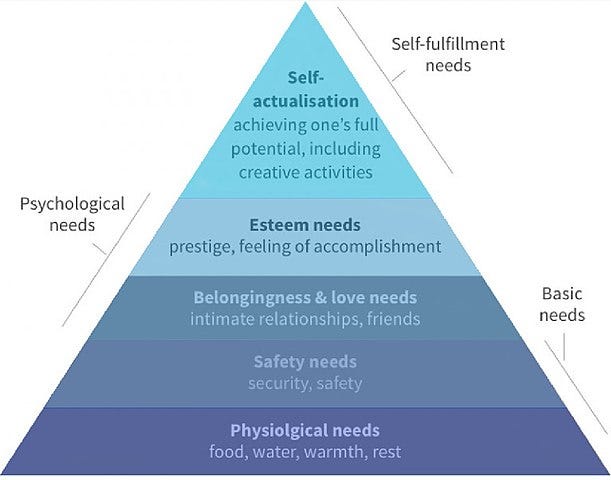
Set aside some quiet time to reflect on your genuine needs. Look at each level of needs in the above pyramid and consider:
- What do you personally need at each level?
- Are those needs being met?
- If they’re not being met, why? What’s blocking you?
Don’t feel limited by the labels or explanations. Make each level personal. For example, quiet is a bottomline, physiological requirement in my own case. Noise wears me down and at can quickly become intolerable.
If you’ve neglected your needs don’t feel bad. I’ve done the same.
I’ve set aside even my most basic needs by skipping meals to get more done, neglecting to put on a sweater when I feel cold, and foregoing sleep to meet a deadline.
But this is your chance to acknowledge your true needs. Knowing and embracing your real needs can transform your life in the best possible way.
“My mission in life is not merely to survive, but to thrive; and to do so with some passion, some compassion, some humor, and some style.” — Maya Angelou
Fulfill Your True Needs
Once you know a true need or two, the next step is to fulfill them. You can start small and progress over time.
Here’s how I began. I decided to take an on-going inventory of the stress-riddled moments of my life. When I experience one in real time, I’d ask myself, “How can I make this situation easier for myself?”
For example:
- Add on fifteen minutes of buffer time to my morning preparations. If I near my destination early, I can stop and watch the waves for five or ten minutes. Then, I’ll arrive on time and at peace rather than stressed out.
- Meal prep earlier in the afternoon. When my cat wanders in and demands a ten-minute massage, I can happily comply without trying to do two entirely different things at once.
- Spread errands over the course of a week instead of attempting to accomplish them all in a single afternoon and ending up a frazzled mess.
This might look like a list of stress reduction tips. But honestly, it’s not a one-size-fits-all stress management formula. It’s a personalized list. It came from looking deeply into how my brain and body operate, accepting my true needs, and creating an appropriate lifestyle accordingly.
You might need more stimulation, not less. It’s okay if you truly want to go to a loud party, ride a roller coaster, or drive a race car. Only you know what you truly need.
Concluding Thoughts
It takes courage and commitment to embrace and fulfill your true needs. But if you don’t address your own needs, who will?
Without recognition of your true needs, you could spend a lifetime going in the wrong direction and end up with regrets. You could get sick and never fully regain your health. You could slip into burnout or depression and live only half a life.
I don’t mean for those scenarios to sound like a threat. But the truth is, our choices have consequences. So will you attend to your true needs? Or will you focus on the needs of others, leaving your own behind?
For more inspiration, sign up for my bi-monthly Wild Arisings newsletter and receive access to free self-discovery resources.
You might also like:


