
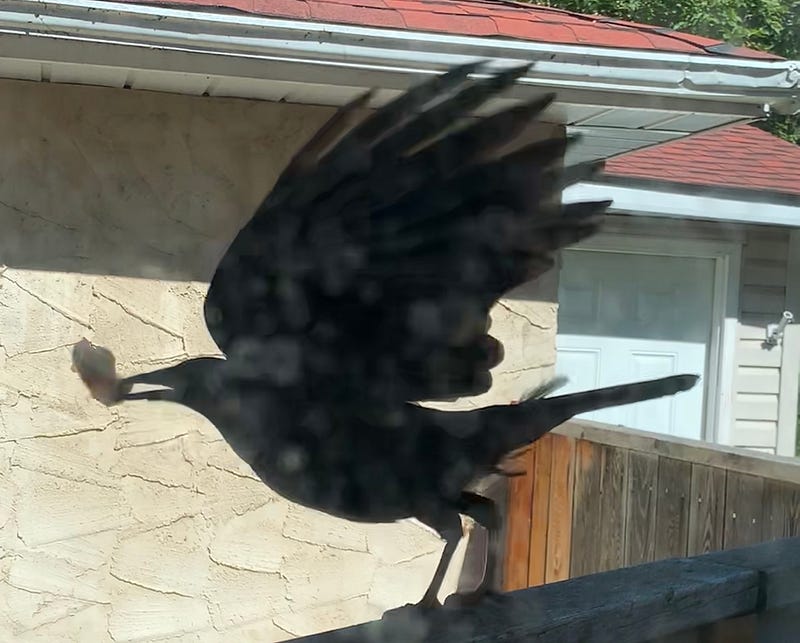
Do You Know The Crow?
The intimate, fascinating life of a crow I’ve named Charles.
Charles is an asshole.
He reminds me of a cat we once had named Odo, may he rest in peace (or rather, we can now peacefully rest as he has passed on!)
Charles is not a cat, he is a young crow. I like to feed him and his family when we have some old bread to share. I have always considered crows to be amazing creatures and have been educating myself on them bit by bit over the years. Of course, I’ve barely scratched the surface of what there is to know about this corvid! They are incredibly intelligent and resourceful creatures.
Having this crow family live so near to us and attracting them with food has ramped up my interest. At the bottom of this article, I share an interesting TED Talk and two of my favorite documentaries about crows.
However, as much as I enjoy learning the biological and social facts about these large glossy birds, I can’t help but engage my imagination — what is going on in their feathery family lives?
In fact, I have no idea what the gender of this animal is. (It’s almost impossible to sex a crow unless you study their behavior over nesting season or are a crow expert.)
He didn’t tell me his name and I can’t explain why I feel he is a “Charles”. Maybe it’s because he comes across as entitled as royalty?
“Caw Caw Caw Cawwwwwww,” his incessant vocalization sounds sarcastic and whiny.
“What is your problem, kid?” I ask him. Then I notice something startling.
Mouth Agape
There are three crows on the top of our garage roof. He and one other crow hop over to the third and lean their heads back with pleading mouths to expose a flash of pink! These are still young ones begging family members for food and the rosy area around their mouths (called a “gape”) indicates they are still young enough to demand to be fed.
(For magnificent captures of the juvenile crow gape, see junehunterimages, The Urban Nature Enthusiast.)
Wow, Charles looks like a fully grown crow, I had no idea he was still really just a kid! So I scour Google in search of more crow-tastic knowledge.
Survival Through Cooperative Breeding
You can recognize a young crow from their feathers: they are disheveled and not as glossy and dark as a mature crow. The “gape” remains a bright pink until they are about three months old.
Once crows hatch from their eggs it’s a survival game. It is rare to see a fluffy young crow because they remain in the nest for 30–45 days until they are mature enough to move independently.
Once the fledglings leave the nest, they are vulnerable because they cannot yet fly. They typically keep near the nest area and take shelter under vegetation when necessary. (Most young crows don’t make it past their first year.)
The little guy is watched over and fed frequently by not only his parents. Little Charlie’s older siblings are also looking out for bullies (a.k.a. predators) and gathering snacks for him too. North American Crows will stick around with the family for at least two to three years, (sometimes even up to six years) helping to build the nest for the next season of eggs and caring for their little brothers and sisters.
While the other family members are discovering their own food sources, Charles follows his family around, screaming his annoying cry, cocking his head back,
“Feed me, feed me, feed me, come on! feed meeeeee!”
What a lazy little jerk! This growing up business to independence is not a good deal, he thinks.
Over the next few weeks as Charles matures my search engine is smoking: “American Crow”, “crow calls”, “intelligence in crows”. I fire in some keywords for reliable sources. I want to understand the drama I am watching unfold around our house.
Developing a Voice
How about this? Did you know that crows are considered part of the songbird family?
Pavarotti's they are not. Crows get a bad rap for their harsh call, but I find it comforting. In fact, when you pay attention, the sounds they are capable of making can be intricate and bizarre. And did you know that crows can even learn to imitate speech? I do not doubt if after witnessing Charles mumbling to himself one morning…
There were no other crows obviously present while he was on this rant. Personally I think he was practicing sounds in private, like a toddler learning to pronounce and form their own communication.
Rebel Without A Clue
As Charles has been maturing I’ve noticed the whiny sounds diminishing as he is forced to learn how to feed himself, although not without complaint!
One morning after throwing bread out on the garage roof, I heard his distinctive irksome noises but they were muffled. Now what was he up to?
I looked up from my work station to observe the following. Charles is picking up the bread and yelling at the same time. Cawing and chewing (do crows chew?) and complaining but eating.
Another crow lands nearby. I’m assuming this one is a family member because Charles hops over to him, performing his whiny screech as if to say, “Don’t make me eat this bread like a chump! Chew it for me first! Come onnnn! Chew it!”
The other crow clearly makes a point by flying away — “You’re on your own now, Bub!”
So Charles returns to his bready morsel and continues to rebelliously mope, chew, caw, chew, caw until he finishes his piece.
Growing Pains
I’m not sure why I don’t see Charles around anymore. Perhaps now at full maturity, he physically blends in with the others and I just can’t tell. Perhaps the Magpies and Blue Jays I’ve been hearing around more often have chased this crow family away.
He was an annoying little jerk and yet here I find myself missing him in a similar way to Odo. I can’t say I miss the galling behavior, but I do miss the way he captured my imagination.
And then…
Just yesterday, Charles made a return. As if knowing I was about to publish a little story about His Highness, he made about five visits to my window, staring in at me just a few feet away, enjoying some morsels of bread. It’s good to see you again, Charlie-boy!
Knowing Me, Knowing You
Crows are inquisitive and smart. There is so much to learn about them I understand how a scientist becomes enamored with studying this species. Emotionally I understand how humans like Shawn Bergman have been lamenting the loss of his best friend, Canuck.
These birds challenge you to take notice of them. And trust me, they are observing you too.
Thank you for reading! To learn more about crows and crow behaviors I hope you’ll enjoy the documentaries and a TED Talk I’ve curated for you here.
8 Step Problem — Solved by a Crow
Crows Ain’t No Bird Brains!
David Suzuki Provides a Glimpse Into Crow Life
A Murder of Crows | The Nature of Things | CBC


