
Do You Know Medical Misdiagnosis is a Major Problem?
Why you need to be your own healthcare advocate.
For more than 40 years, doctors told me I had a herniated disc, spinal stenosis, degenerated discs, and scoliosis. I refused to have my spine fused even when the pain was so bad I ended up in the ER with intravenous morphine.
Then I found out the diagnosis was wrong.
After a severe car accident that broke my pelvis in seven places and required a metal rod to stabilize my fractured femur, I saw my x-ray. The head of the femur extended past the acetabulum or socket and sharp bone spurs prevented outward rotation of the leg.
Compared to the other hip, the difference was noticeable.
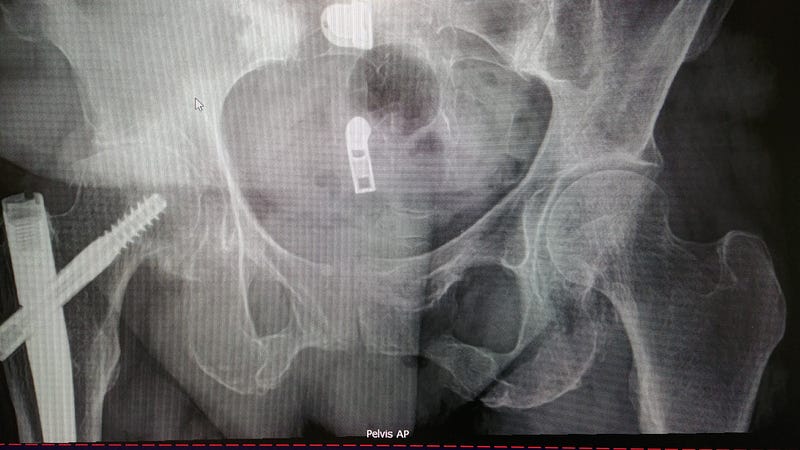
I knew hip dysplasia when I saw it.
I’d previously bred and raised German Shepherd dogs and was very familiar with the look of a dysplastic hip in dogs which is not that different from humans. I knew how dysplasia crippled dogs, making stairs painful and jumping impossible, but I’d never thought that I might have the same condition.
While only 1% to 3% of people have congenital dysplasia, it’s more common in women and, oddly prevalent in the left hip. It is the leading cause of hip replacement in people under 50.
Once I recovered from my accident, I consulted an orthopedic surgeon who readily agreed with my suspicions. As a result, a month before COVID, I had my left hip replaced. Now, I have absolutely no back pain for the first time in many decades and can walk and hike pain-free.
The auto accident was undoubtedly bad news, but it ended up with a positive result. Of course, I wish I’d figured out the problem sooner. Until the adoption of managed healthcare, I’d never had insurance, and like many of us, healthcare was a hit-and-miss affair.
What did I learn from this experience?
We must be advocates for ourselves and our loved ones. I believe most doctors care, but they will never be as concerned as we will ourselves. For example, a doctor never watched me move, asked me questions about how long I’d had pain, or considered I might have an underlying problem.
“Anything that causes the hip to be stiff or not move in a normal way will put pressure on your back,” says Jonathan M. Vigdorchik, MD, hip and knee surgeon at Hospital of Special Surgery.
Dr. Vigdorchik led a study that suggests 82% of patients’ back pain was resolved after a total hip replacement. Eighty-two percent!
I’m not suggesting we all become Doctor Google or diagnose ourselves on WebMD, but we must do all the research we can. Consult two or three doctors regarding serious diagnoses. Don’t be intimidated, and do ask questions.
This was not my first similar experience.
My son had nodules on his thyroid a couple of years ago, and the first doctor he consulted was ready to do a complete thyroidectomy. We researched and found the top specialist in the field, regularly publishing in respected medical journals. She suggested a conservative approach of biopsy and watching them. They were benign and five years later, have not grown and have not needed any treatment.
My father had a stroke, and the doctor said we should leave him in a nursing home as he’d never walk, talk, or eat again. Two years later, he lived by himself, walked to the university, and enrolled in a computer class.
What’s the lesson to be learned?
- Twelve million people in the United States are misdiagnosed each year.
- Of these, 40,000 to 80,000 people will die as a result.
- Women and minorities are affected 20% to 30% more often than others. —Why Getting Medically Misdiagnosed Is More Common Than You May Think
Whenever possible, individuals shouldn’t go to medical appointments alone. It’s hard to make notes and ask questions while being examined, and an advocate can make the process easier.
Research before your appointment and make notes of questions you have. No doctor should be offended if you have an opinion and ask for clarification.
Medical professionals should be our healthcare partners, not a mechanic to fix us up.
Of course, prevention is always better than a cure, whether it’s hips or another condition. You may remember seeing your newborn being screened for hip dysplasia, for instance.
But now that many parents are carrying babies in slings which must be worn properly to avoid potential hip problems. Read more in this article, Baby Wearing, on the International Hip Dysplasia Institute website.
We are ultimately the prime keeper of our own health.
And we better realize it. Poor nutrition is the #1 cause of death in the United States compounded by lack of exercise, smoking, and drinking. We all know we can change those factors.
The internet has put more information than ever before, right at our literal fingertips, so let’s use it to maximize our well-being. When you’re concerned about your health, investigate before you visit your doctor. Ask questions and take responsibility.
I wish I’d been more proactive about my back pain, that’s for sure. But lesson learned, and I love what my grandson calls my new robot hip.
What have been your experiences? How have you learned to be your healthcare advocate? Your stories can help someone else, so please share.
Nature and learning inspire Cindy. People and writing make her happy. To get her Writer Weekly from Dripping Springs, Texas, sign up here.