
Do You Know How to Connect the Dots?
You might gain a new perspective.
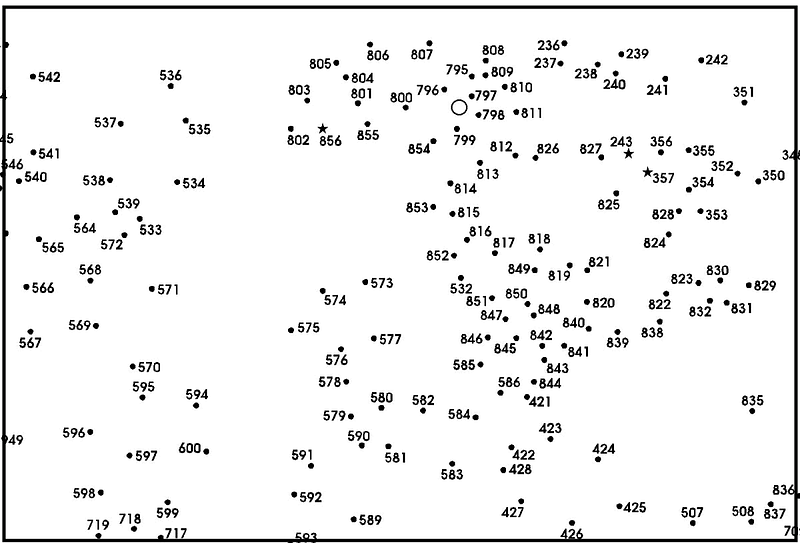
Did you ever solve dot-to-dot puzzles? I loved them and could sit for hours searching for one number after another. Seeing the image revealed by connecting the dots held a magic that I cannot explain.
The metaphor of connecting the dots to learn, to understand, to see with new eyes helps make sense of the unknown. A new perspective emerges when we can visualize how ideas or concepts interrelate.
Connecting the dots in life…
Our families, schools, businesses, the world contain a myriad of dots within systems and processes. To make sense of the world we are constantly trying to connect dots.
Language begins with connecting words to things and eventually more abstract concepts and ideas. As we learn those more complex concepts, our brain naturally searches for something that we already know. We connect the known to the unknown.
Importance of connecting . . .
When we underestimate the power of making connections, we create silos in our homes, communities, and workplaces. I have my dots. You have your dots.
Nature doesn’t work that way. Humans can’t work that way. What happens in our human body when organs stop doing their job of connecting our blood to other vital parts? If predators become extinct and other animals or parasites take over, what can happen? Where do we find ourselves when departments work in silos?
We know the answer to each of those questions. Illness. Disaster. Toxic cultures.
Connecting for meaning. . .
In our knowledge worker society, making meaning of our knowledge becomes dependent on how we make meaningful connections. Connections that foster learning, creativity, and understanding diverse perspectives.
Hugh MacLeod has captured this concept artfully in this drawing. His simple illustration reminds us that having bits and pieces of information is only that. Bits and pieces floating around in space.
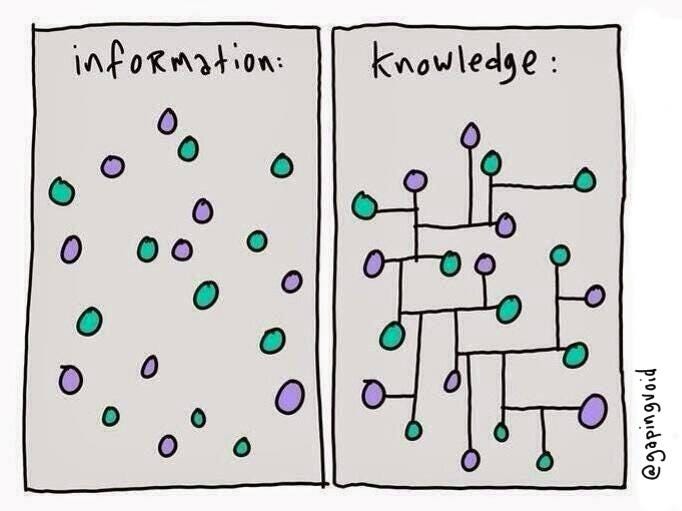
By making connections across bits of disparate knowledge, we formulate ideas and gain the knowledge to see differently, to make decisions, to create something new.
Our world needs our willingness to create knowledge. When we try to make decisions based on isolated data points or snatches of opinion, the results are tenuous at best.
Three ways to connect for new perspectives…
The divisive dialogue running across our screens and within our communities enlarges the gap to understanding one another. We live in the world of our individual dots of information. Here are three ways to begin broadening your knowledge and perspective:
1. Ask questions
How did I get to this point? What happened prior? Has this occurred elsewhere? Do I know the underlying cause?
2. Recognize and test assumptions
What key assumptions do I or others bring to the situation? What are my beliefs? How do those assumptions and beliefs frame my thinking and decisions?
3. Look at the big picture
How do I balance the big picture with the important details? What am I missing? Am I focused on the cause or just the pain points of the situation?
When we don’t connect the dots, or we connect them haphazardly, the picture we create can become distorted. How will you connect dots of information today to improve your ability to view your thinking, beliefs, and life from a fresh perspective?
You might also enjoy…
Be and become your best!
Get more on my newsletter Inspiring #yourbest.
Kathryn A. LeRoy — a relentless seeker of excellence, kindness, learning, and believer in the strength of the human spirit. My why — inspiring your potential to be and become your best.