
Weeks After My Daughter’s Death, and I Still Don’t Know How She Died
The complicated grief that accompanies an ongoing investigation
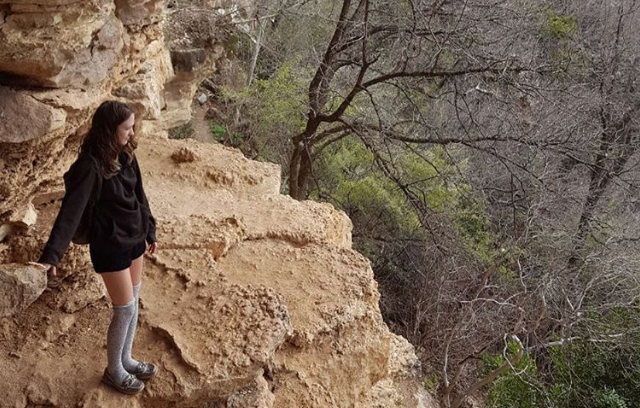
Grieving a 21-year old is complicated enough without dealing with an ongoing investigation.
I can’t talk about the particulars. Even though forming sentences about this agony is the only mental activity that gives shape to this bottomless grief.
Something took my daughter, yet I can’t speak of it. How can this be true if I can’t chew it and swallow? I figured out just now the reason my throat seizes up when I think of her. It’s because I can’t give voice to what I’m thinking, let alone feeling. It’s literally stuck in my throat.
There’s no turning back. And there’s no going forward. I am gagging on my existence, two and a half times her age, a travesty now that she’s gone.
But she was right here. She was right here, last I saw.
Last I checked, she was here in this world. She was doing fine, I thought. She walked among us. She was needed. She had two boxes of contact lenses in her bathroom drawer. She had a purpose, and jokes written down for a stand-up stint, and talent on display, like jazz hands.
Then they told me no, she was not. She was gone.
The doorbell rang before dawn and there were three of them.
Someone started speaking — a woman in blue, with “HOMICIDE” on her breast pocket. She said, “Do you know Catherine?”
“Katie, Yes. I am her mom.” (The dread.)
And she wasted no time. “Catherine has died.”
I have replayed that sentence thousands of times in the past four weeks. “Catherine has died.”
Not “Catherine died last night.”
Not “Catherine is dead.”
Not “Catherine has passed away.”
Not “Catherine is no longer.”
Not “Catherine is deceased.”
Not “Oh, Katie, then… Katie has died.”
This woman, she spoke in the passive tense. I imagined a training manual recommending such phrasing. Use the birth certificate name. Offer no details. Answer questions only if they are asked, etc.
Do not even acknowledge her nickname, “Katie.” This woman with the ugly “Homicide” label on her shirt stuck to her formal name. Catherine.
Do I know Catherine? Do I know Catherine? You are standing at her mother’s door. I DO know Catherine.
And then…
“How did she die?”
There it was; the word DID. In one instant, the world heaved. I did know Catherine. Yes, I did. How did she die? I was the one who asked.
Past. Tense.
Why am I tonguing all these variations, like picking a scab? She is gone.
The grief is the thing, not the death. We will deal with the details later. For now, it’s the fact of her gone-ness. We will put off how she died until we have more information. “The medical examiner needs more evidence,” is what they’re telling us. We’ll just hold tight for a little while…
’Til the chicken thaws; ’til the puddle dries in the shower again; ’til the crepe myrtles start sending up blooming shoots. Could it be as long as that?
For now, all I have is grief and its shape-shifting torment.
Like a torn-off limb, there is the time before the doorbell rang, and the time after.
There is the side hug in the car six days before she died, and the “I love you so much” (an Austin thing) as I dropped her off at her apartment after watching “Knives Out” and laughing at all the same jokes together. There is the memory of her making her way up the apartment steps. I was looking at my phone though, which is odd because I usually watch her until she disappears from sight. But I didn’t that evening.
For some reason, I thought it was more important to check my phone. She was a young adult on her way. She was good. Ever since watching the movie “Gloria,” where the mom circles the airport in her car, then scrambles to see the feet of her daughter rushing toward the gate, I decided it was time to be cool. Katie nicknamed me “Hen,” if that tells you anything.
I glanced up to make sure she made it up to her door, but I must not have tracked her with my eyes the way I usually do, or I would remember her walking, wouldn’t I? I remember thinking this as I checked my phone: YOU ARE CHOOSING YOUR PHONE OVER YOUR DAUGHTER. I remember her green sweater. Maybe I can see her walking.
But sometimes I can’t see her walking away. I can’t see her walking. I can’t see her!
The panic sets in.
Yes, that night I was playing it cool. I had all the time in the world. I could read my texts and cast a casual glance at my girl before she disappeared on the apartment stairs. I’d see her again next week. This life is so good. We are so cool.
Sure.
That was then. Now nothing matters except that last time I saw her.
Six days later, my doorbell rang.
Not knowing how your daughter dies allows you to miss the very fact of her.
You get to savor the pure loss in stunning clarity. Death is unknown. Death is not the point. Death did its job and took her as completely as any other. Death is death. No need to ruminate on details.
An investigation is underway, though, and it somehow preserves this almost-real, current version of her life. Like reading in bed before dropping off to sleep, the drama drips out an imaginary life. As if she’s still engaged in life, and going through the motions of living. As if her shoes and books and makeup are not bagged up in my garage right now. As if I did not see her tiny body in a casket the other week and touch her clammy, waxy forehead with my lips.
I’m play-acting through this investigation. Does it even matter? The action is past. I missed a scene, but I know she’s gone.
I am gone, too. That’s the weird thing about losing a child.
The piece of your heart that you watch walk away like all the thousands of times before, has left the building completely. Poof. The hole expands. You can actually feel it eating your heart away.
Other times it’s as solid as a frozen chunk, clenched between cords of vein and artery, grappling with the idea of surging blood. This will be slow, this will be hard, and it will ache. This heart will not soften and flow. This will, with every beat, be a knot of gristle choking through some gritty passageway. The heart will not let this blood pass, and pass, and pass through as if it would continue beating for long.
And yet it does. Like a heavy cart of coal locked and loaded down gravity’s rails in an endless journey through darkness and light, and darkness again.
I remember to breathe sometimes. And then I forget to breathe and I breathe anyway.
This is the part where I tell you about my daughter. This is the part where I tell you what it was like to be my daughter’s mom. This is the part where I keep her memory alive by breathing life and significance into a dance too wild, exquisite, and short to call a life.
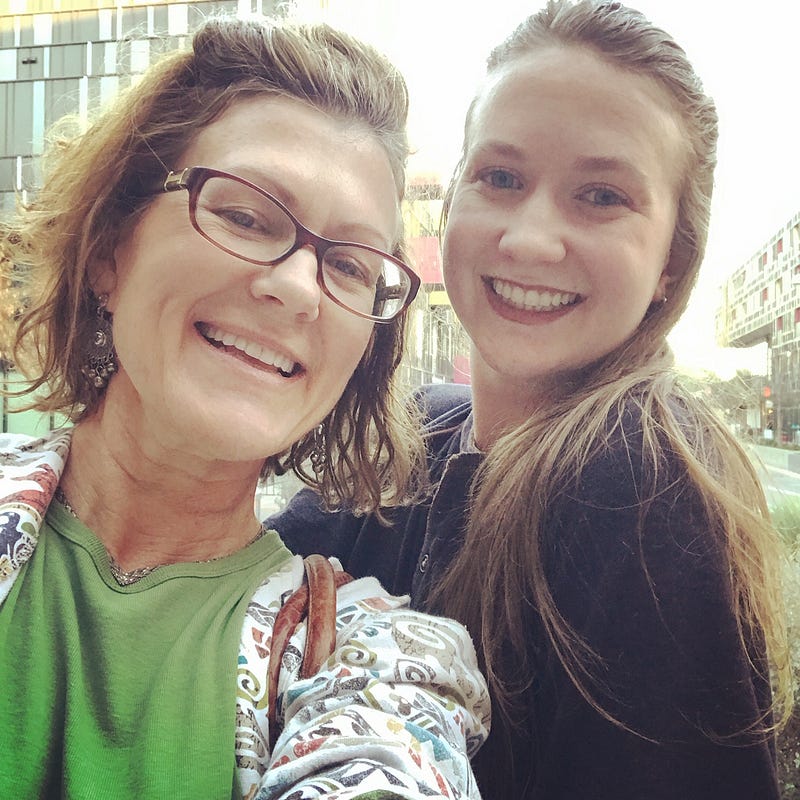
Once, while hiking in Utah, she filled a notebook with words written five lines deep to a line space because she worried she’d run out of paper. This is where I tell you how her senior painting project was ruined by some stupid kid who leaned her still-wet painting against my daughter’s masterpiece, leaving a mean, red streak across her semester’s work. It’s where I tell you about how she loved to dance, but then her foot got crushed under a car in a stupid accident, and so she had to find a way to dance without gravity, and chose a pole and learned to dance with her arms and torso. This is where I get angry about all the injustice in her feisty life and that maybe, just maybe, she was tired of it all. The stupidity of it all. Tired of living so mighty hard.
To grieve my 21-year-old daughter whose death is still undetermined by a medical examiner feels like a pile-on. Bring it.
I want to go too; my faith is gone. The gods are cruel, after all. If I could follow her, wouldn’t it be like another mad pig throwing itself off a cliff, tumbling meat-on-meat to the valley below? I fear I will not recognize her on the way down. I can’t even see her walking away. Redemption is a gift for someone else. Not us.
Some days every breath is a blow. Some days I open several bottles of wine and thank the setting sun for taking mercy. It is winter and the days are short. What arc will this cruelty take when the light doesn’t fall until late in the day? What will I do with so many more waking hours, when my only hope is scratching off the days like a prisoner?


