
Poetry, Nature, Essay
Do You Have to Name it to Know it?
Pondering the question through the eyes of a bee
There are no fixtures in nature. The universe is fluid and volatile. Permanence is but a word of degrees. — Ralph Waldo Emerson
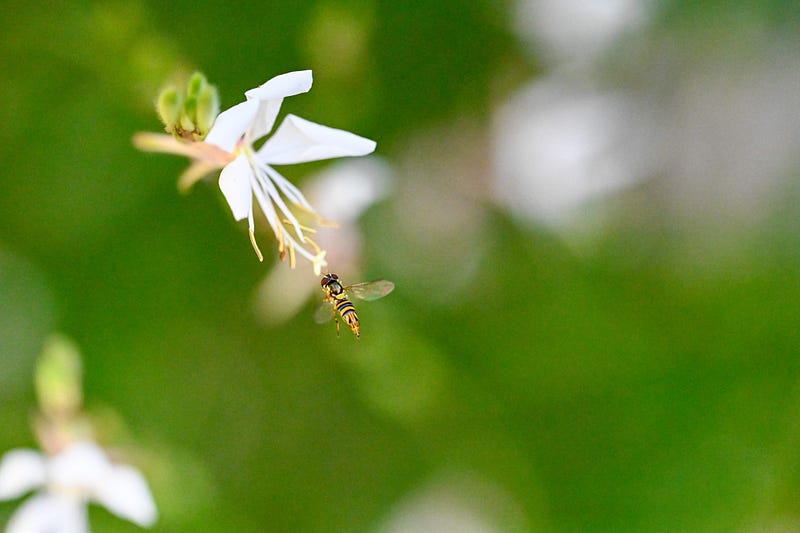
Every year it explodes like white confetti from the sunbaked ground.
I don’t even know your name, dear flower.
But here’s the question — do you have to name it to know it?
Or does that confuddle the whole experience?
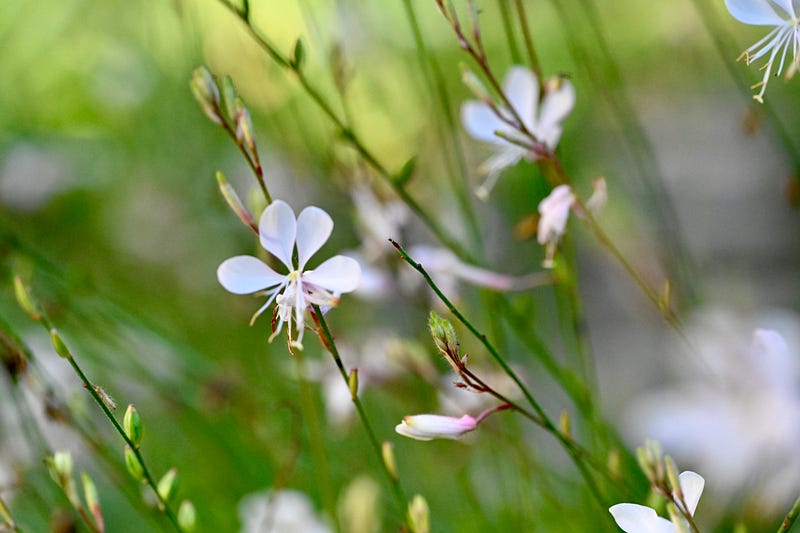
All I know is that I want to see it, that spattering of white-breathed stamen cupped in the baby’s blush four-fingered palm nodding on a stalk of ordinary green,
which doesn't seem so ordinary to the tiny bee nuzzling in the folded snow solidified to flower flesh.
I want to see it as that bee, without words, or words which spill from human tongues, at least.
Perhaps a taste of sun-warmed nectar is all it takes to really see it as a bee.
But then, I ask,
what does that bee seem to “be” to the flower?
Eastern philosophies have long pondered how concepts, objects, and perceptions are changed when they are named. Ralph Waldo Emerson, who was a student of the Upaniṣads, wrote about this in his essay “Circles,” in which he said:
“Our life is an apprenticeship to the truth, that around every circle another can be drawn; that there is no end in nature, but every end is a beginning; that there is always another dawn risen on mid-noon, and under every deep a lower deep opens.”
Emerson’s words influenced me deeply when I first encountered them in college, but it wasn’t until I was much older and was studying Eastern Philosophy in graduate school that I realized how much the Transcendentalists were influenced by teachings from the Upaniṣads, the Bhagavad Gita, and other ancient texts from the East.
All to often we encircle ourselves with words we have formed to describe an experience. The trick is to learn to step outside of that circle, to view it from another perspective, and to realize that, as Emerson said, “around every circle, another can be drawn.”
Erika Burkhalter is a yogi, neurophilosopher, cat-mom, photographer, and lover of travel and nature, spreading her love and amazement for Mother Earth’s glories, one photo, poem, or story at a time. (MS Neuropsychology, MA Yoga Studies).
You might also enjoy:
Photo and poem ©Erika Burkhalter. All rights reserved.