
Do You Have a WingWriter on Twitter?
It’s like a wingman but for Twitter

I have a weird smile.
Half of the people think I’m psycho, the other half that I’m hilarious. The difference? My wingman.
If I go to someone by myself and smile at them, they think I’m a psychopath freshly released from the asylum, and they certainly won’t stay around to see what’s going to happen next. But if my wingman talks with them first and introduces me to the conversation, they find my smile charming and hilarious.
It’s the same on Twitter
Why should you be on Twitter?
Alex Cooper said it best recently, “I keep reading that I need to have a Twitter presence to be a successful online writer.”
Alex has doubts, but I think this advice became so ubiquitous that it’s now true.
Even with other writers on Medium, I find it strange and disappointing when they’re not on Twitter. It’s much easier to interact there than here. You can ask quick questions, have fun, and reach people directly in a much more convenient way.
On top of networking possibilities, there’s the creative inspiration you get from exchanging with other writers and tweeters. If you follow the right kind of accounts (mine), you’ll get a steady flow of new article ideas.
The Writing Community of Twitter
On Twitter, the #WritingCommunity is very active. However, most of the tweets are useless trash because they’re only about self-promotion.
#writerslift, #ShamelessSelfPromo, #follow4follow are popular hashtags.
Lots of tweets are sent by writers promoting their books or articles out of the blue. I’m not saying it doesn’t work at all, but the conversion rate is low.
People click in context
Tweeters will read your article if it makes sense to them. And the chances they read your self-promoting tweet are much higher if it’s in a conversation.
Or if someone else mentions it.
Coming back to the WingWriter
It’s the same as with my smile. A writer constantly retweeting links to his last article looks creepy to other members of the Twitter club. The writer gets muted. Their number of followers doesn’t mean anything because nobody’s engaging with their tweets.
Having someone tweet links to your article is much more efficient.
Here’s an example
- If I tell you to follow me because I’m funny. You’ll be like, “Yeah, right.”
- If I tell you to follow Loudt Darrow because he’s funny. You’ll be like, “Really? Maybe I’ll check!” (do check, he’s funny)
Both works, but the second version works much better because it includes a social proof (external recommendation) and looks disinterested (to the innocent eyes).
Also, it works better if you’re trusting me / if there’s some background to the recommendation. For example, if you read this far, you’re much more likely to check out Loudt’s profile. (Because I was so funny in the intro. Read it again.)
Here’s a Twitter example
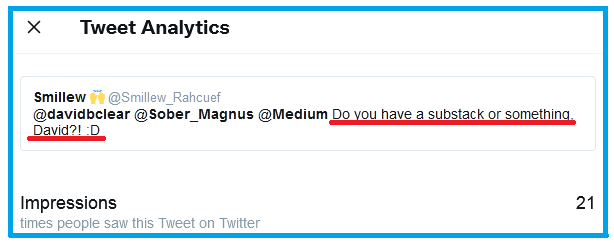
I helped promote David B. Clear’s substack newsletter dedicated to comics in this conversation on Twitter. (Just to be clear, it wasn’t a request from David. I did it on my own.)
The tweet got 21 impressions, meaning 21 tweeters saw it. Hard to know how many clicked and if any subscribed to the newsletter. But 21 is pretty good for a comment deep inside a long conversation about Twitter.
More social proof?
Big names do it too. They recommend each other. All. The. Time. I’m not going to link any examples because I don’t want to promote them. They don’t need it.
4 advantages of having a WingWriter
- Faster growth of your account.
- Online friendship. It’s more fun to have fun with someone else.
- Feedback opportunities.
- Ideas generating machine. Because you bounce upon each other’s creativity.
Find your WingWriter today!
Smillew is a a serial masturbator. He enjoys tweeting too much. Some he does well, some not so well, but he still tries them all.


