
Do You Ever Look at a Snapshot and See More the Second Time Around?
Lessons learned at West Point
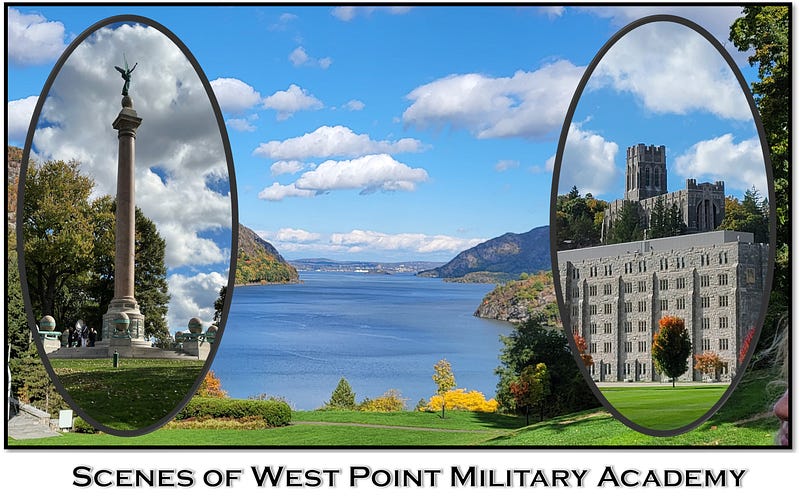
Snapshot: West Point, New York. First in a series.
I spent a month recently traveling through parts of Vermont and New York. I saw so many places I honestly couldn’t keep them straight.
My memory of each place is like a snapshot, a quick look at a place then on to the next one. Only now as I review my mental snapshots am I understanding what I saw. Since West Point is the oldest stop on the trip I will start there.
I would never have gone to West Point if I were not traveling with friends who wanted to go. War colleges just weren’t on my list of places to see. Now I’m glad they brought me along.
Before it was our first military academy, West Point was a key outpost during the Revolutionary War. George Washington called it “the most strategic location in America.” Control of West Point, a plateau jutting into the Hudson River, enabled control of the river. If the British had controlled the Hudson, they could have split the colonies in two, greatly weakening the Colonial forces. Despite the misguided efforts of Benedict Arnold, the infamous Revolutionary War traitor, West Point was never captured.
After the war, President Washington established a school for military training there. It took a few years, but in 1802 the school was transformed by the Military Peace Establishment Act into the nation’s first military academy. President Thomas Jefferson signed the act into law. He had misgivings — he preferred local militia to a standing, professional army — but as the nation grew, as westward expansion accelerated, as the U. S. became a larger player in the world, he came to believe a standing army was necessary. West Point would be “an institution devoted to the art and science of warfare to train and develop officers for the Army.”
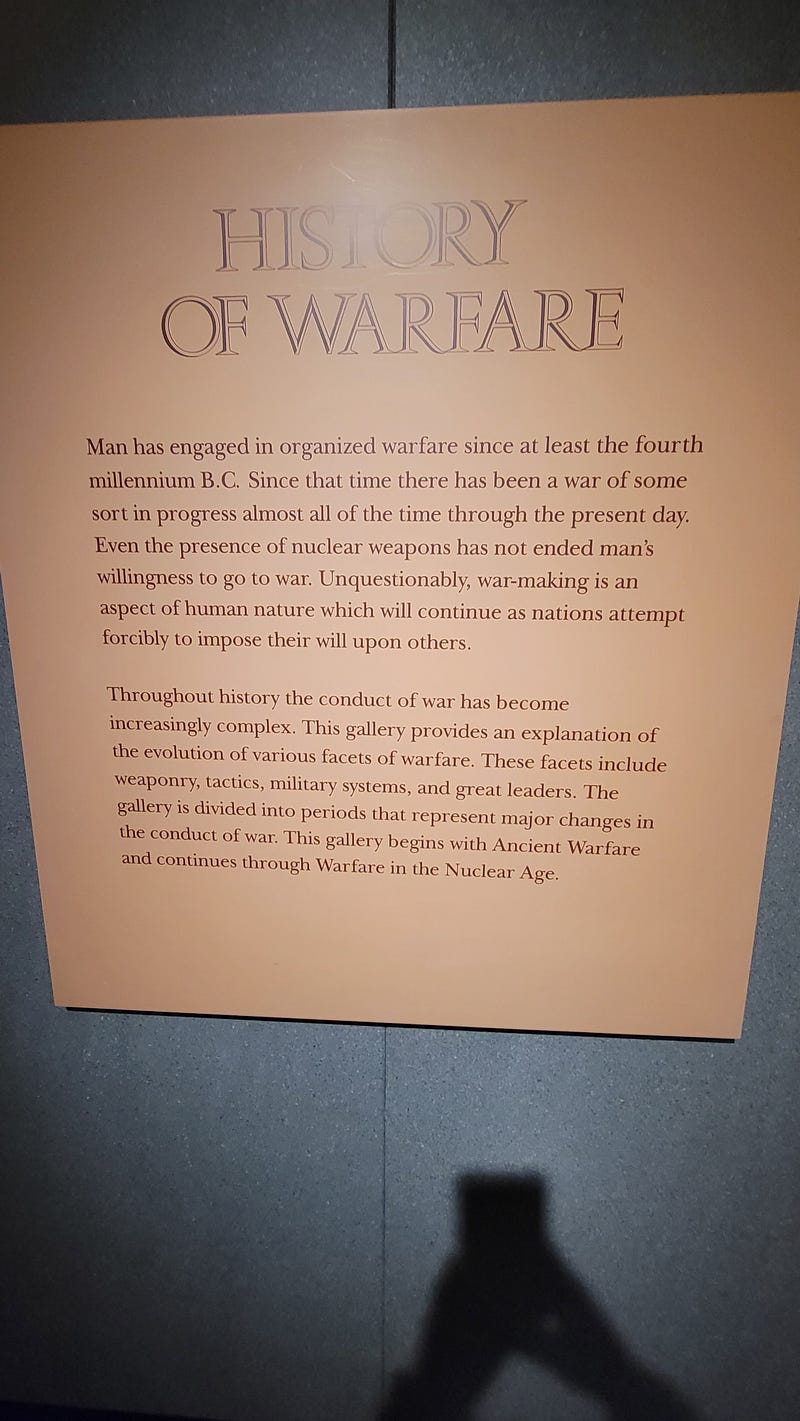
“Man has engaged in organized warfare since at least the fourth millennium BC. Since that time there has been a war of some sort in progress almost all of the time through the present day. Even the presence of nuclear weapons has not ended man’s willingness to go to war. Unquestionably, war-making is an aspect of human nature which will continue as nations attempt forcibly to impose their will upon others.” (From West Point exhibit, above)
The simple placard pictured above opens the History of Warfare exhibit at the West Point Museum. Whether war-making is “[u]nquestionably” a part of human nature is a topic for another day. However, it is unquestionable that war has a long history. The museum has four floors devoted to history, weaponry, artifacts, and personnel. I didn’t have time to see it all. I didn’t even get through one floor. I did see enough to recognize there is good and evil and both sides fight hard.
I have never understood how or at what point a leader decides it is time to sacrifice young people’s lives to pursue a policy objective. I still don’t.
Reading this placard, though, I realized I don’t have to understand something for that something to be a fact to be reckoned with. I will confess that I have never liked the idea of a military academy — a place that teaches young people how to go to war — but my trip to West Point helped me find new perspectives.
Humans go to war. Over and over. And they will likely continue to do so. As sad as it is, bullies or illegitimate aggressors will try to impose their will on their targets unless someone stops them. To prevail, the good guys have to know how to fight the bad guys. West Point and our other military academies help leaders develop the necessary skills to do that. To their credit they also teach cadets to look for options, to avoid conflict, to see war as a last resort.
Another placard at West Point carries this, from General and President Dwight D. Eisenhower:
“Men acquainted with the battlefield will not be found among the numbers that glibly talk of another war.”
I don’t like that we need to teach people to fight wars, but by looking at my snapshot of West Point more closely, I see the Academy’s mission, understand it better, and accept it. Our history is not unblemished. We are flawed, but we are trying to be better.
I contemplate these things as we drive past the vibrant colors of the Vermont woods, traverse the wonderful waterways of New England, and enjoy glorious sunrises and sunsets as the world continues its cycle of day, night, spring, summer, fall, and winter, seemingly oblivious to our wars and assaults.
Yet our assault on the environment has caused great change — damage, I would say — and the Earth adapts. To say it is oblivious is probably wrong, but the Earth does absorb our insults with equanimity, changing herself to maintain equilibrium. That these changes endanger people is simply a part of the consequence of our own misguided actions. When battles wound the Earth, level the buildings man has made, kill thousands of our own species, time heals though scars remain. Plants sprout through rubble, decay gives way to renewal, the Earth continues to spin, the sun continues to shine, the ecosystem continues to adapt and prosper. The Earth survives. Let’s hope we learn to be kinder so we stop the damage.
My next snapshot will be a peaceful scene at the Saratoga National Historic Site, also on the Hudson. The site of the first British Army surrender in world history, Saratoga is also testament to the Earth’s power to regenerate.
Thank you for reading! If you enjoyed this story and are not a Medium member, consider supporting me and other Medium writers by clicking here: Join Medium with my referral link — S.K. Shandlin. When you join, I will receive a portion of your membership fees.


