avatarDr. Leon Eversberg

Free AI web copilot to create summaries, insights and extended knowledge, download it at here

2181

Abstract

he AIA.</b></p><h1 id="dc9c">AI systems with high risk</h1><p id="8098">AI systems that pose a high risk to the health and safety or fundamental rights of natural persons fall into this category. What matters is not only the function performed by the AI system, but also its intended use.</p><p id="369e">The AIA specifies two main categories for high-risk AI systems:</p><ul><li>AI systems intended to be used as safety components of products</li><li>stand-alone AI systems with mainly fundamental rights implications that are explicitly listed in Annex III of the AIA [2]</li></ul><p id="824f"><b>High-risk AI systems will be allowed on the European market if they meet certain mandatory requirements and undergo a conformity assessment.</b></p><p id="e567">The capAI conformity assessment procedure was developed and published by Floridi et al. for AI systems under the AIA [4].</p><p id="daa3">The regulatory requirements cover many topics, such as data and data governance, documentation and record keeping, transparency and provision of information to users, human oversight, robustness, accuracy, and security.</p><figure id="c9fc"><img src="https://cdn-images-1.readmedium.com/v2/resize:fit:800/1*6-WiipX6BkDrxcla35qAbg.png"><figcaption>Four-step process for high-risk AI systems [3] (image source: <a href="undefined">Leon Eversberg</a>)</figcaption></figure><h1 id="3d06">AI systems with limited risk</h1><p id="2cc1">AI systems in this category must mitigate specific risks of manipulation by providing transparency. This applies to systems that (1) interact with humans, (2) are used to detect emotions, or (3) generate or manipulate content (deep fakes).</p><p id="a12c"><b>If an AI system is used to generate or manipulate content, there will be an obligation to disclose that the content was generated by automated means.</b></p><h1 id="6dae">AI systems with minimal or no risk</h1><p id="6f0d">The AIA allows the free use of minimal-risk AI. The majority of AI systems currently in use in the EU fall into this category.</p><h1 id="aa91">Conclusion</h1><p id="4644">Based on the AIA, generative AI such as ChatGPT, Midjourney, or DALL-E would be classified as being

Options

at least of limited risk. This would require these AI systems to provide more transparency that the content is AI-generated.</p><p id="c2b3">Self-driving cars would be classified as high-risk, which would require them to go through a certification process.</p><p id="d908">Because the AIA looks at the intended use of AI systems, ChatGPT, for example, could be deemed unacceptable if it were used in a way that attempted to manipulate people.</p><p id="2362">What do you think of the EU’s risk-based approach with the AIA proposal?</p><div id="9e09" class="link-block"> <a href="https://strawpoll.com/polls/GPgV6pr9Bga"> <div> <div> <h2>Do We Need Regulation of High-Risk AI? - Online Poll - StrawPoll.com</h2> <div><h3>What's your opinion? Vote now: Yes, the EU Artificial Intelligence Act is a good proposal, Yes, but the EU Artificial…</h3></div> <div><p>strawpoll.com</p></div> </div> <div> <div style="background-image: url(https://miro.readmedium.com/v2/resize:fit:320/0*E2QLb65WPYAEt85N)"></div> </div> </div> </a> </div><h1 id="6ab5">References</h1><p id="9655">[1] Y. Bengio et al. (2023): <a href="https://futureoflife.org/open-letter/pause-giant-ai-experiments/">Pause Giant AI Experiments: An Open Letter</a> (accessed: 02.04.2023)</p><p id="bba5">[2] European Commision (2021): <a href="https://digital-strategy.ec.europa.eu/en/library/proposal-regulation-laying-down-harmonised-rules-artificial-intelligence">Proposal for a Regulation laying down harmonised rules on artificial intelligence</a></p><p id="a917">[3] European Commision (2022): <a href="https://digital-strategy.ec.europa.eu/en/policies/regulatory-framework-ai">Regulatory framework proposal on artificial intelligence</a></p><p id="f172">[4] L. Floridi, M. Holweg, M. Taddeo, J. A. Silva, J. Mökander, Y. Wen (2022): <a href="https://dx.doi.org/10.2139/ssrn.4064091">capAI — A Procedure for Conducting Conformity Assessment of AI Systems in Line with the EU Artificial Intelligence Act</a>, Available from SSRN</p></article></body>

Do We Need Regulation of High-Risk AI?

An Introduction to the Artificial Intelligence Act of the European Union

Photo by Christian Lue on Unsplash

Artificial intelligence (AI) is moving so fast these days that some people - including Yoshua Bengio, Elon Musk, Steve Wozniak, and others — have signed a letter to stop its rapid progress [1]. Apparently, the topic of AI regulation is becoming increasingly important. For this reason, this article will focus on the Artificial Intelligence Act (AIA) of the European Union.

What is the Artificial Intelligence Act?

The proposal for a regulation on AI was announced by the European Commission in April 2021. It aims to address the risks of certain uses of AI, categorizing them into 4 different levels: unacceptable risk, high risk, limited risk, and minimal risk. With this risk-based approach, the AI regulation wants to ensure that Europeans can trust the AI they use [2].
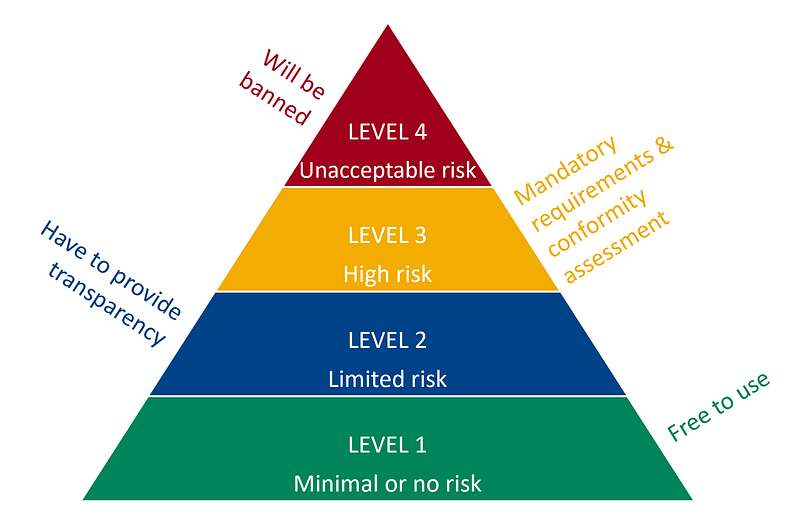
The AIA proposes four levels of risk for AI systems [3] (image source: Leon Eversberg)

Let’s look at each of the four risk levels in more detail.

AI systems with unacceptable risk

AI systems fall into this category when their use is considered unacceptable. For example, by violating fundamental rights, manipulating people, or exploiting vulnerable groups.

In addition, AI-based social scoring and real-time remote biometric identification systems (e.g., facial recognition) in publicly accessible spaces for law enforcement are explicitly prohibited.

All AI systems in this category will be banned by the AIA.

AI systems with high risk

AI systems that pose a high risk to the health and safety or fundamental rights of natural persons fall into this category. What matters is not only the function performed by the AI system, but also its intended use.

The AIA specifies two main categories for high-risk AI systems:

  • AI systems intended to be used as safety components of products
  • stand-alone AI systems with mainly fundamental rights implications that are explicitly listed in Annex III of the AIA [2]

High-risk AI systems will be allowed on the European market if they meet certain mandatory requirements and undergo a conformity assessment.

The capAI conformity assessment procedure was developed and published by Floridi et al. for AI systems under the AIA [4].

The regulatory requirements cover many topics, such as data and data governance, documentation and record keeping, transparency and provision of information to users, human oversight, robustness, accuracy, and security.
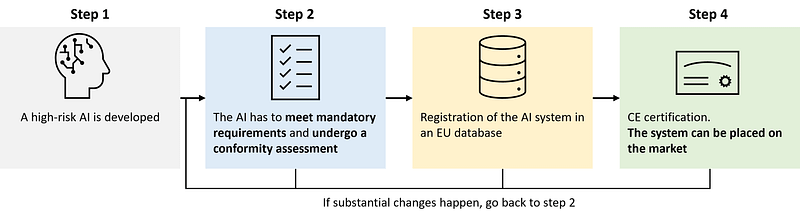
Four-step process for high-risk AI systems [3] (image source: Leon Eversberg)

AI systems with limited risk

AI systems in this category must mitigate specific risks of manipulation by providing transparency. This applies to systems that (1) interact with humans, (2) are used to detect emotions, or (3) generate or manipulate content (deep fakes).

If an AI system is used to generate or manipulate content, there will be an obligation to disclose that the content was generated by automated means.

AI systems with minimal or no risk

The AIA allows the free use of minimal-risk AI. The majority of AI systems currently in use in the EU fall into this category.

Conclusion

Based on the AIA, generative AI such as ChatGPT, Midjourney, or DALL-E would be classified as being at least of limited risk. This would require these AI systems to provide more transparency that the content is AI-generated.

Self-driving cars would be classified as high-risk, which would require them to go through a certification process.

Because the AIA looks at the intended use of AI systems, ChatGPT, for example, could be deemed unacceptable if it were used in a way that attempted to manipulate people.

What do you think of the EU’s risk-based approach with the AIA proposal?

References

[1] Y. Bengio et al. (2023): Pause Giant AI Experiments: An Open Letter (accessed: 02.04.2023)

[2] European Commision (2021): Proposal for a Regulation laying down harmonised rules on artificial intelligence

[3] European Commision (2022): Regulatory framework proposal on artificial intelligence

[4] L. Floridi, M. Holweg, M. Taddeo, J. A. Silva, J. Mökander, Y. Wen (2022): capAI — A Procedure for Conducting Conformity Assessment of AI Systems in Line with the EU Artificial Intelligence Act, Available from SSRN

Artificial Intelligence
Technology
Machine Learning
Science
Ai Ethics
Recommended from ReadMedium