
What Peace Means to Me
It’s not the absence of conflict but the absence of a question.
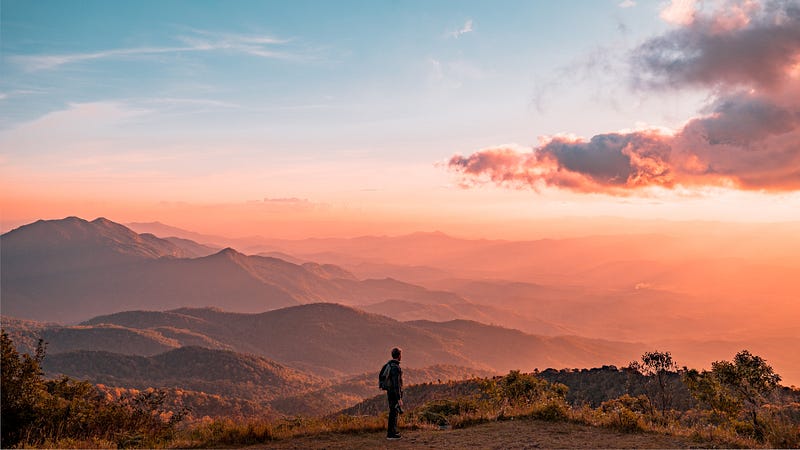
When I sit in nature, a familiar feeling washes over me. That feeling is peace. I know that many others feel this too. At first blush, you might think that nature provides us this relief because we experience a respite from the chaos and frenetic energy of electronic life, social media, and interpersonal conflict.
But nature is not always “peaceful” either in the sense of being calm or slow. Trees can sway perilously in the wind. The rain can hammer the earth. Nature can be violent. Does that mean it is also not peaceful? What do we mean, then, by “peace”?
Having paused many times to reflect on those questions, it occurs to me that the answer lies somewhere outside of movement. It is not velocity that determines peace. A rapid wind, a high-speed bird diving, a bee zooming about a pasture, all can be fast and still at peace.
Rather, it seems to me we experience peace because the trees, the grass, the wind, the sun, the rain do not ask themselves who they are and why they are here.
It is not the respite from modern life that nature offers, but relief from an existential question.
Is peace, then, the same as acceptance? As trust? As surrender? They seem intimately related. The thing about acceptance, trust, and surrender is that while they are all steps on a path from separation to oneness with all that is, to accept, trust, and surrender, there must be a someone —a me or a you — who relates to those external circumstances as external. We accept, trust, and surrender to something that we perceive to be apart from us even if it is a part of us.
It is only because we experience a state of separation that we ask ourselves: Who am I? Why am I here? Those questions have most often emerged with a sense of angst, with a sense that failing to answer them might be the greatest failure of all.
Peace, then, would seem to be what arises after acceptance, trust, and surrender have given way to a deeper sense of connection, to a place where those questions can no longer arise because, on a certain level, I am not me. At least, not me alone. Not me, as I currently think of me, with pronouns, and a sense of linear time that takes me forward into an imagined future, or backward to memorialized past. If I too am the wind, the trees, the grass, the sun, then I can no longer ask who I am and why I am here because those questions no longer have meaning in a world beyond the self.
But we so often miss this lesson when we talk about peace. We talk about negotiating peace or building peace, as if peace were something created or constructed. We think of peace as a momentary lack of conflict between two warring sides. If we think of peace as just a break from our relationships built on separation and strife, we are misidentifying what peace is. The trees do not negotiate peace with the wind and the rain; the clouds do not negotiate peace with the sun. They simply interact, each according to their nature.
Of course, I am not only the sun, wind, and rain. I am also me, in a body, with a name, and a history, and you are also you. To deny that would be to deny our nature as humans who experience separation. That is the great paradox of being human — to accept that we are both separate and one with all that is. Peace, then, is available to us when we accept that paradoxical connection with our world, that our nature is to be both separate and connected at once, without trying to resolve it.
From that vantage point, we might begin to entertain the possibility that our actions and choices could be made from a place where our identity is not a question of existential anxiety. I am because I am. I am me, and I am you, and I am the earth, and so are you. My existence is not a question to be defended, nor is yours.
From this place of peace, we would still experience a world of separation, for that is the world we inhabit. But that need not be a world in which we are isolated and alone fighting for our place to be guaranteed. It’s not a place where peace happens because we negotiate away all conflict. Rather, peace is there when we can see those episodes of separation as ways in which the world leads us on a journey back to ourselves, and back to God. These are, of course, one and the same. The sun, the rain, the wind, and the earth already know that.
Thanks to 𝘋𝘪𝘢𝘯𝘢 𝘊. for this week’s beautiful prompt on peace:


