avatarThe One Alternative View

Summary

The article emphasizes the importance of understanding the difference between being busy (doing something) and being productively engaged (having something to do), advocating for the latter as it allows for thinking and true productivity.

Abstract

The author distinguishes between the act of staying busy for its own sake and having meaningful tasks to accomplish. They suggest that African mothers exemplify a preference for their children to be visibly occupied, reflecting a broader societal expectation. However, in the modern workplace, especially for coders, there's a desire for substantive work rather than tasks that merely create an illusion of busyness. The article argues that "doing something" can inhibit thinking and productivity, whereas "having something to do" fosters a more meaningful engagement with work, including time for abstraction and reflection. The author points out that the constant barrage of notifications and the "poverty of attention" trap individuals in a cycle of reactivity. To counteract this, the author recommends a morning routine that prioritizes personal actions over immediate responses to external prompts, thus reclaiming attention and focus.

Opinions

  • The author's mother, and by extension African mothers, value visible activity over idleness, even if that activity is not inherently productive.
  • Modern work environments, particularly in tech jobs like coding, often leave employees feeling unfulfilled due to a lack of meaningful tasks.
  • The author critiques the societal obsession with appearing busy, suggesting it is akin to a performance rather than genuine productivity.
  • "Doing something" is seen as a superficial act that can prevent genuine thinking and productivity, while "having something to do" allows for deeper engagement and cognitive processing.
  • The article suggests that the design of social media platforms and the fear of missing out (FOMO) contribute to a reactive lifestyle where individuals are constantly doing something rather than engaging in meaningful activity.
  • The author proposes a strategy to break the cycle of busyness by prioritizing personal actions in the morning and delaying the response to notifications

Do Something vs Having Something To Do

The importance of knowing the difference
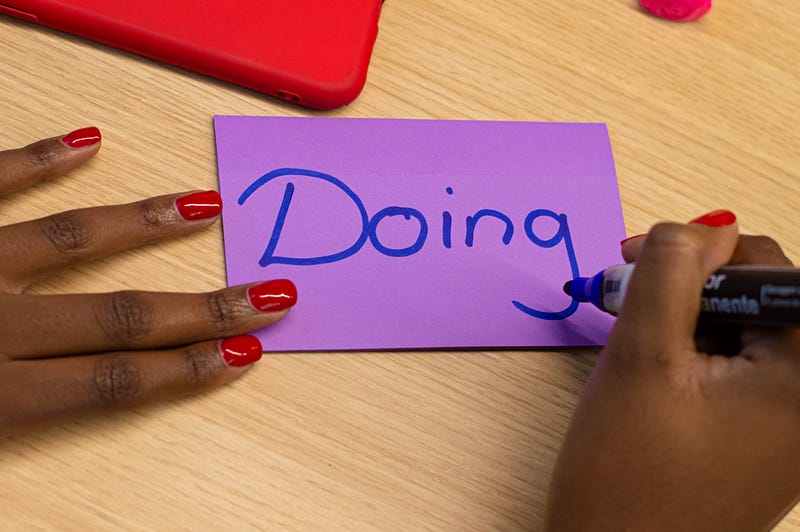
Photo by Eden Constantino on Unsplash

My mother would prefer the former to the latter

It’s a thing about African mothers. They’d rather see you do something than sit idle — which ironically is doing something.

The point is you should be on your feet, busy. Nowadays, with so much automation, people do jobs that make them appear to be doing something.

In such work environments, those passionate about their job often wonder if they applied to the right company. I have heard such stories among coders. They hoped to have something meaningful to do rather than just doing something for appearance's sake.

As much as I love the song by Konshens, doing something is mostly only important if you’re going for a dance audition.

The opposite, having something to do, offers a chance for productivity orders of magnitude better and more progressive than the false façade of productivity.

Furthermore, it makes you open to interval breaks of abstraction. Thinking is a form of abstraction. By this logic, having something to do gives you time to think. Just doing something deprives you of this time.

Doing something prevents thinking.

In the fast-paced world we live in, most of us are trapped in the do-something phase. Notifications always ping, to-do lists lengthen and calendars remind you of meetings and tasks you are yet to do.

Poverty of attention makes you bent toward doing something rather than having something to do.

Here’s one thing you can do to break from this habit

It’s what I’ve been doing, and I love how it’s going.

When you wake up:

  1. Don’t check the unread messages you have.
  2. Don’t scroll through the notifications.
  3. Don’t go through your email.

Act, don’t react.

Do what you’d want to do, then follow up on other things later. For me, it’s run through my mental models and occasionally my home workouts. Then I can check my notifications.

If it was an emergency, they would have called. If they did not, don’t rush to see what it is.

Most of these social media platforms hijack your attention psychologically through the FOMO principle — fear of missing out.

They take away the most precious element we have presently — our attention. As a result, most of us end up doing something, instead of having something to do.

Flip the script.

Don’t just do something.

Have something to do.

PS: For more alternative perspectives, join the 15+ community of alternative viewers.

Productivity
Meaningful Work
Reaction
Recommended from ReadMedium