
Do Not Read Unless Process-Oriented: How To Find Love in 2024
Yes, I will find love, and yes, I have a strategy. And destiny? You’re fired.
Sunday was drinks at the low-key trendy Le Mary Celeste avec Jacques, who then invited me to consider options for the second date — opera, or cabaret? Monday was beers and Baos at a snazzy Chinese diner with George, who bakes, sails, and climbs.
Patrick and I challenged each other at Fussball, before a vernissage. And architect and interior designer Gui and I met for a glass of rosé on an unusually sparkling February day, by the Bois de Vincennes.
Am I a maneater?

No. But what I am is 35, and yes, time is of the essence. And so, as I start this new year, I have decided to approach my love life a little differently.
Why is it that, while we tend to be super strategic about everything else in life, when it comes to love, we simply throw our hands up and rely almost exclusively on destiny — or, as it is also known in some cultures, The Almighty Tinder Algorithm?
And make no mistake — this is not only about romance. If choosing my life partner is linked to my well-being and my physical health, if this determines how much money I’ll make and even how long I will live, I do need a better strategy. Or a strategy, to start with.
And so, here we are: this is the year I am finding the love of my life, and yes — I have a strategy to do it. AND a spreadsheet. And I am not kidding.
Over the next 10 months, I will use what I understand to be OKR to reboot my love life and find my life partner.
For each objective, I will add a screenshot of my spreadsheet with the details of my OKRs, and underneath, an explanation of the rationale behind each item. And yes, I am planning to publish regular updates 😉
OK — what?
OKR stands for Objectives and Key Results, and it is a framework for creating progress and movement in a desired direction created by Andrew Grove while working for Intel in the 70s, and later adopted by Google.
In What Matters, John Doer explains how “Goals come in two pieces, Objectives and Key Results. Objectives are the ‘what.’ They describe the path forward, the place you want to be. Key Results are the ‘how.’ They provide the roadmap for accomplishing your Objectives.”
I first heard the term when I met my friend E. back in Amsterdam a few years ago, who is an expert on the subject, and a successful consultant. We recently reconnected here in Paris as he was passing through over the holidays. We met in a crowded, festive Le Barav, my neighborhood’s wine bar, and over a few glasses of champagne and a couple of charcuterie boards, we compared notes on life. He has a wonderful growth mindset and every pore of his skin seems to scream STRATEGY, an attitude that left me refreshed and hopeful. And that got me thinking.
Surely, if it works for Google…
In Love, What Is It That I Want?
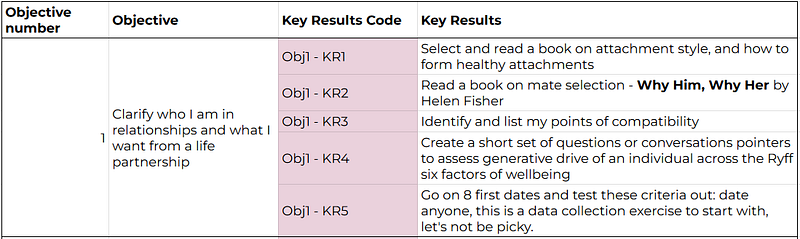
Quarter 1: Objective 1
Quarter 1 will be an exploratory phase. It will be about understanding myself and my patterns, how I show up in relationships, and how I tend to approach mate selection. And crucially, I will walk back to the drawing board and get a really good sense of what I want.
What this translates into is an exploration across three separate dimensions, which are:
- About me: where do I sit on the six factors of well-being according to Carol Ryff? What is my attachment style, what triggers me, and how do I lower my trigger points?
- About the other: who do I like, and why? Where do they sit on the six dimensions of well-being according to Ryff?
- About the relationship I want: identify points of compatibility (essentially listing the criteria without which it would be very tricky to build a happy relationship, for example, we both want children, or we both live in the same…at least country?) and measure generative drive (more on this a little further down).
I find the six factors of psychological well-being, which according to the psychologist who developed the theory contribute to a person’s general well-being and happiness, as a very helpful tool to simplify a whole set of values that are important to me, and that I live by. These are:
- Autonomy — how much someone is influenced by social pressure
- Environmental mastery — whether someone takes full advantage of opportunities and has a sense of agency over their environment
- Personal growth — an attitude towards learning, improving, seeing options, curiosity, etc
- Positive relations with others — a focus on building and strengthening deep relationships
- Purpose in life — a self-determined direction of travel
- Self-acceptance — a good attitude, and perhaps just understanding and patience toward oneself
But taken on their own, these are not as life-changing. What I find particularly powerful here is applying the generative drive concept to each of these.
Dr. Paul Conti talks about the generative drive (in his chat with Dr. Huberman) as an impulse stemming from gratitude and a sense of agency. The way I understand it is that an individual with, on average, a good generative drive builds, creates, enjoys, and sees what others would consider issues as opportunities. It measures to what degree we tend to live by default and by a self-imposed strict set of rules that continue unchallenged in our brain, and to what degree we are likely to embrace a more generative approach to life instead.
Or, as Daniel Priestley puts it in his chat with Steven Bartlett, a measure of whether we are functional, or vital.
While none of us scores 100% on each of these categories, to me, it is all about assessing how aware, intentional, vital, and creative I am (and who I am dating, is) about each of these factors.
The next section of my strategy will last two quarters and will involve, yes meeting, but also potentially some iterations of the “meeting + exploring attachment combo” with a small set of individuals. The strategy for exploring attachment is covered in the section about Objective 3.
Where Do People Meet Their Spouses?
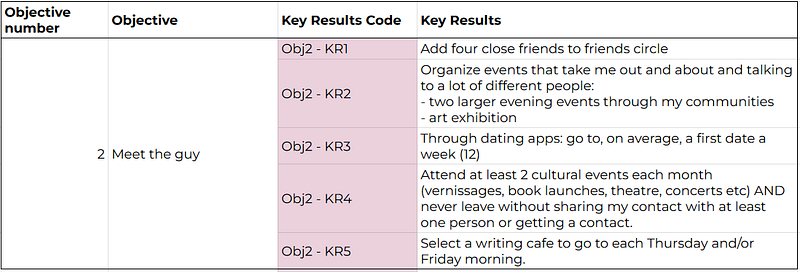
Quarters 2 & 3: Objective 2
Now that I know who I am, what I want, and who I want it with, it is time to maximize the opportunities I have to meet as many people as I can, and when appropriate, explore attachment (Objective 3).
Which begs the question: where do, on average, most people meet their spouse?
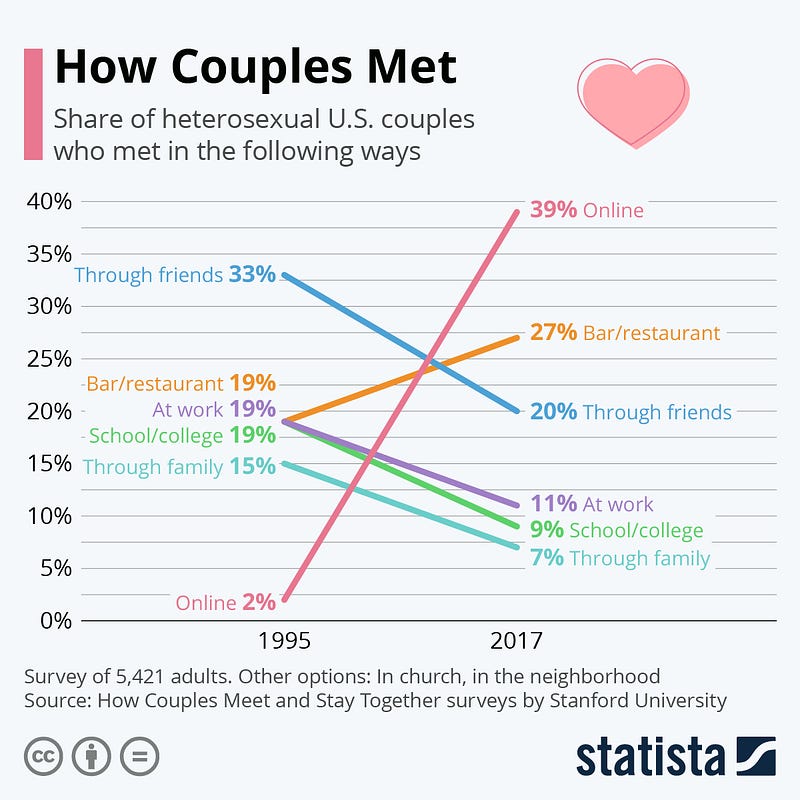
Though frustratingly, I could not find good, recent data on Europe (if you know of a source, send it over!), there are some interesting statistics for different countries that, in general, seem to agree (YouGov in the UK, and Statista here for the US — also see chart below).
To cover all my bases, I also asked ChatGPT:
The ways people meet their spouses in Europe, as in many parts of the world, can vary significantly depending on cultural, societal, and technological factors. However, some common avenues for meeting romantic partners in Europe include:
- Through mutual friends
- At work or school
- Online dating
- Social events and activities
- Bars and nightlife (less common than in some other regions)
- Through family introductions
While these statistics are not for France, where I recently moved, and are outdated, they still do make sense. If I discard the avenues that are less likely in my case (Through family introductions, and School), here is where I can focus:
- Through mutual friends: great, I am new to the city, so have to build my social circle anyway.
- Work: I do work from home, and not ultra-fond of coworking spaces. However, a friend and I are planning to bring her contemporary art exhibition to Paris, and that will involve some extensive event planning, so that could be one way (I just love the idea of her reading this and realizing that my drive to work with her on the project is more about meeting cute guys than the love for arts — which I do have, I promise!)
- Online dating: this is a sore one for me — and don’t we all hate it? But, if in the US, 39% of couples met online (and this six years ago, pre-COVID-19), this is just too large a number to be ignored. Moreover, dating apps do open you up to people who do not live in your immediate surroundings and do not go to your same cafés at exactly the same times. So I did have to eat a rather large slice of sour-tasting humble pie and get back on Hinge.
- Social events and activities, and bars and nightlife to me are one and the same: this is sort of already set up and part of the social networking practice I have created as new in town. I host a couple of communities and several events each month on Meetup, and I am a member of several other communities. I go to at least two events each week that expose me to various new people, and also help me make true friends. The cultural life here is also wonderfully rich, I am a member of various museums and galleries and often attend events such as vernissages and book launches.
How To Create a Healthy Attachment?
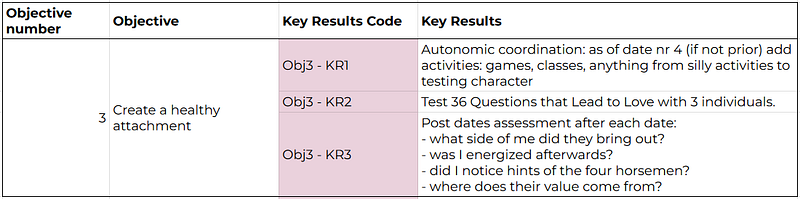
Quarters 2 & 3: Objective 3
With everything going according to plan, by July 1st, I will have met my life partner. Or, let us not get carried away, an excellent candidate for the role. Or perhaps a few. And this is great timing indeed, as I am hoping for a romantic getaway at some point this summer. Or perhaps a few. 😉
So now, it is all about building a (healthy) attachment. For this phase, I found two tools to explore attachment in early dating, and two tools to identify what to watch out for.
Tools for building attachments:
- Autonomic coordination: Dr. Huberman explains how autonomic arousal is one of the three essential components of forming loving relationships, and how the quality and depth of a social bond are related to how physiologically synchronized the pair is — for example in terms of breathing, heartbeat, sweat, and a lot other physiological factors. In other words, sharing experiences that give our bodies similar reactions, can lead us to feel connected. Indeed, you may have experienced the quick bond you can feel with someone you met traveling and whom you went on a short adventure or had a deeply unusual experience with. So to me, this points to the fact that just having cocktail or dinner dates is not conducive to creating a sense of bond.
- 36 Questions that Lead to Love: this comes from a study conducted in the late ’90s, in which they tested the theory that a set of questions such as this one could speed up intimacy between individuals (and I should mention that a couple in the study ended up married). Dr. Huberman believes the underlying mechanism is also rooted in autonomic coordination, which does not need a physical trigger to happen. Listening to the same narrative, or in this case, each other’s narrative can also cause synchronization of the autonomic nervous system.
Tools for identifying what to watch out for:
- The Four Horsemen of Relationship Apocalypse: these were created by the psychologist Dr. Gottman, who specializes in predicting divorce, and studying what makes relationships thrive. Straight from their “5 Days of dating advice”:
Red Flags
So what makes a couple a “disaster”? In his 50+ years of research, Dr. John Gottman identified four specific relationship-destroying communication patterns. He named them The Four Horsemen of the Apocalypse.
Look for the presence of The Four Horsemen in your dating partner:
Criticism — They describe your character flaws and verbally attack you.
Defensiveness — They victimize themselves to reverse blame and do not take responsibility for their part.
Contempt — They belittle you and take a superior position.
Stonewalling — They shut down or shut you out during hard conversations.
- Spot the Cheater: in this fascinating segment, Dr. Huberman talks about a concept called self-expansion —which refers to “enhancing oneself and increasing self-efficacy, and pleasure, arousal, and excitement.” Individuals whose self-expansion ability is very much linked to, or even driven by, their partner (for example, through praise or actions directed at them) are more likely to find people outside the relationship as attractive. My basic understanding of this is that if a lot of your value comes from your partner or, in general, from an external source, when the source of that good is lacking, it makes sense you might look for it elsewhere. So how do we spot this? I may be wrong here, but if much of the relationship with you is about their perceived value, their desire to self-expand, I think this may come across as a person who is not as interested in you — the whole individual behind, what makes you tick, the way you approach life. They may be more interested in how you look, your social status, how you present yourself, and your achievements. I have certainly met guys who have made me feel wonderful, the center of their universe, and, oddly, invisible at the same time.
Building a Strong Relationship

Quarter 4: Objective 4
This section is admittedly a little thin. While I do have some guiding principles here, too, I believe this section, which is about starting to co-create a life with that special person, will need to be discussed with and agreed upon by my partner — as soon as the role has been assigned.
My guiding principles for building a strong relationship:
- Applying the concept of generative drive to the couple: what does it take to be a couple with a strong generative drive? I believe that next to each person’s vision across those same six dimensions of well-being (in Objective 1), a couple may create a shared vision for the relationship as well that can give them a sense of a shared direction.
- Autonomic coordination: Yes, again. It is clear that autonomic coordination isn’t just static — we cannot create it once and then expect that it will stay high. To me, this refers to planning regular activities that induce autonomic coordination. I have been in relationships in which going for dinner dates as the only act of connection outside the house turned the relationship into a very boring cage.
- Communication: Ali Abdaal often talks about how he and his fiancé organize regular relationship audits (and he has a great Notion template!). These are moments in which they sit down and, in an atmosphere of love and appreciation, give each other feedback, for example, on whether they feel supported and appreciated, whether they feel stressed out, how connected they feel, and what else they might need.
So, if you made it here — well done! What do you think? Do you think I am going to make it by the end of the year?
If you are an OKR expert, a dating expert, or have any other valuable insight to adjust and improve this strategy, please get in touch!
And yes, I will share monthly updates here on Medium, and weekly ones on my brand-new Substack.