
Startup Tech: The Outsourcing Odyssey
Do not outsource your startup tech before reading this first
A CTO’s candid take on the enticements and pitfalls of delegating your tech dreams.
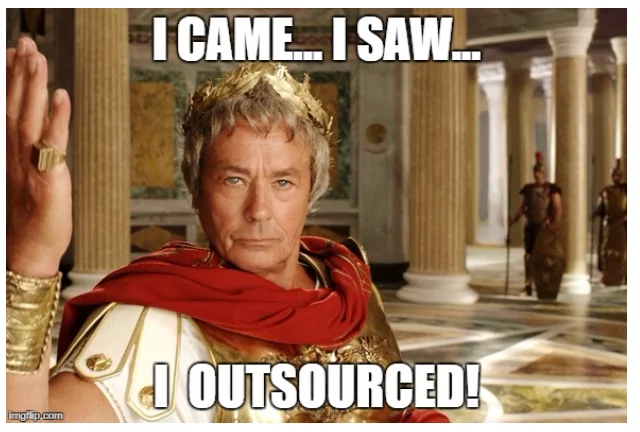
There have been many empire declines due to IT outsourcing. While managing tech providers, from decades-long legacy partners, software houses or just freelancers, I have seen enough to know that outsourcing your tech is not as easy as it might seem in the first instance.
What are some common reasons to outsource tech?
Software houses want to sell, so you will easily find multiple arguments why working with them is the decision of a lifetime. You will reduce costs, save time… All the good stuff! They sell themselves like they’re the latest miracle diet.
Now, if doing things in-house means building tech like you’re stuck in the 90s, responding to biased product managers and resorting to outdated, inexperienced or just overall poorly coders… then yeah, the propaganda is probably right. But I’ll argue that that’s not most of the cases and that it’s a case-by-case, project-by-project decision.
When they extend you their brochure, this is what they are likely gonna sell you:
- Cost savings: Outsourcing can help businesses reduce costs by taking advantage of lower labour and operating costs in other countries. Why pay more when you can outsource and buy that office ping-pong table you’ve always wanted?
- Access to specialized skills: Need a ninja coder who’s also a part-time magician? Outsourcing can provide access to specialized skills and expertise that may not be available in-house.
- Improved efficiency: Let your in-house team focus on what they’re great at, like attending 3-hour meetings about font choices. And leave the non-core tasks to specialized partners.
- Flexibility and scalability: Grow or shrink your development like your waistline during the holidays. Outsourcing helps you scale up or down your development depending on your needs.
- Time-to-market: Get your product out there faster than you can say “We might need a pivot.” By being able to scale up you can get your product so you have no knowledge to maintain it faster.
- Compliance: Ensure you’re on the right side of the law by hiring someone who reads the 101 of what GDPR is and other complex regulations and standards you never even heard about.
“If doing things in-house means building tech like you’re stuck in the 90s… then yeah, the propaganda is probably right.”
…and Reasons to NOT Outsource Startup Tech?
Ah! Outsourcing. It looks dazzling, but with so many potential things that can go wrong: it’s a bit like hitting the lottery.
- Loss of Control: So, you’ve outsourced your tech. Suddenly, you’re a bit like a parent watching their kid’s first sleepover through a foggy window. Sure, they’re in there somewhere, and they might even be having fun. But who knows what mess they’re creating without you?
- Quality & Reliability: “Let’s play Russian Roulette with our startup’s quality!” — said no sensible CTO ever. When you outsource, you’re potentially rolling the dice with your product. Sure, I can spend months interviewing, getting references and trying to find an outsourcing IT I trust, but I can also use it to build my team.
- Communication & Coordination: You: “Good morning!”, them: “Goodnight!”. Ah, the charm of coordinating with a team 10,000 miles away. I’ve heard people telling you that it’s a good thing: you can use the time they are not working to figure product out so they can work at night. Synchronous communication is so old school, what can go wrong?
- Cultural & Language Barriers: Ever played broken telephone? Now imagine that on steroids. “I said a scalable backend, not a whale’s back end!” — I’ve worked with people with so bad English that I can completely see this happening.
- Security Concerns: Fancy exposing your startup’s “liquid gold” in the form of data? Didn’t think so. In order to protect your intellectual property one must ensure that appropriate safeguards are in place to prevent unauthorized access or disclosure. Do you know what would be easier? Do not take your most sensitive data on an outsourcing tour.
- Hidden Costs: Outsourcing sometimes feels like a budget airline ticket. Sure, the initial price is alluring, but by the time you add the baggage, meal, legroom, and sanity fees, you’re reminiscing about first class. Well, with the loss of control, communication and coordination issues maybe it’s not that strange that they charge you for extra features after claiming that the bug is indeed a feature that you asked for in your requirements.
“Let’s play Russian Roulette with our startup’s quality!” — said no sensible CTO ever
The Startup Lifecycle & Essential Tech Considerations
Now that I told you about the common reasons pro and against outsourcing, I will now speak more frankly and from experience, as a CTO and mentor who guided many startups through the maze of tech decisions and, unfortunately, saw many fail due to tech decisions — both with and without outsourcing.
So here it is: DON’T DO IT! And here is why.
1. The MVP & Build-Measure-Learn Handicap
MVPs is where your dream takes shape. Entrusting its delicate formative stage to an external entity? That’s like asking a stranger to name your firstborn!
If you know about “The Lean Startup” you know how important the Build-Measure-Learn loop is. If you externalize the “build” then one of the main elements of this loop is outside of your control.
Consequently, many startups that don’t know the tech basics, also don’t know how to make proper requirements and are therefore also dependent to “measure”. Typically you will have a person making the bridge with the tech team, like a “scrum master”. He doesn’t have visibility over the business and you don’t have visibility over tech.
And in the end, if you cannot “build” and you cannot “measure”, how are you supposed to “learn”? Which is the main thing your startup needs to do.
2. Testing, Tweaks & Tantrums
Once that MVP is out there, you’re in for a rollercoaster. Immediate tweaks, hotfixes, and iteration become your daily bread. Now imagine waiting 12 to 24 hours for a bug fix because your dev team is on another client project. That’s startup years!
“Well, but my IT consultants are different! They are crazy good and I really trust the owner!” — I imagine you saying.
They can be indeed good and trustable. But tell me, who would you prioritize: the over-demanding and needy startup that pays crumbs or a major bigger company that is contempt with one week response time? Unless you are indeed one of their main clients, and paying them as such, I would argue that the best dev team is the one that can pivot quickly and give you feedback in real time.

3. Scaling — The Make it or Break it
So, your startup’s showing promise and it’s time to scale. But here’s the catch — scaling isn’t just about adding more servers or pushing out more features. Nothing in tech is really a turnkey. In order to scale you need to really understand both the deep-rooted intricacies of your product and your business.
Here’s the curveball: Tech products need constant fine-tuning. Just like a vintage car, you can’t just set it and forget it. There’s a term for this in the tech world — “technical debt”. This refers to the “quick-fix” solutions implemented in the initial stages that become liabilities in the long run. Often, these quick fixes are chosen over better, more scalable approaches due to time constraints or budgetary concerns.
A traditional outsourcing model doesn’t naturally motivate teams to address this technical debt. Why? Simply put, there’s no direct incentive. They often deliver fast to move on to their next project or client. But remember, in the tech world, fast doesn’t always equate to scalable.
There are indeed alternatives: selling the IT agency some equity. This ensures they have some skin in the game, aligning their long-term interests with yours. They’ll think twice before brushing off technical debt or choosing a non-scalable solution. But if you gonna go this road, maybe you should also look into venture builders.
Conclusion and Firsthand Experience
I had the chance to manage multiple tech providers…
In one instance, I was responsible for internalizing the MVP that an external contractor had built for us. There was no documentation, limited help from the supplier and ongoing bugs and issues in production the moment I arrived. It took months, several sleeping hours and one major refactoring before the tech could progress steadily. In this case, we had the runaway and things went fairly well, but luck was definitely a major contributor.

In another instance, I was managing a 16-year-old legacy tech provider for a big company. Things didn’t feel as urgent, but It would frustrate me how often it would be orders of magnitude more difficult to successfully manage tech than what it could be if I had access to the code and just did it myself.
This is not to say that both of these didn’t have incredibly talented professionals on it. Much of my best learning came from interacting with their scrum masters and senior developers.
In conclusion, outsourcing tech can be a tempting option for startups. But before you make a decision to do so, you should carefully consider the potential benefits and drawbacks.
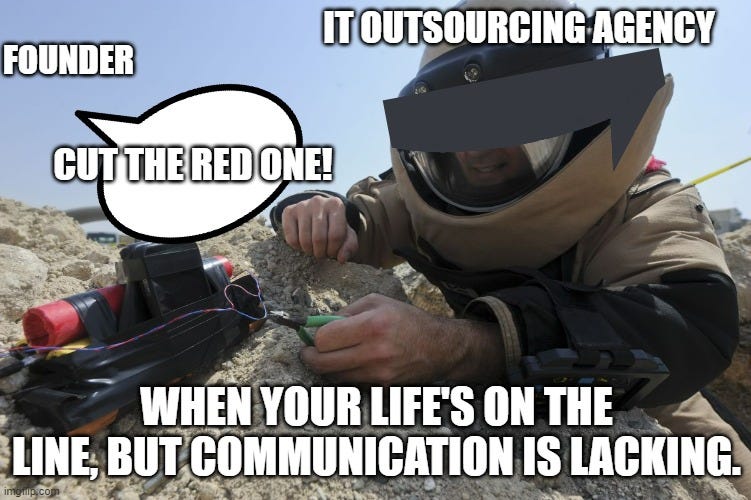
Startups are in a life-or-death struggle to learn how to build a sustainable business. So this is not your typical relationship, it’s one where you have a freaking time bomb attached to you (aka “runway”) and they are the ones cutting the wires (aka “build”). Oh, also they have their eyes closed (you are the one who “measure” and “learn”) and you need to give them directions without proper visibility about what they are doing.
On this occasion, wouldn’t you prefer to cut the wires yourself?