
Physics
Do multiple pasts exist? (# 43)

Previous articles discuss ideas associated with showing the origin of our universe lies in mathematics; the mathematical configuration of an eternal Anti-de Sitter (AdS) space that contains our universe creates quantum particles. Laboratories have demonstrated that when three quantum particles are combined, a new phenomenon can arise where that phenomenon is not present in any of the individual particles. This emergence is called the Efimov effect. An example of emergence is a rule equivalent to ‘What can happen, does happen’. AdS space facilitates a never-ending process to create more and more complex content.
Our universe is part of a never-ending process that creates original content of increasing complexity. The physical laws in our universe promote innovation. Some of the laws may be fixed, others may vary such as allowing the history of events to change. In effect, the distant past is associated with quantum-like probabilities. While some pasts may be more probable than others, a range of pasts are possible from our present-day perspective just like there seems to be a range of possible futures.
A second feature associated with the origin of our universe is how mathematics implements the rule ‘What can happen, does happen’. One analogy is the Artificial Intelligence (AI) process called Generative Adversarial Networks (GAN). These ideas are developed in more detail in this article.
Our world is like a game
The board game ‘Go’ used to be considered too complex for a computer to win. In 2016, however, the computer, AlphaGo, beat the world champion. A short time later, another computer beat AlphaGo. These computers were programmed using GANs. A GAN involves a computer reprogramming itself. Initially, a computer may be trained using existing information such as the moves in previous Go games. The GAN program then devises new winning strategies without oversight by a human programmer.
Our universe could be compared to a game where the objective is to discover new scenarios. A description of a universe could be programmed into a computer. A second computer is given the challenge of describing a universe with new features without knowing the source code of the original universe. Once the second computer can describe a new universe, the first computer is challenged to describe an even more complex universe.
The complexity of the universes keeps on increasing. New features that the computers introduce could include agents with free will, and an objective to maximize the total happiness of all agents. As happiness involves qualitative or subjective judgments, there can be no unique way of maximizing total happiness. For example, the happiness of an individual agent may be conditional on the happiness of another agent e.g. both agents want to marry the same person but only monogamous relationships are allowed. How could the subjective ‘happiness’ of each agent be added together?
Our world could be the stage on which two computers try to maximize total happiness while stimulating originality.
Wheeler’s game of 20 questions
One of the pioneers of quantum physics, Professor John Wheeler, suggested that the quantum world could be the party game called ’20 questions’ but with some modifications. Instead of one person thinking of an object and everyone else asking questions to discover the object, one person could ask the questions and the rest of the group take turns to provide answers. The first person thinks of an object but does not tell anyone else. After the first person answers a question, a second person thinks of an object consistent with the answer to the first question.
When the second question is answered, a third person thinks of an object consistent with the answers (clues) to the first two questions. This process continues until the object is correctly guessed. At the start of the game, no one knows what will be the correct object.
Our world contains many clues but there is no agreement on the meaning of the clues. The game finishes when there is an agreed novel interpretation of the clues. Our world could have been pre-programmed with several possible answers; our challenge is to come up with a new idea without necessarily knowing all the pre-programmed answers.
.jpg)
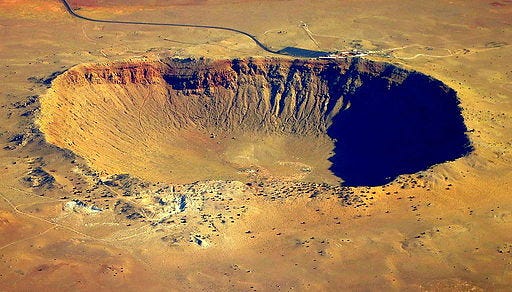
The rules of the game could be modified such that the answers to some of the previous questions become irrelevant; the rules of the game can change over time. For example, there is increasing evidence that Earth was hit by several asteroids or meteors about 12,900 years ago. The result was catastrophic for many of Earth’s inhabitants at the time. Some researchers speculate that, before 10,900 BC, there was a relatively advanced civilization; advanced in the sense that they had scientific knowledge that we are now only just re-discovering. How they might have acquired such knowledge is not known.
From our present-day perspective, the clues that an advanced civilization might have used to acquire their knowledge may not be relevant today. Furthermore, there could be many possible sequences of events in the time before 10,900 BC that would lead to present-day knowledge. Not only is perfect knowledge about the sequence of events in the past irrelevant to us, but some apparent clues may turn out to be ‘red herrings’ deliberately set up to make the task of coming up with a new idea more difficult.
An example of information becoming irrelevant is defining the moment at which Earth became Earth i.e. before asteroids started to combine no single rock or asteroid would have been called Earth. Perhaps the best definition for when Earth becomes Earth is when a collection of asteroids started the process of convection i.e. rocks in the center of the collection become so hot that molten material flows back up to the surface. In the context of Wheeler’s game of 20 questions, answers to questions about the early stages of the formation of Earth may no longer be relevant after convection starts on Earth.
The role of our current civilization
Part of the explanation for the origin of our universe is the Efimov effect. Something new emerges from certain combinations of quantum particles. Copying this phenomenon, a new concept for our universe may only emerge from a group rather than the ideas of an individual. Our civilization needs to combine ideas from many people to come up with novel solutions to existential crises.
This series of articles describes a range of ideas. Many alternative hypotheses may be identified. If the thrust of these ideas is accepted, one of the challenges could be agreeing on which hypotheses are to be tested first.
The question for this article is:
Are there multiple possible pasts consistent with our present?
To view the headings of all the articles to be published in this series please click on https://michaeledalton.medium.com/orbiting-stars-and-origin-of-our-universe-338906930f51
To obtain a copy of the book ‘Orbiting Stars’ which contains the first drafts of all these articles, please visit https://www.amazon.com