
Do Longer Articles Make More Money on Medium?
Comparing member reading time to article length

Medium shares the majority of their subscription revenue back out to authors based on what subscribers read.
You can see this in the stats on any of your articles where Lifetime Earnings and Member Reading Time go up linearly. An important question then is whether a longer article generates more member reading time.
I’m going to answer that question based on a tool we are working on to help authors make more money on Medium (it’s called Moneyball and you can request early access).
Right now, Moneyball has data from the three Medium publications that I own: Better Marketing (where you are reading this article), Better Humans, and Better Programming.
I’m going to use the acronym MRT for Member Reading Time. It’s really the key to understanding compensation on Medium right now.
How Much Do You Make Per Hour of MRT?
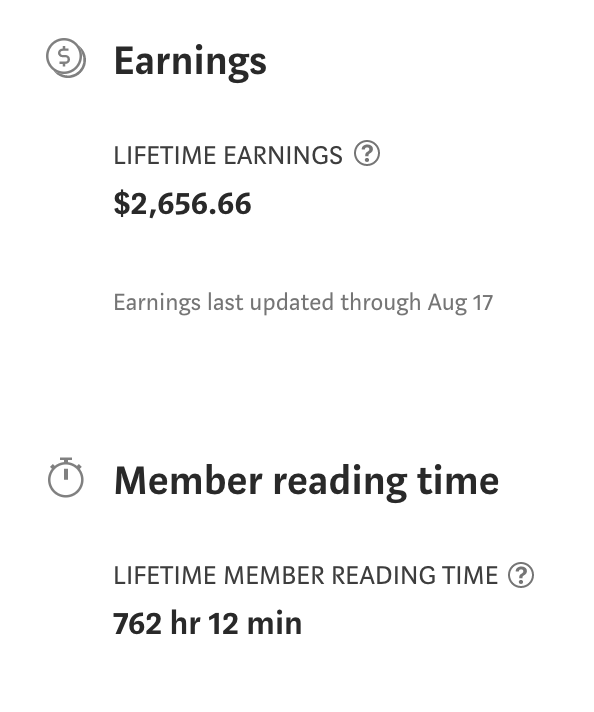
We think the two key concepts in Medium’s compensation are,
- First, that you get paid based on optimizing for Member Read Time. That’s how much time Medium subscribers spend reading your article. SEO and virality matter much less, except when they bring in readers who are already subscribers or who convert into subscribers.
- Second, you can convert MRT into a dollar amount. In the example from my article above, I made $3.49 per hour of Member Reading Time. Unfortunately, this number varies quite a bit, and this particular article is much higher than the norm. The data we have is that the average payment is about $2.50 per hour of MRT. I’ll use this lower number as an estimate in the rest of the article.
So keeping that in mind, you get paid about $2.50 per hour of MRT. (As of the time this article was published.)
Do Longer Articles Earn More in Total?
Here’s my naive look at that answer, which is simply to compare the average earnings of each article to article length in minutes. In our publications, articles that were 14-minute reads made $228 on average and articles that were 3-minute reads made $44.
So, yes, very clearly in the graph, longer articles make more money.
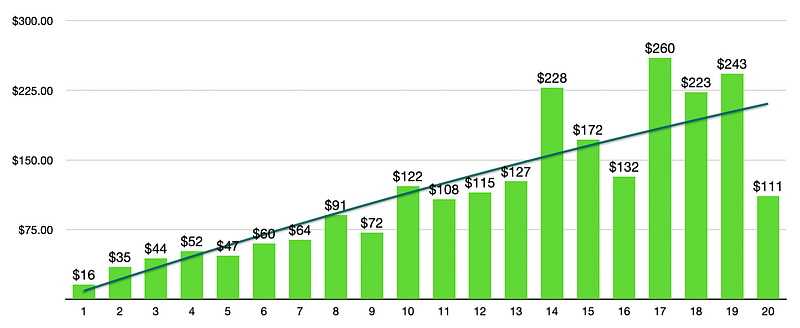
But the first problem is that the graph above is so choppy. Why does a 16-minute read make less than both of its neighbors, 15-minute and 17-minute reads?
The answer is because articles are a hits business. There are one or two 17-minute reads in our publications that are massive hits that falsely make it seem that a 17-minute read is a better length than a 16-minute.
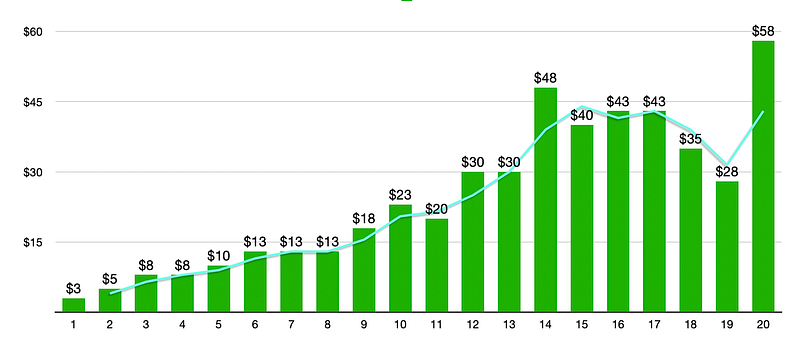
So, I looked again at the medians for each length. If that word median hasn’t come up for you in a while, it’s the middle value. If there are 19 articles, how much did the 10th best article make? The earnings for the middle article is the median.
I already knew before pulling the data that the median was going to be much lower. In our pubs, the average earnings is always 3x more than the median because, again, publishing is a hits business.
Looking at it by median, yes, I think you can say pretty clearly that longer articles make more money. At the longer lengths, the data has more variance because we publish fewer articles at that length (i.e. we have 2,300 4-minute reads and only 55 16-minute reads).
Where did this data come from? We are working on a tool to help authors optimize their earnings. It’s called Moneyball and right now we just have 12,000 articles in it that have been published in our three pubs. But if you’d like to see ways to optimize your own writing, sign up here and we’ll give you early access.