
Do I need to relate to Olivia Rodrigo to enjoy GUTS?
Applying a Business Decision Model Analysis to the relatability of GUTS.

I spend a lot of time thinking about what it is that connects us with the artists we listen to, and the decisions we make when evaluating whether to persist or abandon a particular recording if the motivation to listen isn’t immediately validated.
We all have subconscious incentives for deciding what we’re open to exploring, and sometimes that connection with a recording is immediate — it’s like a prompt to an AI generator that outputs exactly what the user wanted — even exceeding expectations. When it comes to making the decision to listen to anything new or unfamiliar, we all have some level of expectation as to what we’ll gain from the experience, and depending on how immediate that satisfaction is achieved, will influence whether we persist with the nominated album, as is the case here.
What makes a listener choose to work at an album when they could just skip to the next one?
When we talk of connection, we’re delineating between an artist we recognise (even peripherally) as credible, versus a sugar rush kinda performer who drops a phenomenal track but doesn’t offer us anything more substantive that we can relate to. My goal isn’t to marginalise — everyone has the right to create and represent as they see fit — but artists that sustain a following seem to have more going for them than the songs alone, noting that the songs can be valuable enough.
For the listener, it’s about identifying those sustainability conditions as efficiently as possible, which is a clumsy way of saying that the artist wants to have enough signals out in the ether to help prospective fans make their compatibility assessment.
For example, I didn’t know that Olivia Rodrigo was politically stimulated — it’s difficult to draw any alternative meaning from the image below. And that’s good, voters need to hear from authentic voices. Though I’m not an American, sensible messaging that encourages sensible choices is needed. I’m a firm believer in the notion that when America sneezes, the world catches a cold. This stance from Rodrigo made an impression.
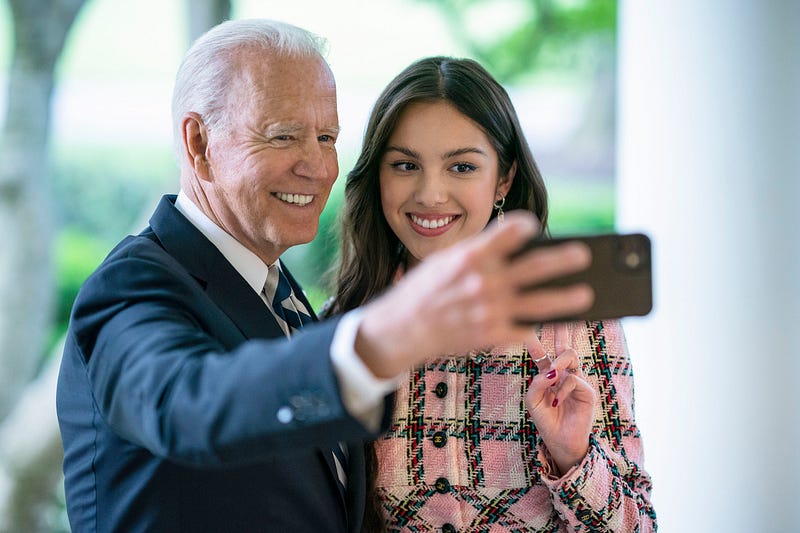
Why did I care enough to persist with Olivia Rodrigo’s GUTS?
Two of my 9–5 peers were recently talking animatedly about the pending release of GUTS. I had listened to SOUR a few times, appreciating it, but not enough to dial into it in any meaningful way. I tend to value people’s enthusiasm for an artist and find them relatable in that instance, even when it’s not a performer I care about. Creating a rainy day Spotify playlist to get to an album once compelled is a zero-barrier opportunity, and inevitably I got around to GUTS. My immediate impression, however, was not relatable.
Artists and albums can create a sense of conflict for a listener.
I’ve made the decision to work at appreciating a few artists over the years, where my initial impression was run, screaming! I thought Badmotorfinger was ridiculous, and Don’t Break The Oath by Mercyful Fate, laughable. I don’t dial into Soundgarden like I used to, but remain a King Diamond diehard, grateful that I wasn’t stubborn enough not to consider I might be missing something. So there is a personal precedent to this scenario, noting that these were both recommendations from friends. My professional peers weren’t trying to make a case for GUTS; I was peripheral to their conversation, and the content of the discussion wasn’t the type of narrative that’d draw me in. The conviction they observed in what Olivia Rodrigo was doing, however, that was the hook.
Why choose to work on GUTS?
I’ve observed enough to know that Olivia Rodrigo speaks to fans on a personal level. They resound with the experiences narrated within her songs, it’s not sugar rush music. There’s also the incremental satisfaction that comes from repeated listens. My immediate reaction was one of familiarity, especially across the first two cuts, but it wasn’t too close to anything I could identify that would cloud my willingness to proceed.
There were two other things that I did.
- I read the lyrics.
- I read an interview.
Point 1 offers a perspective that, when separated from the music, the lyrics have a level of insight that the completed song — factoring energy and arrangement — might be experienced differently.
Point 2 illustrates the blessing and curse of learning more about artists of interest. Fortunately for Olivia Rodrigo, her interview responses reinforce the understanding of why her voice is meaningful to people.
GUTS is her life, it’s what she has to say, and it needs to be stressed that the purpose of this discussion is not to try and determine whether her second LP is objectively good — the fans have spoken, and the commercial accomplishments (if you validate those sorts of indicators) support the notion that what Olivia Rodrigo is producing as a songwriter is valuable to a large swathe of people.
The exploration is concerned with the motivation to persist when the immediate deduction is that it’s not for me.
How does it look through the prism of a business decision analysis?
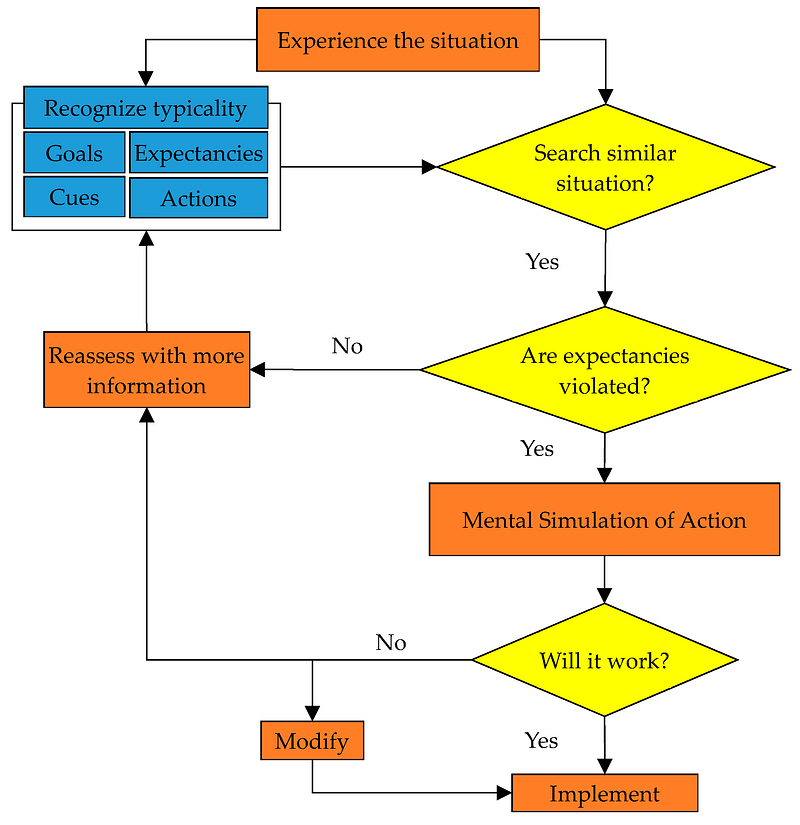
I got to thinking about how a business decision model like Recognition Primed was suitable for explaining the process of onboarding a new artist or album into our personal musical ecosystem. This should be seen as explicitly separating from the idea that you’d use a model like this to decide whether to listen. In the easy come, easy go age of streaming, there’s no barrier I experience in trying something new, so it’s critical to consider this framing. While these approaches are arguably two sides of the same coin, to suggest that someone would work through a decision model to decide whether to listen to an album is kind of absurd. I have nothing to lose by rolling the dice.
The following is an example of the Recognition Primed model, and per the scenario, I’m exploring here — why have I persisted in listening — this model is also applied in a business setting where a rational approach may be a little too dry and intuition alone too subjective. It promotes pattern matching, which in the instance of GUTS may consider:
Is this too similar to something I’ve heard before?
- If yes, is that a positive or negative?
- If negative, consider why?
- If no compelling reason why can be resolved, it may be worth proceeding with.
Is there something about it I find unsettling or per my earlier example, difficult to relate to?
- Am I interpreting this as intended? Have I listened to the lyrics and read them independently?
- Is my understanding of the artist’s message comprehensive enough?
- Am I ready to shelve this record and give my attention to something else instead?
- If no compelling reason why can be resolved, it may be worth proceeding with.
Having cycled through the initial decisions, it’s on to an exploration as to whether I can draw satisfaction from this recording on an ongoing basis. This isn’t particularly complicated — you’re getting to the four, five listens stage by this point and ideally clear enough on what you like and don’t like about it. In the spirit of artist connection, determining whether there’s enough attraction to make that covenant with their craft.
The final decision, will it work in a real-life setting — ie: repeated listening, and adoption of the artist as one you’ve welcomed into your musical biosphere.
Where did I land? What did I implement?
My first impression is that GUTS wasn’t for me. Songs like “bad idea right?” and “get him back!” are not personally relatable at this juncture of my life. This doesn’t suggest I don’t understand the feelings being expressed, that I fail to empathise with what Olivia Rodrigo is communicating, or that these are neither convincing nor valid emotions. It’s a testament to her as an artist to focus on her voice and experience, and how that’s channeled into a message that happens to resonate with millions of people.
The idea that all things should be accessible by all people is anathema to the authentic artist, and most of what I listen to is what you’d call outlier music in which I seek legitimacy within whatever sort of art they are creating. I reason that the emotionally intelligent individual needs an array of different styles, points of view, and emotional currents to satisfy a more complex human experience. What I don’t want to do is present as someone critical to her craft; to extrapolate that would be missing the point I’m making.
My original idea for this article was to ask the question:
Am I too old to appreciate Olivia Rodrigo?
The answer is no, but as someone who appreciates music in the conventional, linear album format, I’ve concluded that at the time of writing, I don’t see myself as having an ongoing relationship with this record as a whole, though specific songs like “vampire” express the intention perfectly.
Having said that, a door has been opened and it’s possible that I’ll find myself revisiting GUTS in the future. Some albums take years to click. Maintaining an open mind to possibility is to any music fanatic’s advantage.


