
Do grades help to maintain the status quo or bring change?

The public is often bombarded with stories of billionaires like Bill Gates and Mark Zuckerberg being college dropouts. Little is told that most billionaires already came from privileged backgrounds and dropping out from college wasn’t a major roadblock in their lives. Bill Gates had a computer in his high school. It was a big deal back in the day. Yet, high-achievers in schools and colleges do not change the status-quo, do not cause disruption by introducing a new product or starting a successful business.
I recently read Robert T Kiyosaki’s “Why “A” students work for “C” students?” A students mean Academics, high achievers, students consistently getting A grades while the C means Capitalists, or the not-so-bright-but-exceeded-expectations, the ones who were unsuccessful in school but got successful after school.
The B students were classified as Bureaucrats who work for the government. His argument was that A students, the Academics, go for prestigious positions in companies where they could get a huge paycheck and maintain the status quo. The A students mostly do not question the methods of the school system. They believe in the mantra, “Get good grades, you’ll get a good job with a huge paycheck.”
Most people rely on only one source of income, their paychecks. Having a cash flow through investments and big businesses help generate more income.
The C students, Capitalists, do not conform to the traditional school system. They are visionaries who think differently. They rebel against the school system by not getting good grades. They are ridiculed by their teachers, “You don’t get good grades, you won’t get a good job. You will not be successful in life.” It’s not like C students are stupid, they just think and learn differently. They create something different which doesn’t conform the school system. When their traditional schooling is done, that’s when they shine by becoming entrepreneurs and investing in real estate or other fields that will bring them money.
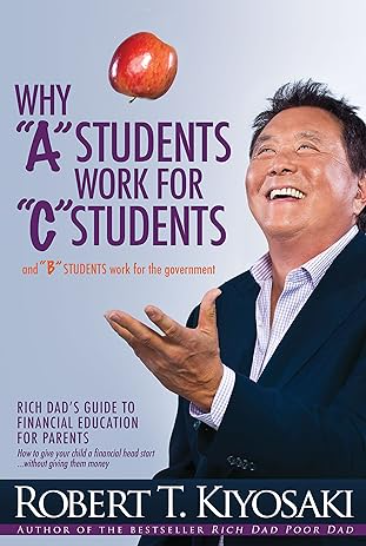
Kiyosaki himself didn’t conform to the school system. His dad, or Poor Dad, had a Master’s Degree and got a leadership position in his city’s school district. Yet, he was stuck in debt. He was a believer in the traditional school system and its mantra, “Get good grades, you’ll get a good job with a huge paycheck.” Meanwhile, Kiyosaki’s friend’s dad, the Rich Dad, didn’t had a degree but was a successful entrepreneur. He was the Capitalist. While he didn’t paid little Robert when he used to work for him, Rich Dad taught a lesson on how to diversity cash flow. Most people rely on only one source of income, their paychecks. Having a cash flow through investments and big businesses help generate more income.
Some of you might not agree with Rich Dad’s methods of teaching Robert a valuable lesson by not paying him. Mr. Kiyosaki is thankful for his Rich Dad and that’s the important thing. You can pay the kid who works for you before turning 18 but education is more valuable than money. Mr. Kiyosaki doesn’t deny education is not important. It’s the way education is being taught in most American schools (or in other countries like my country of origin, Pakistan) which is the problem.
While it’s a broad debate, I’m guessing a lot of us were upset when we got poor grades. It’s problematic in desi families where family pressure is on you to get A’s always. You are ridiculed if you don’t get good grades and even worse, being compared to somebody else’s kid who got straight A’s and being told, “You should be like that kid.” It’s sick!
This is where I agree with him. Every child is different with different needs and interests. Every child learns differently, verbally, audio/visual, kinesthetic, American Sign Language, English, Urdu, Spanish, any other language the child has the most grasp. The education system treats every child the same. Grades are given the utmost importance, not the child being capable of standing on his/her own.
Which brings back to my question, do grades contribute to change or maintain the status quo?
Kiyosaki’s book argues most A students aim for a job that would give them a fat paycheck and a recognition by society. Many folks fight for the CEO position. They do not bring change or innovation, they maintain what’s already working for better or worse. They enjoy fat paychecks and the luxuries associated with the position like first-class flights, luxury hotels, access to people in the same top hierarchy. Once a problem arises however, they panic and might do weird things like firing employees while maintaining their benefits and luxuries and putting the company in shambles while keeping money in a foreign country.

While it’s a broad debate, I’m guessing a lot of us were upset when we got poor grades. It’s problematic in desi families where family pressure is on you to get A’s always. You are ridiculed if you don’t get good grades and even worse, being compared to somebody else’s kid who got straight A’s and being told, “You should be like that kid.” It’s sick!
I wrote a blog previously about how grades don’t define who a person is throughout their lives. A person’s value relies on a lot of things, actions, intelligence, respect, self-worth. Grades don’t even measure intelligence. They calculate how well the student has a grasp over a subject or how well remembered (“rata lagaya” in Urdu/Hindi) the content. Even IQ tests don’t add up much. A lot of books have been written how IQ tests were a mechanism to uphold white supremacy (“The Mismeasure of Man”).
You can learn through multiple ways, you can be successful after school.
Believe In Yourself!
Let me know in the comments what you guys think. If you like my blogs, you can support me by buying me coffee at https://www.buymeacoffee.com/bilalali1000.


