
Do Germans Have No National Pride?
As a German, I’d say “jein” (yes and no).
When I first moved to France, I was blown away: Whenever I walked through Paris, Lyon or even smaller cities, I saw French flags — and the national motto Liberté, Égalité, Fraternité (Freedom, Equality, Fraternity). On bridges, buildings owned by the State, or schools — the French made sure you didn’t forget in which country you were. (Disclaimer: I’ve never been to the U.S. but it would sure be a mind-boggling experience from what I can say by watching American movies. Long Live America!)
A not-so patriotic Germany
The reason I was so astonished is a simple one: I’m German and have lived in Germany for most of my teenage and adult years so far. We don’t have open national pride. You won’t see many German flags or the federal eagle, there is no motto written on buildings, you won’t see the name “Bundesrepublik Deutschland” (Federal Republic of Germany) very often. Of course, you’ll see it at some places in Berlin since it hosts some of the most prestigious and important buildings of the State. No point in denying that this is the German parliament— there can as well be a German flag attached to it.
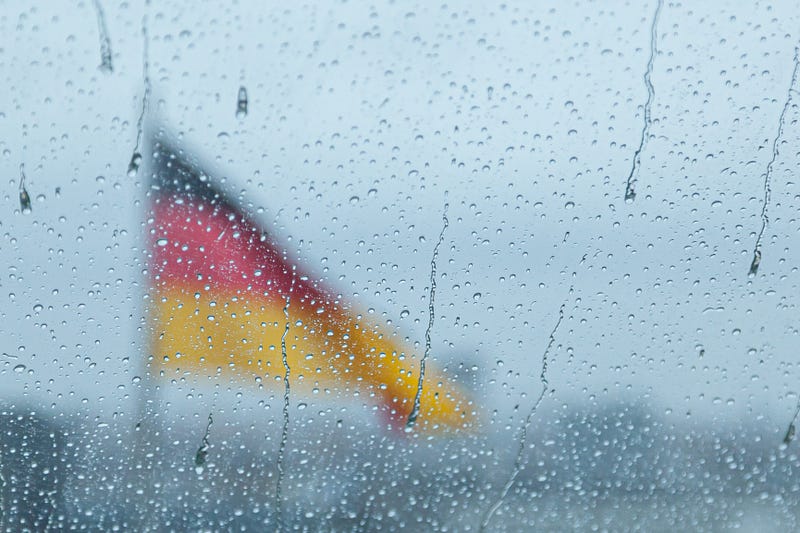
No, I’m talking about places other than Berlin, where you won’t see many national symbols. “Wait”, you might protest, “I was in Germany and there was a flag on every car! Black, red and yellow stripes!” Okay, let me stop you there. I bet that was during a European or a World soccer championship. The unwritten rule for Germans goes as follows: Open patriotism is okay, provided it’s related to sports (mainly soccer).
In these exceptional periods occurring every few years, most Germans walk around with a German flag, draw three stripes on their cheeks and sing the national hymn or whatever German song is trending as “the summer hit of the soccer championship”. We are proud of our national male (!) soccer team — even though I personally think they’re overrated, I’ve watched numerous games in the past to please my soccer-loving friends or relatives.
How we got to this point
I think we need a quick breakdown of German history to explain why patriotism is a difficult topic in Germany. Skip this part if you’re familiar with German history. After World War I, Germany as a losing country had to accept the treaty of Versailles in which it declared to take all the blame for the lost war, cease territories and colonies, etc. So far, so good. The German king had to abdicate and what followed was democracy: The “Republic of Weimar” which got its name because the Constitution was signed in the beautiful town of Weimar in the middle of Germany, known until today for the poets Goethe and Schiller who resided there centuries ago — I’ve lived there for two years; it’s a real fairy tale town. This Republic existed from 1918 until 1933.
In January 1933, Adolph Hitler was elected (yes, pretty much elected by the people!) and promised to make up for the “injustices imposed” by the winners of WWI. He promised employment, national pride (“Make Germany Great Again” — that weren’t his words, but we sure know who they refer to…), a good economy (the hyperinflation after WWI had blown away all too many savings) and more. We all know the story more or less: Hitler successfully twisted the formerly democratic Constitution and imposed new laws and rules with his far-right party NSDAP (the National Socialist German Workers’ Party). Soon, Jews, homosexuals, gypsies and other minorities were heavily persecuted and the fascist leader came up with a “Final Solution”, a euphemism for the total extermination of these groups, in particular Jews which he made responsible for all the bad in the world. What we today call the “Shoah” or the “Holocaust” refers to the mass killings in concentration and labor camps.
Luckily, Germany was finally defeated in 1945 and most Germans nowadays still live with a tremendous amount of national shame for the innocent lives taken during the Genocide of the Third Reich (the correct word for “Nazi Germany”). After the end of WW2 in 1949, Germany was divided among the allies: France, the U.S., the U.K. and the Soviet Union. In 1949, East Germany was declared an independent state, the German Democratic Republic (GDR or DDR in German). West Germany (The Federal Republic of Germany) was also assigned sovereignty a few years later. Since many citizens living in Berlin would have preferred to live in West Germany, the politicians of the GDR decided to build the Berlin wall that lasted from 1961 to 1989. Berlin was divided into the Soviet East and the capitalist West.
Only in 1990 did the two German states reunite and become the current Federal Republic of Germany (BRD). Thus, it’s “only” been three decades that Germany as a united country has existed. This might help understand why patriotism is, especially for generations living in a divided Germany, still a strange concept.
So, are Germans proud to be German or not?
National pride in Germany is a typical “jein” situation. Let me explain: In German, the fusion of the words yes (“ja”) and no (“nein”) equals “jein”; yes and no at the same time. If somebody asks me: Do Germans have national pride? I’d have to say: Jein!
The thing is: Most Germans DO feel a portion of national pride. We’ve just been taught not to brag about it or show it because most of us are very aware of our dark history. However, most Germans do feel proud or at least pretty happy about being born in or having a passport from Germany. We know that nowadays, many people have positive connotations when thinking of Germany, such as:
- The automobile industry (Audi, Volkswagen, BMW, Mercedes-Benz)
- German literature (Goethe, Schiller, Herman Hesse, Heinrich Heine)
- German composers (Beethoven, Bach, Wagner)
- A free education system
- A functioning public health care system
- Angela Merkel and pretty stable democracy
- Jobs in IT and other sectors for which foreigners are more than welcome (It’s not a cliché that Indians move to Germany to work in the software industry.)
- Pretty good English skills
- Oktoberfest (Beer! Sausages! Pretzels! Awesome! Disclaimer: I haven’t been there yet.)
- German Netflix shows like “Dark” (just kidding, that’s not really an essential part.)

The cosmopolitan German?
When I meet international people for the first time and tell them I’m German, there are two separate things they might think of:
- The dark history: Third Reich, Nazis, nationalism and a dark heritage
- The positive sides of the current situation: free education, a smiling female leader, good German cars, etc.
I believe most people have both negative and positive images of Germany. I’d dare to say the positive image comes, among other things, from the fact that most people have met a German in their life. Germans generally travel a lot which is why wherever you go in the world, you could be pretty certain to meet a German.
Most Germans you’d meet nowadays are very open-minded and curious about other cultures and countries. I feel like we purposely portray ourselves as “world citizens” and multilingual travelers to show the world that we are different than our ancestors. Statistics from 2018 show that in the European Union, Germans are the ones spending the most on international travel.

Note: That is not to say that we have no problem with racism. As a result of our colonial history, racist attitudes, behaviors and laws are unfortunately still deeply enrooted in our society. However, bestsellers like the German book “Exit Racism” show that Germans are increasingly willing to deconstruct the pervasive racism within themselves and the societal structure.
I’d also dare to say that Germans don’t take particular pride in their language. Many of my compatriots don’t even like the German language (I do, I promise). In Berlin, you’re very unlikely to improve your German because you’ll notice that even some people working in cafes and restaurants speak only English. Generally speaking though, people in West Germany have better English skills because when Germany was divided, East Germans learned Russian instead of English.
Another phenomenon is quite remarkable, especially among young Germans: A group of Germans is talking to each other. Enter: a non-German speaker. Reaction: All Germans switch to English to include the foreigner.
© Annika Erika 2020
Continue reading: