
Do Female College Graduates Earn Less?
Using linear regressions, I study whether female college graduates in America fare worse in the labour market than their male counterparts.

I’m sure most (if not all) of us have heard claims about gender gaps in many spheres of life, including the labour market. Are they mere claims without any basis? In this article, I investigate whether there is a gender gap in terms of employment outcomes for those who are highly educated — college graduates in America.
Simply comparing the employment outcomes for all female and male college graduates will give us an inaccurate picture of the gender gap, because male and female graduates differ in many ways. I won’t go into a detailed explanation (and risk putting everyone to sleep), but generally, we often say that these two groups differ in terms of observable characteristics (such as race, citizenship, employer sector) as well as unobservable characteristics (such as ability and motivation). For this study, I will make an assumption that female and male college graduates only differ in terms of observable characteristics, and address these differences by using multivariate linear regressions. The main idea behind regressions is that we’re trying to make female and male college graduates similar to each other in terms of observable characteristics that could affect labour market outcomes (these are the variables that we control for) so that these two groups are more comparable to each other.
Dataset
The dataset that I use is the 2017 National Survey of College Graduates (NSCG) that is provided for public use. The NSCG is a biennial survey conducted on college graduates in the United States. It is sponsored by the National Science Foundation, so it oversamples subjects from fields that are of interest to them. However, survey weights are provided to allow for adjustments to make the sample representative of the entire population. These weights are used in my study.
Outcomes of interest
The following outcomes will be studied.
- Earnings: this is the income obtained from one’s principal job. I adjust for inflation in order to obtain real earnings using the annual CPI provided by the US Bureau of Labor Statistics. Natural logarithm of earnings is used.
- Full-time permanent employment: this only applies to those in the labour force. It takes on a value of 1 if a person is in full-time permanent employment (working at least 35 hours per week) and 0 otherwise.
- Job satisfaction: takes on a value of 1 if a person is either somewhat satisfied or very satisfied with their job and 0 otherwise.
- Job match: takes on a value of 1 if a person’s job is either somewhat related or closely related to their college degree and 0 otherwise.
Sample of interest
To allow for a clean comparison, I limit my sample to those with only one bachelor’s degree. In other words, observations who went on to complete graduate degrees, multiple bachelor’s degrees or associate degrees are excluded from my sample.
Strategy
The following regression specification is used:
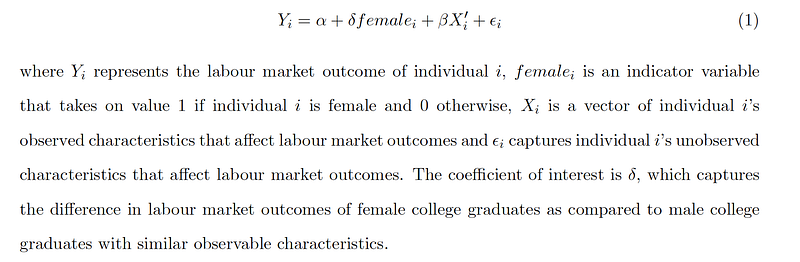
As for standard errors, I cluster them on school type-field-cohort level, which will allow for heteroskedasticity and arbitrary correlation within each cluster. An example of a cluster would be observations that graduated from a research university with a degree in the field of computer and mathematical sciences between 1971 to 1973.
I will conduct an analysis on two levels.
- Homogeneous effects: what is the general effect of being female on labour market outcomes for college graduates?
- Heterogeneous effects: does the effect of being female on labour market outcomes for college graduates vary across different fields of study?
Control variables
I include all control variables that could affect labour market outcomes. The control variables that I use can be categorised into a few groups.
- Socio-demographic characteristics: age, race, birthplace, citizenship, whether they have children in the household, parental education levels, marital status
- Physical characteristics: whether they experience any physical difficulties, whether they have any disabilities
- College characteristics: college institution type (based on 1994 Carnegie code), year of award of degree, location of college, major, whether they took on a double major programme
- Employer characteristics: sector of company, size of company, location of company
Additionally, I also control for the American Community Survey cohort they belonged to.
Results
Let’s first take a look at the results from the homogeneous effects analysis — what is the general effect of being female on labour market outcomes for college graduates?
Homogeneous effects
Table 1 summarises the results for this analysis.
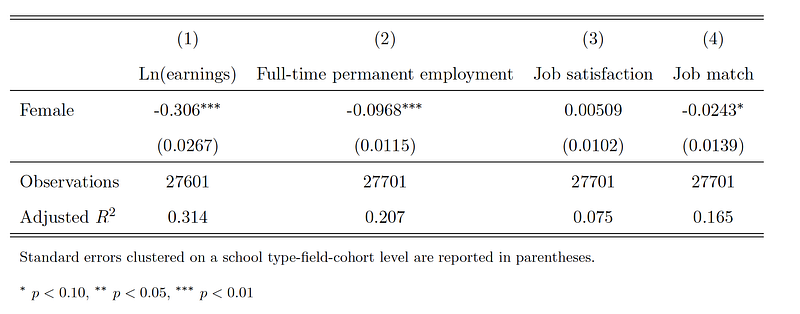
In column (1) of Table 1, the estimate for the outcome of earnings is statistically significant at the 1% level, and it suggests that female college graduates, on average, earn 30.6% less than male college graduates with similar observed characteristics. This suggests a pretty large earnings gap between male and female college graduates!
Let’s take a look at the other labour market outcomes. From column (2), the estimate suggests that female college graduates are 9.68 percentage points less likely to be in full-time permanent employment. From column (3), there is no evidence that female college graduates are more likely to be satisfied with their jobs, since the estimate is statistically insignificant. From column (4), the estimate suggests that female college graduates are 2.43 percentage points less likely to be in a job that is related to their degree. However, this estimate is less significant as compared to the estimates for earnings and full-time permanent employment.
Overall, the analysis from this segment does seem to suggest that female college graduates are subjected to more disadvantageous employment outcomes as compared to their male counterparts.
Heterogeneous effects
In this segment, I will allow for effect heterogeneity across fields of study. I would like to find out whether the gender gap across the employment outcomes of interest varies for different fields of study. For example, is there a wider gender gap for college graduates who studied social sciences?
1. Computer and Mathematical Sciences
This would include college graduates who majored in fields such as computer science, mathematics and statistics. Table 2 summarises the results from this analysis.
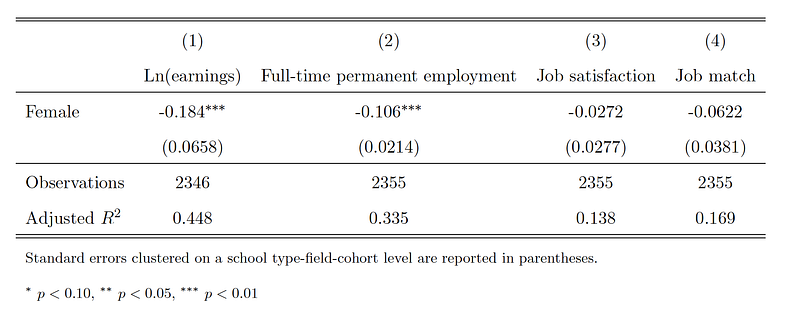
As seen in Table 2, for these fields, female college graduates earn 18.4% less and are 10.6 percentage points less likely to be in full-time permanent employment as compared to male college graduates. Compared to a homogeneous effects analysis, the earnings gap appears to be a lot smaller.
2. Biological, Agricultural and Environmental Life Sciences
This would include college graduates who majored in fields such as animal sciences, biology and environmental sciences. Table 3 summarises the results from this analysis.
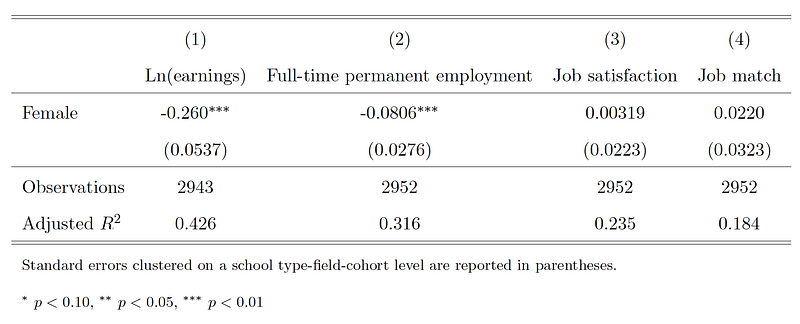
As seen in Table 3, for these fields, female college graduates earn 26% less and are 8.06 percentage points less likely to be in full-time permanent employment as compared to male college graduates.
3. Physical Sciences
This would include college graduates who majored in fields such as physics and chemistry. Table 4 summarises the results from this analysis.
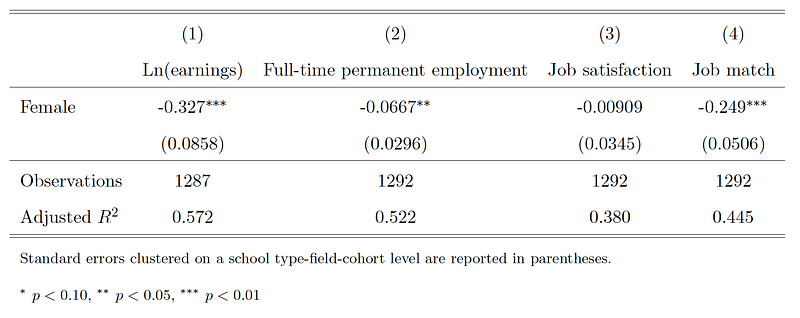
As seen in Table 4, for these fields, female college graduates earn 32.7% less, are 6.67 percentage points less likely to be in full-time permanent employment and are 24.9 percentage points less likely to be in a job that is related to their degree as compared to male college graduates.
4. Engineering
This would include college graduates who majored in fields such as chemical engineering, mechanical engineering and civil engineering. Table 5 summarises the results from this analysis.
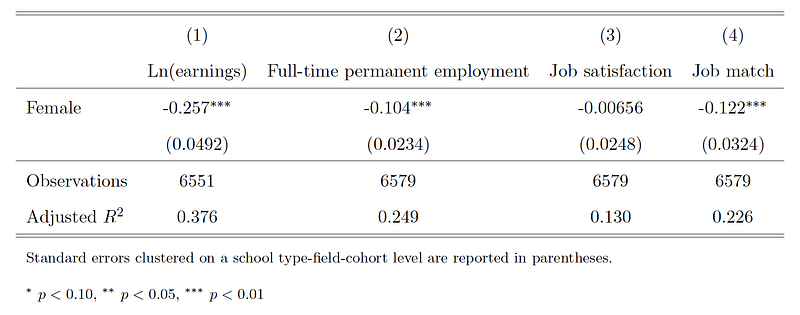
As seen in Table 5, for these fields, female college graduates earn 25.7% less, are 10.4 percentage points less likely to be in full-time permanent employment and are 12.2 percentage points less likely to be in a job that is related to their degree as compared to male college graduates.
5. Social Sciences
This would include college graduates who majored in fields such as economics and psychology. Table 6 summarises the results from this analysis.
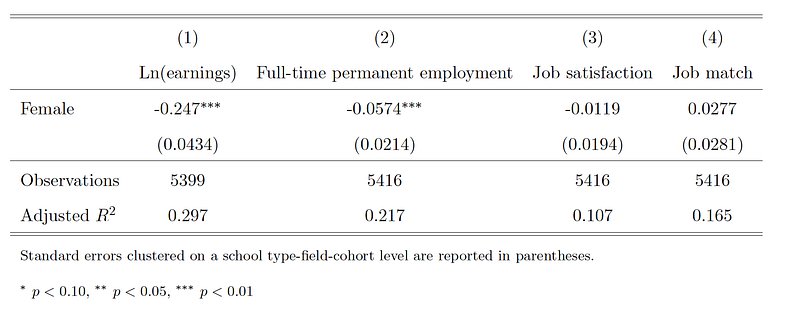
As seen in Table 6, for these fields, female college graduates earn 24.7% less and are 5.74 percentage points less likely to be in full-time permanent employment as compared to male college graduates.
6. Other Science and Engineering related fields
This would include college graduates who majored in fields such as pharmacy and data processing. Table 7 summarises the results from this analysis.
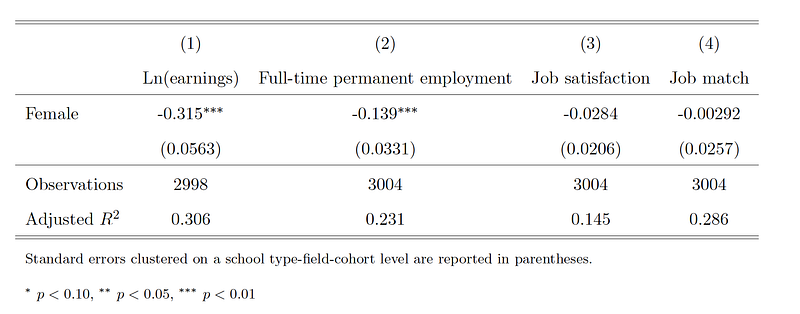
As seen in Table 7, for these fields, female college graduates earn 31.5% less and are 13.9 percentage points less likely to be in full-time permanent employment as compared to male college graduates.
7. Non Science and Engineering related fields
This would include college graduates who majored in fields such as education, business and arts and humanities. Table 8 summarises the results from this analysis.
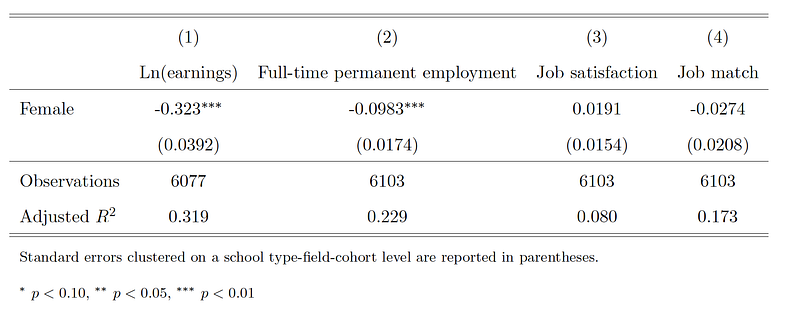
As seen in Table 8, for these fields, female college graduates earn 32.3% less and are 9.83 percentage points less likely to be in full-time permanent employment as compared to male college graduates.
Based on the results presented in Tables 2 to 8, it would seem that the earnings gap is the largest for graduates who majored in the physical sciences and the smallest for graduates who majored in computer and mathematical sciences. However, it appears to be true that the earnings gap does exist across all fields of study. For full-time permanent employment, the estimates for all fields of study are significant and negative. The coefficient is the largest for graduates who majored in other science and engineering related fields and the smallest for those who studied the social sciences. For job match, only the estimates for graduates who majored in the physical sciences and engineering are statistically significant. The coefficients are negative, meaning that female college graduates who studied these fields are less likely to be in a job that matches their degree.
Limitations
The findings of this study rely on the assumption that female and male college graduates only differ in terms of observable characteristics. This may not be realistic, since it is possible that college graduates of both genders are likely to differ in terms of unobservable traits such as ability and motivation level. This would mean that the estimates obtained from this study could be biased. Other techniques such as difference-in-differences, regression discontinuity or a fixed effects analysis could be employed instead. Additionally, this dataset does not provide any information on how these graduates fared in college, which can serve as a better proxy of their ability, as compared to the education levels of their parents.
Conclusion
From this study, an earnings gap between female and male college graduates does exist, and the gap ranges from 18.4% for graduates from computer and mathematical sciences to 32.7% for graduates from physical sciences. Female college graduates across all fields also experience a negative effect on the probability of being in full-time permanent employment. Does this mean that female college graduates are facing discrimination in the labour market? If we want to find out whether there is gender discrimination, it would be more appropriate to use another statistical model called the Blinder-Oaxaca decomposition, which will be discussed in another post!
Note: All analyses are performed using Stata. The do file that can be used to replicate all the analyses in this article is hosted on GitHub.


