
Do Crypto Sanctions Work? The Shocking Truth Behind 2022’s Most Notorious Cases
Illicit activity is on the rise despite the bear market
Last year was chaotic for crypto, with several major firms collapsing amidst allegations of fraud (e.g. Celsius, Three Arrows Capital, FTX, etc.).
It was nasty and unfortunately, it was just the tip of the iceberg.
Here’s a breakdown of Chainalysis’ crime report on on-chain data that paints a more detailed but grimmer picture.
While we wait for the legal system to determine the criminality of the abovementioned firms, we can learn more about the online alleys we should avoid.
So what happened last year?
2022 was a shitty year for crypto
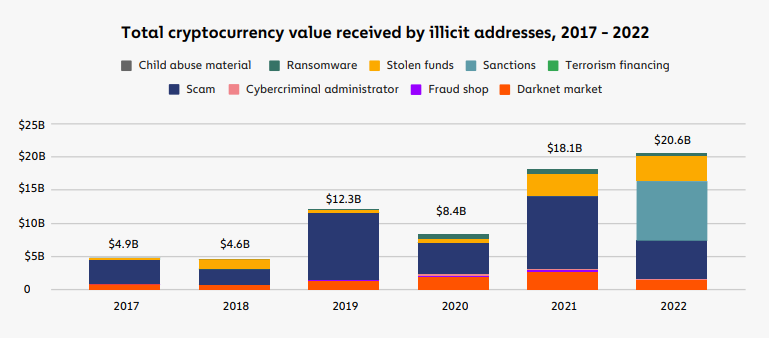
We just keep going up and not in a good way.
As we’re able to identify more or new addresses engaging in illicit activities this number is surely going to grow over time.
For instance, figures from the 2021 Chainanlysis report were revised, and although the initial figure was $14 billion, the total rose to $18.1 billion.
The “good news” is that 43% of the illicit transactions from last year came from sanctioned entities like the Russian-based crypto exchange Garantex. But since it’s a Russian business, it’s like nothing happened. They’re still in business. At least the business is red flagged and the damage can be somewhat contained.
Yeah, I know, a lousy consolation prize.
Now crypto scams generate less revenue during bear markets. This is because people are more pessimistic and less prone to believe promises of high returns.
It would be nice to have the same mentality in a bull market but it seems too far-fetched, doesn’t it?
More crypto projects are being sanctioned
Let’s not be that negative.
We used to only go after naughty geeks but now we’re seeing more prosecution of big crypto services.
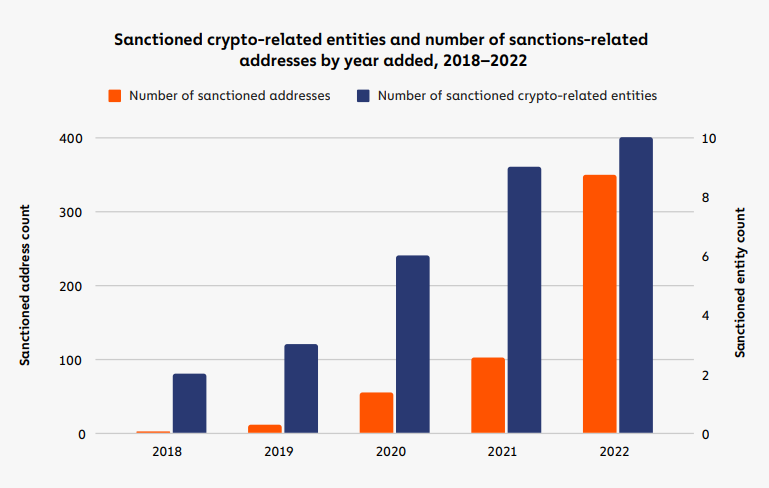
Agencies like the Office of Foreign Assets Control (OFAC) from the U.S. Department of Treasury have been more ambitious in controlling crypto services.
Thanks to the transparent nature of cryptos, there’s hope for more effective enforcement of sanctions in the space.
It paid off.
Some of the most noteworthy sanctions last year went to the following entities:
- Tornado Cash: the decentralized mixer of tainted crypto funds with purer ones (to obscure the trail to the source).
- Hydra: the world’s largest dark web marketplace used for illegal drugs.
- Garantex: a fast-growing Russian crypto exchange.
Other honorable mentions included:
- Lazarus Group: cybercrime group run by the North Korean government.
- Blender.io: money laundering with completely anonymous transactions without using VPN.
- Task Force Rusich: a Russian neo-nazi paramilitary unit in Ukraine sanctioned for invading Ukraine.
Compared to 2021, the OFAC was able to expand its reach from individuals to other types of entities.
Let’s consider it a huge success.
Do sanctions work?
Looking at on-chain data we can see some mixed effects.
Here’s what the report shows for the 3 most prominent cases of 2022. By comparing the activity of the 60 days before and 60 days after the sanctions we saw the following:
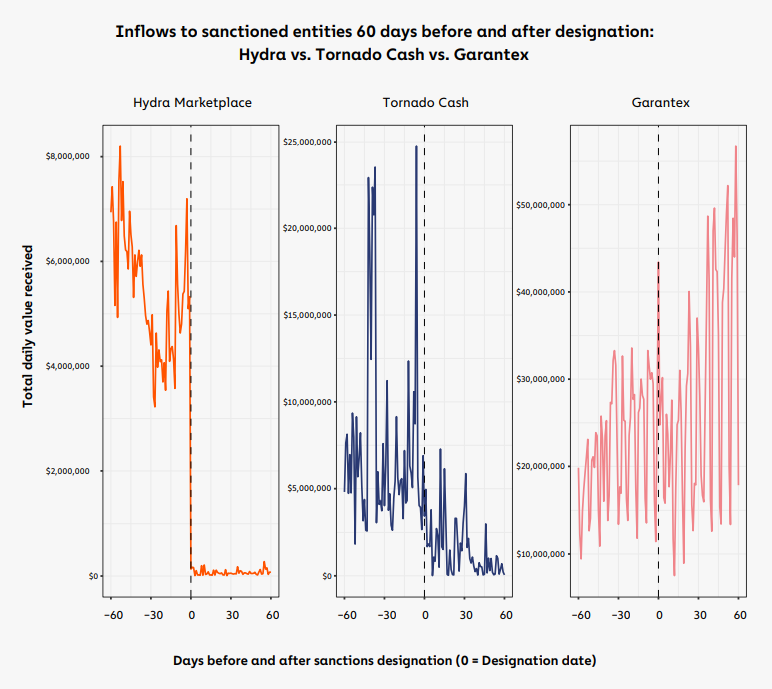
Hydra’s inflows dropped to zero.
This is because all its infrastructure was seized along with $25 million in BTC. Since 2015, the marketplace has transacted over $5.2 billion in cryptos, which made it one of the oldest and largest darknet marketplaces in the world. Thanks to the collective efforts of the German government and U.S. agencies, Hydra ceased to exist.
Unfortunately, the same fate can’t be said for Garantex. Sanctions just brought more transaction volume. While the inflow before the sanctions was around $620 million, after the sanctions it skyrocketed to $1.3 billion in monthly inflows on average.
There’s no bad marketing, wouldn’t you say?
Russia didn’t enforce U.S. sanctions, so nothing happened to them. And given that most users of the platform are based in Russia, there’s no incentive to shut it down.
Now Tornado Cash falls somewhere in the middle.
Yes, its activity fell sharply, but it hasn’t ceased completely. You can’t just take a smart contract (like the one it operated on) offline as you would a centralized service. Smart contracts can run indefinitely, so anyone can use them at any given time. But at least they took down their website making it more difficult to access the service.
Overall, sanctions have a positive effect, but we need to have international cooperation (like Hydra’s case) to get the most out of it.
Crypto users are getting smarter
Scams are the largest form of crypto crime.
However, its revenue fell significantly last year from $10.9 billion in 2021 to “just” $5.9 billion in 2022.
This is thanks to the bear market. It puts people on edge and it pays off to have a pessimistic and suspicious mindset in dealing with this space.
Still, there were some very successful scams last year.
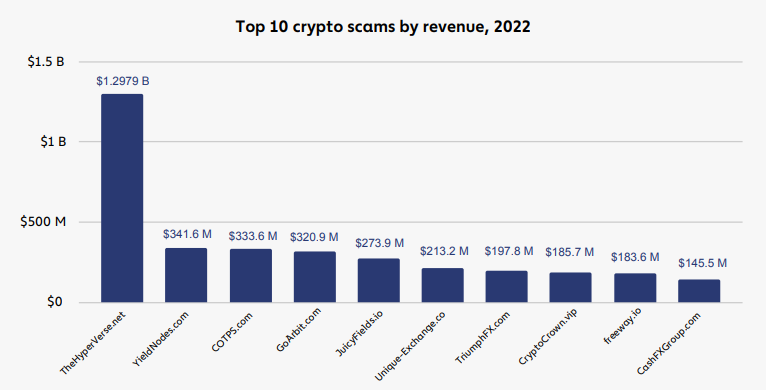
People are greedy.
And sometimes they get too blinded by it.
The 10 scams you see in the chart were all investment scams where fraudsters promised some outrageous returns by investing in some fake company.
On average, people deposited $996 on these fake projects and while it’s not the highest average deposit among all types of scams, it’s the most lucrative one.
For instance, romance scams, where the fraudster tricks the victim into giving them money over a fake romantic relationship, had the highest average deposit ($15,559). And here we are thinking NFT scams are the worst and most common, but the victim’s average deposit is the smallest ($463) among all the other scams.
When do these scams happen?
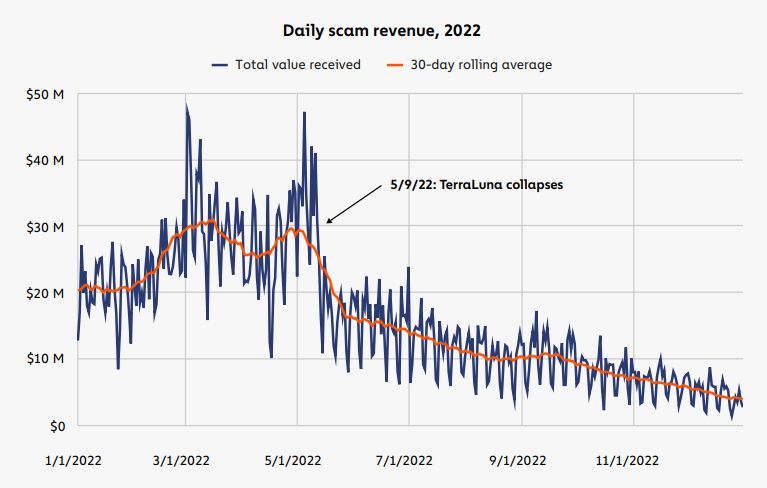
Scams are sensitive to wider trends in crypto.
After the collapse of TerraLuna, we saw a sharp decline in daily scam revenue which thankfully continued throughout the rest of the year.
As a rule of thumb, the lower the price of BTC the lower the revenue of daily scams will be.
This is true for most types of scams: investment, impersonation, and NFT scams.
However, giveaway scams and romance scams follow a slightly different pattern. The higher the price of BTC the higher these scams appear to be. But just slightly.
Why?
Because it’s more of a personal relationship between the scammer and the victim, the price of BTC fades away. The price just isn’t the main driver to get them to send you money. It’s not about getting rich quickly, it’s about helping out your fake romantic partner.
Scammers will also change strategies (e.g. going from investment to romance scams) as they see the price of BTC decline, given this trend. So be aware of all these random lovers appearing on your feed.
The pump and dump schemes
According to the report, 24% of all new tokens released last year that had some swap activity (around 40,500 tokens) were a pump-and-dump scheme.
It’s easy to carry out.
How does it typically work?
The creator launches the token and funds a liquidity pool on a popular decentralized exchange (DEX). They promote it on social media and hundreds buy it on that DEX, causing the price to skyrocket in a couple of hours. The creator then sells all of his tokens leaving others holding the bag. In this process, the price has declined by over 90%.
This can happen within the day of launch or during the first week, but it usually follows a similar pattern.
In other words, the scammer launches a new token, puts a high price on it artificially (e.g. control of the circulating supply), remains anonymous throughout the process, and gets the big bucks soon after the token’s release.
And since the team can remain anonymous, these people can carry on doing it over and over again.
In fact, 445 individuals or groups were responsible for 24% of all the pump-and-dump tokens (around 9,900 tokens). One token creator even launched 264 tokens with this scheme. Outrageous.
This scheme brings a lot of bad reputation to the space and it could hinder the massive adoption of cryptocurrencies.
So whenever there’s a new crypto on the market, give it time before you even consider getting in.
The takeaway
Consider that this report was based on-chain illicit activity alone.
All the Celsiuses, 3ACs, FTXs, and other off-chain fraudsters are not even considered in the report. Think about it.
Things are even worse than what the report shows us.
But at least we learn more about the industry with every new year it doesn’t go caput.
We need this transparency in the industry if we’re to survive.
Luckily, a bear market will help us regain consciousness from greedy behaviors and cools down our greedy desires. It’s a time to build, reevaluate, and educate ourselves so that when the bull market returns we’re better prepared to deal with what comes with it.
This report is a warning for our future behavior.
Don’t let it go to waste.
Note: this is not financial advice and you should always do your research before making any financial decisions.
Here are other articles you might enjoy reading:
If you enjoy reading stories like these and would like to support writers on Medium, consider signing up to become a Medium member. It’s just $5 a month and you’ll have unlimited access to articles from amazing writers all over the world.


